
Abstract
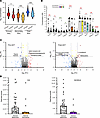
Androgen deprivation therapy (ADT), a cornerstone of advanced prostate cancer treatment, effectively suppresses androgen signaling but frequently induces systemic metabolic dysregulation. Here, we delineate an unrecognized intestinal steroid/bile acid regulatory axis that mechanistically links androgen suppression to extratumoral metabolic aberrations. HSD3B1 is the most common inherited link to prostate cancer mortality and mediates its effects by regulating steroid metabolism. Integrated metabolomic profiling of patients undergoing ADT revealed a rapid genotype-associated reduction in circulating bile acids, most pronounced in carriers of the adrenal-permissive HSD3B1 (1245C) allele. Surprisingly, analyses in human intestinal tissue and mechanistic investigations in in vitro models identified the terminal ileum as a unique site of HSD3B1 and SLC10A2 (ASBT) coexpression, where catalytically active 3βHSD1 is transcriptionally governed by liver receptor homolog-1 (LRH-1). Pharmacologic or genetic LRH-1 inhibition coordinately suppressed HSD3B1 and SLC10A2 expression and function, while inducing adaptive HSD11B2 upregulation and enhanced glucocorticoid inactivation. This LRH-1–dependent regulatory program persisted independently of androgen and glucocorticoid receptor signaling under in vitro conditions modeling androgen deprivation. These findings establish LRH-1 as a central integrator of intestinal steroidogenesis and bile acid transport and implicate the LRH-1/HSD3B1/SLC10A2 network as a mechanistic driver of ADT-associated metabolic disturbances and a potential target for therapeutic intervention.
Authors
Nikou Fotouhi, Robert Diaz, Mohammad Alyamani, Yoon-Mi Chung, Gail West, Pranab K. Mukherjee, Alireza Abdshah, Robert A. Burgess, Samreen Jatana, Rana R. McKay, Florian Rieder, Mary-Ellen Taplin, Nima Sharifi
This file is in Adobe Acrobat (PDF) format. If you have not installed and configured the Adobe Acrobat Reader on your system.
Having trouble reading a PDF?
PDFs are designed to be printed out and read, but if you prefer to read them online, you may find it easier if you increase the view size to 125%.
Having trouble saving a PDF?
Many versions of the free Acrobat Reader do not allow Save. You must instead save the PDF from the JCI Online page you downloaded it from. PC users: Right-click on the Download link and choose the option that says something like "Save Link As...". Mac users should hold the mouse button down on the link to get these same options.
Having trouble printing a PDF?
- Try printing one page at a time or to a newer printer.
- Try saving the file to disk before printing rather than opening it "on the fly." This requires that you configure your browser to "Save" rather than "Launch Application" for the file type "application/pdf", and can usually be done in the "Helper Applications" options.
- Make sure you are using the latest version of Adobe's Acrobat Reader.
Supplemental data - Download (2.70 MB)


Copyright © 2026 American Society for Clinical Investigation
ISSN: 0021-9738 (print), 1558-8238 (online)