
Go to JCI Insight
  • About
  • Editors
  • Consulting Editors
  • For authors
  • Publication ethics
  • Publication alerts by email
  • Advertising
  • Job board
  • Contact
  • Clinical Research and Public Health
  • Current issue
  • Past issues
  • By specialty
    • COVID-19
    • Cardiology
    • Gastroenterology
    • Immunology
    • Metabolism
    • Nephrology
    • Neuroscience
    • Oncology
    • Pulmonology
    • Vascular biology
    • All ...
  • Videos
    • ASCI Milestone Awards
    • Video Abstracts
    • Conversations with Giants in Medicine
  • Reviews
    • View all reviews ...
    • The cGAS-STING pathway: DNA sensing in health and disease (Jun 2026)
    • Neurodegeneration (Mar 2026)
    • Clinical innovation and scientific progress in GLP-1 medicine (Nov 2025)
    • Pancreatic Cancer (Jul 2025)
    • Complement Biology and Therapeutics (May 2025)
    • Evolving insights into MASLD and MASH pathogenesis and treatment (Apr 2025)
    • Microbiome in Health and Disease (Feb 2025)
    • View all review series ...
  • Viewpoint
  • Collections
    • In-Press Preview
    • Clinical Research and Public Health
    • Research Letters
    • Letters to the Editor
    • Editorials
    • Commentaries
    • Editor's notes
    • Reviews
    • Viewpoints
    • 100th anniversary
    • Top read articles

  • Current issue
  • Past issues
  • Specialties
  • Reviews
  • Review series
  • ASCI Milestone Awards
  • Video Abstracts
  • Conversations with Giants in Medicine
  • In-Press Preview
  • Clinical Research and Public Health
  • Research Letters
  • Letters to the Editor
  • Editorials
  • Commentaries
  • Editor's notes
  • Reviews
  • Viewpoints
  • 100th anniversary
  • Top read articles
  • About
  • Editors
  • Consulting Editors
  • For authors
  • Publication ethics
  • Publication alerts by email
  • Advertising
  • Job board
  • Contact
Extracellular matrix reprogramming by the YAP/TAZ– TGF-ß2 axis drives immune exclusion in cholangiocarcinoma models
Marco Jessen, KyungMok Kim, Marie Tollot-Wegner, Anita Cindric Vranesic, Cagla Dönmez, Celina Junker, Tina Lehmann, Advitiya Khandelwal, Yuliya Kurlishchuk, Tom Hünniger, Christin Ritter, Evaristo Di Napoli, Shyam Murali, Konrad Bücking, Viktoria Haug, Sabine Muth, Tracy T. Tang, Andreas Rosenwald, Markus Radsak, Donato Inverso, Tanja Deckert-Gaudig, Volker Deckert, Orlando Paciello, Björn von Eyss
View: Text | PDF
Research In-Press Preview Hepatology Oncology

Extracellular matrix reprogramming by the YAP/TAZ– TGF-ß2 axis drives immune exclusion in cholangiocarcinoma models

  • Text
  • PDF
Abstract

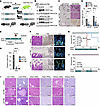
YAP and TAZ, key effectors of the Hippo pathway, are often hyperactivated in cancer, promoting tumor progression and therapy resistance. Their oncogenic role depends on interaction with TEAD transcription factors, making the TEAD-YAP/TAZ complex a promising therapeutic target. Using translational mouse models, we showed here that sustained systemic YAP/TAZ depletion caused severe side effects. These could be avoided through pulsed inhibition, which effectively suppressed tumor growth, even at advanced stages. We identified Tgfb2 as a critical YAP/TAZ target gene for tumor formation and demonstrated that YAP/TAZ drove T cell exclusion via activation of tissue remodeling genes. Consequently, YAP/TAZ inhibition enhanced immune cell infiltration. However, infiltrating T cells rapidly underwent exhaustion. Combining YAP/TAZ inhibition with immune checkpoint blockade (ICB) reversed this exhaustion and sensitized resistant tumors to immunotherapy. This combination reshaped the tumor microenvironment to support immune cell infiltration and activation, representing a therapeutic strategy that maximizes anti-tumor immunity while minimizing toxicity.

Authors

Marco Jessen, KyungMok Kim, Marie Tollot-Wegner, Anita Cindric Vranesic, Cagla Dönmez, Celina Junker, Tina Lehmann, Advitiya Khandelwal, Yuliya Kurlishchuk, Tom Hünniger, Christin Ritter, Evaristo Di Napoli, Shyam Murali, Konrad Bücking, Viktoria Haug, Sabine Muth, Tracy T. Tang, Andreas Rosenwald, Markus Radsak, Donato Inverso, Tanja Deckert-Gaudig, Volker Deckert, Orlando Paciello, Björn von Eyss

×
Problems with a PDF?

This file is in Adobe Acrobat (PDF) format. If you have not installed and configured the Adobe Acrobat Reader on your system.

Having trouble reading a PDF?

PDFs are designed to be printed out and read, but if you prefer to read them online, you may find it easier if you increase the view size to 125%.

Having trouble saving a PDF?

Many versions of the free Acrobat Reader do not allow Save. You must instead save the PDF from the JCI Online page you downloaded it from. PC users: Right-click on the Download link and choose the option that says something like "Save Link As...". Mac users should hold the mouse button down on the link to get these same options.

Having trouble printing a PDF?

  1. Try printing one page at a time or to a newer printer.
  2. Try saving the file to disk before printing rather than opening it "on the fly." This requires that you configure your browser to "Save" rather than "Launch Application" for the file type "application/pdf", and can usually be done in the "Helper Applications" options.
  3. Make sure you are using the latest version of Adobe's Acrobat Reader.

Unedited blot and gel images - Download (10.15 MB)

Advertisement

Copyright © 2026 American Society for Clinical Investigation
ISSN: 0021-9738 (print), 1558-8238 (online)

Sign up for email alerts