
Advertisement
Research ArticleDevelopmentGenetics
Open Access |  10.1172/JCI199043
HER2 deficiency causes a developmental disorder with growth retardation and craniofacial malformations
Huaxiang Zhao,1,2,3,4 Pan Wang,5,6 Yuhua Jiao,1,4 Huimei Huang,7 Min Yu,8,9 Qing He,10 Chengkai Pan,10 Shuang Guo,11 Wenbin Huang,12 Yunfei Jia,1,4 Qianying Kong,13 Huifang Peng,13 Yandong Han,1,4 Yuxia Hou,1,4 Zhanping Ren,1,14 Yongwei Tao,1,14 Fei Huang,15,16 Hongwei Jiang,13 Shan Sun,17 Yanying Dong,2 Jiuxiang Lin,3,9 Chunyan Yin,11 Xuechen Zhu, Feng Chen,9,21 and Yi Ding2,10
1Key Laboratory of Shaanxi Province for Craniofacial Precision Medicine Research, College of Stomatology, Xi’an Jiaotong University, Xi’an, Shaanxi, China.
2Department of Transfusion Medicine, The Second Affiliated Hospital of Xi’an Jiaotong University, Xi’an, Shaanxi, China.
3Department of Orthodontics, Peking University School and Hospital of Stomatology, Beijing, China.
4Department of Orthodontics, College of Stomatology, Xi’an Jiaotong University, Xi’an, Shaanxi, China.
5Research Center for Industries of the Future, Westlake University, Institute of Biology, Westlake Institute for Advanced Study, Hangzhou, Zhejiang, China.
6Westlake Laboratory of Life Sciences and Biomedicine, Hangzhou, Zhejiang, China.
7Department of Nephrology, Xi’an Children’s Hospital, The Affiliated Children’s Hospital, Xi’an Jiaotong University, Xi’an, Shaanxi, China.
8Department of Prosthodontics, Peking University School and Hospital of Stomatology, Beijing, China.
9National Center of Stomatology, National Clinical Research Center for Oral Diseases, National Engineering Laboratory for Digital and Material Technology of Stomatology, Beijing Key Laboratory for Digital Stomatology, Research Center of Engineering and Technology for Computerized Dentistry Ministry of Health, NMPA Key Laboratory for Dental Materials, Beijing, China.
10Department of Physiology and Pathophysiology, School of Basic Medical Sciences, Health Science Center, Xi’an Jiaotong University, Xi’an, Shaanxi, China.
11Department of Pediatrics, The Second Affiliated Hospital of Xi’an Jiaotong University, Xi’an, Shaanxi, China.
12Department of Orthodontics, Stomatological Center, Peking University Shenzhen Hospital, Shenzhen, Guangdong, China.
13Henan Key Laboratory of Rare Diseases, Endocrinology and Metabolism Center, The First Affiliated Hospital, and College of Clinical Medicine of Henan University of Science and Technology, Luoyang, Henan, China.
14Department of Cleft Palate-Craniofacial Surgery, College of Stomatology, Xi’an Jiaotong University, Xi’an, Shaanxi, China.
15Central Laboratory, Fujian Key Laboratory of Precision Medicine for Cancer, Key Laboratory of Radiation Biology of Fujian Higher Education Institutions, The First Affiliated Hospital, Fujian Medical University, Fuzhou, Fujian, China.
16Central Laboratory, National Regional Medical Center, Binhai Campus of the First Affiliated Hospital, Fujian Medical University, Fuzhou, Fujian, China.
17State Key Laboratory of Membrane Biology, Beijing Frontier Research Center for Biological Structure, School of Life Sciences, Tsinghua University, Beijing, China.
18State Key Laboratory of Female Fertility Promotion, Department of Human Anatomy, Histology and Embryology, School of Basic Medical Sciences, Peking University Health Science Center, Beijing, China.
19Department of Pediatrics, Children’s Medical Center, Peking University First Hospital, Beijing, China.
20Neuroscience Research Institute, Peking University, Beijing, China.
21Central Laboratory, Peking University School and Hospital of Stomatology, Beijing, China.
Address correspondence to: Chunyan Yin, Department of Pediatrics, The Second Affiliated Hospital of Xi’an Jiaotong University, Xi’an 710004, Shaanxi, China. Phone: 8618192119212; Email: yinchunyan@mail.xjtu.edu.cn. Or to: Xuechen Zhu, State Key Laboratory of Female Fertility Promotion, Department of Human Anatomy, Histology and Embryology, School of Basic Medical Sciences, Peking University Health Science Center, Beijing 100191, China. Phone: 8618810718992; Email: zhuxc@bjmu.edu.cn. Or to: Feng Chen, Central Laboratory, Peking University School and Hospital of Stomatology, Beijing 100081, China. Phone: 8615699986322; Email: chenfeng2011@hsc.pku.edu.cn. Or to: Yi Ding, Department of Physiology and Pathophysiology, School of Basic Medical Sciences, Health Science Center, Xi’an Jiaotong University, Xi’an 710061, Shaanxi, China. Phone: 8618792450405; Email: dingyi1510@xjtu.edu.cn.
Authorship note: HZ, PW, Y. Jiao, and HH contributed equally to this work.
Find articles by Zhao, H. in: PubMed | Google Scholar
1Key Laboratory of Shaanxi Province for Craniofacial Precision Medicine Research, College of Stomatology, Xi’an Jiaotong University, Xi’an, Shaanxi, China.
2Department of Transfusion Medicine, The Second Affiliated Hospital of Xi’an Jiaotong University, Xi’an, Shaanxi, China.
3Department of Orthodontics, Peking University School and Hospital of Stomatology, Beijing, China.
4Department of Orthodontics, College of Stomatology, Xi’an Jiaotong University, Xi’an, Shaanxi, China.
5Research Center for Industries of the Future, Westlake University, Institute of Biology, Westlake Institute for Advanced Study, Hangzhou, Zhejiang, China.
6Westlake Laboratory of Life Sciences and Biomedicine, Hangzhou, Zhejiang, China.
7Department of Nephrology, Xi’an Children’s Hospital, The Affiliated Children’s Hospital, Xi’an Jiaotong University, Xi’an, Shaanxi, China.
8Department of Prosthodontics, Peking University School and Hospital of Stomatology, Beijing, China.
9National Center of Stomatology, National Clinical Research Center for Oral Diseases, National Engineering Laboratory for Digital and Material Technology of Stomatology, Beijing Key Laboratory for Digital Stomatology, Research Center of Engineering and Technology for Computerized Dentistry Ministry of Health, NMPA Key Laboratory for Dental Materials, Beijing, China.
10Department of Physiology and Pathophysiology, School of Basic Medical Sciences, Health Science Center, Xi’an Jiaotong University, Xi’an, Shaanxi, China.
11Department of Pediatrics, The Second Affiliated Hospital of Xi’an Jiaotong University, Xi’an, Shaanxi, China.
12Department of Orthodontics, Stomatological Center, Peking University Shenzhen Hospital, Shenzhen, Guangdong, China.
13Henan Key Laboratory of Rare Diseases, Endocrinology and Metabolism Center, The First Affiliated Hospital, and College of Clinical Medicine of Henan University of Science and Technology, Luoyang, Henan, China.
14Department of Cleft Palate-Craniofacial Surgery, College of Stomatology, Xi’an Jiaotong University, Xi’an, Shaanxi, China.
15Central Laboratory, Fujian Key Laboratory of Precision Medicine for Cancer, Key Laboratory of Radiation Biology of Fujian Higher Education Institutions, The First Affiliated Hospital, Fujian Medical University, Fuzhou, Fujian, China.
16Central Laboratory, National Regional Medical Center, Binhai Campus of the First Affiliated Hospital, Fujian Medical University, Fuzhou, Fujian, China.
17State Key Laboratory of Membrane Biology, Beijing Frontier Research Center for Biological Structure, School of Life Sciences, Tsinghua University, Beijing, China.
18State Key Laboratory of Female Fertility Promotion, Department of Human Anatomy, Histology and Embryology, School of Basic Medical Sciences, Peking University Health Science Center, Beijing, China.
19Department of Pediatrics, Children’s Medical Center, Peking University First Hospital, Beijing, China.
20Neuroscience Research Institute, Peking University, Beijing, China.
21Central Laboratory, Peking University School and Hospital of Stomatology, Beijing, China.
Address correspondence to: Chunyan Yin, Department of Pediatrics, The Second Affiliated Hospital of Xi’an Jiaotong University, Xi’an 710004, Shaanxi, China. Phone: 8618192119212; Email: yinchunyan@mail.xjtu.edu.cn. Or to: Xuechen Zhu, State Key Laboratory of Female Fertility Promotion, Department of Human Anatomy, Histology and Embryology, School of Basic Medical Sciences, Peking University Health Science Center, Beijing 100191, China. Phone: 8618810718992; Email: zhuxc@bjmu.edu.cn. Or to: Feng Chen, Central Laboratory, Peking University School and Hospital of Stomatology, Beijing 100081, China. Phone: 8615699986322; Email: chenfeng2011@hsc.pku.edu.cn. Or to: Yi Ding, Department of Physiology and Pathophysiology, School of Basic Medical Sciences, Health Science Center, Xi’an Jiaotong University, Xi’an 710061, Shaanxi, China. Phone: 8618792450405; Email: dingyi1510@xjtu.edu.cn.
Authorship note: HZ, PW, Y. Jiao, and HH contributed equally to this work.
Find articles by Wang, P. in: PubMed | Google Scholar
1Key Laboratory of Shaanxi Province for Craniofacial Precision Medicine Research, College of Stomatology, Xi’an Jiaotong University, Xi’an, Shaanxi, China.
2Department of Transfusion Medicine, The Second Affiliated Hospital of Xi’an Jiaotong University, Xi’an, Shaanxi, China.
3Department of Orthodontics, Peking University School and Hospital of Stomatology, Beijing, China.
4Department of Orthodontics, College of Stomatology, Xi’an Jiaotong University, Xi’an, Shaanxi, China.
5Research Center for Industries of the Future, Westlake University, Institute of Biology, Westlake Institute for Advanced Study, Hangzhou, Zhejiang, China.
6Westlake Laboratory of Life Sciences and Biomedicine, Hangzhou, Zhejiang, China.
7Department of Nephrology, Xi’an Children’s Hospital, The Affiliated Children’s Hospital, Xi’an Jiaotong University, Xi’an, Shaanxi, China.
8Department of Prosthodontics, Peking University School and Hospital of Stomatology, Beijing, China.
9National Center of Stomatology, National Clinical Research Center for Oral Diseases, National Engineering Laboratory for Digital and Material Technology of Stomatology, Beijing Key Laboratory for Digital Stomatology, Research Center of Engineering and Technology for Computerized Dentistry Ministry of Health, NMPA Key Laboratory for Dental Materials, Beijing, China.
10Department of Physiology and Pathophysiology, School of Basic Medical Sciences, Health Science Center, Xi’an Jiaotong University, Xi’an, Shaanxi, China.
11Department of Pediatrics, The Second Affiliated Hospital of Xi’an Jiaotong University, Xi’an, Shaanxi, China.
12Department of Orthodontics, Stomatological Center, Peking University Shenzhen Hospital, Shenzhen, Guangdong, China.
13Henan Key Laboratory of Rare Diseases, Endocrinology and Metabolism Center, The First Affiliated Hospital, and College of Clinical Medicine of Henan University of Science and Technology, Luoyang, Henan, China.
14Department of Cleft Palate-Craniofacial Surgery, College of Stomatology, Xi’an Jiaotong University, Xi’an, Shaanxi, China.
15Central Laboratory, Fujian Key Laboratory of Precision Medicine for Cancer, Key Laboratory of Radiation Biology of Fujian Higher Education Institutions, The First Affiliated Hospital, Fujian Medical University, Fuzhou, Fujian, China.
16Central Laboratory, National Regional Medical Center, Binhai Campus of the First Affiliated Hospital, Fujian Medical University, Fuzhou, Fujian, China.
17State Key Laboratory of Membrane Biology, Beijing Frontier Research Center for Biological Structure, School of Life Sciences, Tsinghua University, Beijing, China.
18State Key Laboratory of Female Fertility Promotion, Department of Human Anatomy, Histology and Embryology, School of Basic Medical Sciences, Peking University Health Science Center, Beijing, China.
19Department of Pediatrics, Children’s Medical Center, Peking University First Hospital, Beijing, China.
20Neuroscience Research Institute, Peking University, Beijing, China.
21Central Laboratory, Peking University School and Hospital of Stomatology, Beijing, China.
Address correspondence to: Chunyan Yin, Department of Pediatrics, The Second Affiliated Hospital of Xi’an Jiaotong University, Xi’an 710004, Shaanxi, China. Phone: 8618192119212; Email: yinchunyan@mail.xjtu.edu.cn. Or to: Xuechen Zhu, State Key Laboratory of Female Fertility Promotion, Department of Human Anatomy, Histology and Embryology, School of Basic Medical Sciences, Peking University Health Science Center, Beijing 100191, China. Phone: 8618810718992; Email: zhuxc@bjmu.edu.cn. Or to: Feng Chen, Central Laboratory, Peking University School and Hospital of Stomatology, Beijing 100081, China. Phone: 8615699986322; Email: chenfeng2011@hsc.pku.edu.cn. Or to: Yi Ding, Department of Physiology and Pathophysiology, School of Basic Medical Sciences, Health Science Center, Xi’an Jiaotong University, Xi’an 710061, Shaanxi, China. Phone: 8618792450405; Email: dingyi1510@xjtu.edu.cn.
Authorship note: HZ, PW, Y. Jiao, and HH contributed equally to this work.
Find articles by Jiao, Y. in: PubMed | Google Scholar
1Key Laboratory of Shaanxi Province for Craniofacial Precision Medicine Research, College of Stomatology, Xi’an Jiaotong University, Xi’an, Shaanxi, China.
2Department of Transfusion Medicine, The Second Affiliated Hospital of Xi’an Jiaotong University, Xi’an, Shaanxi, China.
3Department of Orthodontics, Peking University School and Hospital of Stomatology, Beijing, China.
4Department of Orthodontics, College of Stomatology, Xi’an Jiaotong University, Xi’an, Shaanxi, China.
5Research Center for Industries of the Future, Westlake University, Institute of Biology, Westlake Institute for Advanced Study, Hangzhou, Zhejiang, China.
6Westlake Laboratory of Life Sciences and Biomedicine, Hangzhou, Zhejiang, China.
7Department of Nephrology, Xi’an Children’s Hospital, The Affiliated Children’s Hospital, Xi’an Jiaotong University, Xi’an, Shaanxi, China.
8Department of Prosthodontics, Peking University School and Hospital of Stomatology, Beijing, China.
9National Center of Stomatology, National Clinical Research Center for Oral Diseases, National Engineering Laboratory for Digital and Material Technology of Stomatology, Beijing Key Laboratory for Digital Stomatology, Research Center of Engineering and Technology for Computerized Dentistry Ministry of Health, NMPA Key Laboratory for Dental Materials, Beijing, China.
10Department of Physiology and Pathophysiology, School of Basic Medical Sciences, Health Science Center, Xi’an Jiaotong University, Xi’an, Shaanxi, China.
11Department of Pediatrics, The Second Affiliated Hospital of Xi’an Jiaotong University, Xi’an, Shaanxi, China.
12Department of Orthodontics, Stomatological Center, Peking University Shenzhen Hospital, Shenzhen, Guangdong, China.
13Henan Key Laboratory of Rare Diseases, Endocrinology and Metabolism Center, The First Affiliated Hospital, and College of Clinical Medicine of Henan University of Science and Technology, Luoyang, Henan, China.
14Department of Cleft Palate-Craniofacial Surgery, College of Stomatology, Xi’an Jiaotong University, Xi’an, Shaanxi, China.
15Central Laboratory, Fujian Key Laboratory of Precision Medicine for Cancer, Key Laboratory of Radiation Biology of Fujian Higher Education Institutions, The First Affiliated Hospital, Fujian Medical University, Fuzhou, Fujian, China.
16Central Laboratory, National Regional Medical Center, Binhai Campus of the First Affiliated Hospital, Fujian Medical University, Fuzhou, Fujian, China.
17State Key Laboratory of Membrane Biology, Beijing Frontier Research Center for Biological Structure, School of Life Sciences, Tsinghua University, Beijing, China.
18State Key Laboratory of Female Fertility Promotion, Department of Human Anatomy, Histology and Embryology, School of Basic Medical Sciences, Peking University Health Science Center, Beijing, China.
19Department of Pediatrics, Children’s Medical Center, Peking University First Hospital, Beijing, China.
20Neuroscience Research Institute, Peking University, Beijing, China.
21Central Laboratory, Peking University School and Hospital of Stomatology, Beijing, China.
Address correspondence to: Chunyan Yin, Department of Pediatrics, The Second Affiliated Hospital of Xi’an Jiaotong University, Xi’an 710004, Shaanxi, China. Phone: 8618192119212; Email: yinchunyan@mail.xjtu.edu.cn. Or to: Xuechen Zhu, State Key Laboratory of Female Fertility Promotion, Department of Human Anatomy, Histology and Embryology, School of Basic Medical Sciences, Peking University Health Science Center, Beijing 100191, China. Phone: 8618810718992; Email: zhuxc@bjmu.edu.cn. Or to: Feng Chen, Central Laboratory, Peking University School and Hospital of Stomatology, Beijing 100081, China. Phone: 8615699986322; Email: chenfeng2011@hsc.pku.edu.cn. Or to: Yi Ding, Department of Physiology and Pathophysiology, School of Basic Medical Sciences, Health Science Center, Xi’an Jiaotong University, Xi’an 710061, Shaanxi, China. Phone: 8618792450405; Email: dingyi1510@xjtu.edu.cn.
Authorship note: HZ, PW, Y. Jiao, and HH contributed equally to this work.
Find articles by Huang, H. in: PubMed | Google Scholar
1Key Laboratory of Shaanxi Province for Craniofacial Precision Medicine Research, College of Stomatology, Xi’an Jiaotong University, Xi’an, Shaanxi, China.
2Department of Transfusion Medicine, The Second Affiliated Hospital of Xi’an Jiaotong University, Xi’an, Shaanxi, China.
3Department of Orthodontics, Peking University School and Hospital of Stomatology, Beijing, China.
4Department of Orthodontics, College of Stomatology, Xi’an Jiaotong University, Xi’an, Shaanxi, China.
5Research Center for Industries of the Future, Westlake University, Institute of Biology, Westlake Institute for Advanced Study, Hangzhou, Zhejiang, China.
6Westlake Laboratory of Life Sciences and Biomedicine, Hangzhou, Zhejiang, China.
7Department of Nephrology, Xi’an Children’s Hospital, The Affiliated Children’s Hospital, Xi’an Jiaotong University, Xi’an, Shaanxi, China.
8Department of Prosthodontics, Peking University School and Hospital of Stomatology, Beijing, China.
9National Center of Stomatology, National Clinical Research Center for Oral Diseases, National Engineering Laboratory for Digital and Material Technology of Stomatology, Beijing Key Laboratory for Digital Stomatology, Research Center of Engineering and Technology for Computerized Dentistry Ministry of Health, NMPA Key Laboratory for Dental Materials, Beijing, China.
10Department of Physiology and Pathophysiology, School of Basic Medical Sciences, Health Science Center, Xi’an Jiaotong University, Xi’an, Shaanxi, China.
11Department of Pediatrics, The Second Affiliated Hospital of Xi’an Jiaotong University, Xi’an, Shaanxi, China.
12Department of Orthodontics, Stomatological Center, Peking University Shenzhen Hospital, Shenzhen, Guangdong, China.
13Henan Key Laboratory of Rare Diseases, Endocrinology and Metabolism Center, The First Affiliated Hospital, and College of Clinical Medicine of Henan University of Science and Technology, Luoyang, Henan, China.
14Department of Cleft Palate-Craniofacial Surgery, College of Stomatology, Xi’an Jiaotong University, Xi’an, Shaanxi, China.
15Central Laboratory, Fujian Key Laboratory of Precision Medicine for Cancer, Key Laboratory of Radiation Biology of Fujian Higher Education Institutions, The First Affiliated Hospital, Fujian Medical University, Fuzhou, Fujian, China.
16Central Laboratory, National Regional Medical Center, Binhai Campus of the First Affiliated Hospital, Fujian Medical University, Fuzhou, Fujian, China.
17State Key Laboratory of Membrane Biology, Beijing Frontier Research Center for Biological Structure, School of Life Sciences, Tsinghua University, Beijing, China.
18State Key Laboratory of Female Fertility Promotion, Department of Human Anatomy, Histology and Embryology, School of Basic Medical Sciences, Peking University Health Science Center, Beijing, China.
19Department of Pediatrics, Children’s Medical Center, Peking University First Hospital, Beijing, China.
20Neuroscience Research Institute, Peking University, Beijing, China.
21Central Laboratory, Peking University School and Hospital of Stomatology, Beijing, China.
Address correspondence to: Chunyan Yin, Department of Pediatrics, The Second Affiliated Hospital of Xi’an Jiaotong University, Xi’an 710004, Shaanxi, China. Phone: 8618192119212; Email: yinchunyan@mail.xjtu.edu.cn. Or to: Xuechen Zhu, State Key Laboratory of Female Fertility Promotion, Department of Human Anatomy, Histology and Embryology, School of Basic Medical Sciences, Peking University Health Science Center, Beijing 100191, China. Phone: 8618810718992; Email: zhuxc@bjmu.edu.cn. Or to: Feng Chen, Central Laboratory, Peking University School and Hospital of Stomatology, Beijing 100081, China. Phone: 8615699986322; Email: chenfeng2011@hsc.pku.edu.cn. Or to: Yi Ding, Department of Physiology and Pathophysiology, School of Basic Medical Sciences, Health Science Center, Xi’an Jiaotong University, Xi’an 710061, Shaanxi, China. Phone: 8618792450405; Email: dingyi1510@xjtu.edu.cn.
Authorship note: HZ, PW, Y. Jiao, and HH contributed equally to this work.
Find articles by Yu, M. in: PubMed | Google Scholar
1Key Laboratory of Shaanxi Province for Craniofacial Precision Medicine Research, College of Stomatology, Xi’an Jiaotong University, Xi’an, Shaanxi, China.
2Department of Transfusion Medicine, The Second Affiliated Hospital of Xi’an Jiaotong University, Xi’an, Shaanxi, China.
3Department of Orthodontics, Peking University School and Hospital of Stomatology, Beijing, China.
4Department of Orthodontics, College of Stomatology, Xi’an Jiaotong University, Xi’an, Shaanxi, China.
5Research Center for Industries of the Future, Westlake University, Institute of Biology, Westlake Institute for Advanced Study, Hangzhou, Zhejiang, China.
6Westlake Laboratory of Life Sciences and Biomedicine, Hangzhou, Zhejiang, China.
7Department of Nephrology, Xi’an Children’s Hospital, The Affiliated Children’s Hospital, Xi’an Jiaotong University, Xi’an, Shaanxi, China.
8Department of Prosthodontics, Peking University School and Hospital of Stomatology, Beijing, China.
9National Center of Stomatology, National Clinical Research Center for Oral Diseases, National Engineering Laboratory for Digital and Material Technology of Stomatology, Beijing Key Laboratory for Digital Stomatology, Research Center of Engineering and Technology for Computerized Dentistry Ministry of Health, NMPA Key Laboratory for Dental Materials, Beijing, China.
10Department of Physiology and Pathophysiology, School of Basic Medical Sciences, Health Science Center, Xi’an Jiaotong University, Xi’an, Shaanxi, China.
11Department of Pediatrics, The Second Affiliated Hospital of Xi’an Jiaotong University, Xi’an, Shaanxi, China.
12Department of Orthodontics, Stomatological Center, Peking University Shenzhen Hospital, Shenzhen, Guangdong, China.
13Henan Key Laboratory of Rare Diseases, Endocrinology and Metabolism Center, The First Affiliated Hospital, and College of Clinical Medicine of Henan University of Science and Technology, Luoyang, Henan, China.
14Department of Cleft Palate-Craniofacial Surgery, College of Stomatology, Xi’an Jiaotong University, Xi’an, Shaanxi, China.
15Central Laboratory, Fujian Key Laboratory of Precision Medicine for Cancer, Key Laboratory of Radiation Biology of Fujian Higher Education Institutions, The First Affiliated Hospital, Fujian Medical University, Fuzhou, Fujian, China.
16Central Laboratory, National Regional Medical Center, Binhai Campus of the First Affiliated Hospital, Fujian Medical University, Fuzhou, Fujian, China.
17State Key Laboratory of Membrane Biology, Beijing Frontier Research Center for Biological Structure, School of Life Sciences, Tsinghua University, Beijing, China.
18State Key Laboratory of Female Fertility Promotion, Department of Human Anatomy, Histology and Embryology, School of Basic Medical Sciences, Peking University Health Science Center, Beijing, China.
19Department of Pediatrics, Children’s Medical Center, Peking University First Hospital, Beijing, China.
20Neuroscience Research Institute, Peking University, Beijing, China.
21Central Laboratory, Peking University School and Hospital of Stomatology, Beijing, China.
Address correspondence to: Chunyan Yin, Department of Pediatrics, The Second Affiliated Hospital of Xi’an Jiaotong University, Xi’an 710004, Shaanxi, China. Phone: 8618192119212; Email: yinchunyan@mail.xjtu.edu.cn. Or to: Xuechen Zhu, State Key Laboratory of Female Fertility Promotion, Department of Human Anatomy, Histology and Embryology, School of Basic Medical Sciences, Peking University Health Science Center, Beijing 100191, China. Phone: 8618810718992; Email: zhuxc@bjmu.edu.cn. Or to: Feng Chen, Central Laboratory, Peking University School and Hospital of Stomatology, Beijing 100081, China. Phone: 8615699986322; Email: chenfeng2011@hsc.pku.edu.cn. Or to: Yi Ding, Department of Physiology and Pathophysiology, School of Basic Medical Sciences, Health Science Center, Xi’an Jiaotong University, Xi’an 710061, Shaanxi, China. Phone: 8618792450405; Email: dingyi1510@xjtu.edu.cn.
Authorship note: HZ, PW, Y. Jiao, and HH contributed equally to this work.
Find articles by He, Q. in: PubMed | Google Scholar
1Key Laboratory of Shaanxi Province for Craniofacial Precision Medicine Research, College of Stomatology, Xi’an Jiaotong University, Xi’an, Shaanxi, China.
2Department of Transfusion Medicine, The Second Affiliated Hospital of Xi’an Jiaotong University, Xi’an, Shaanxi, China.
3Department of Orthodontics, Peking University School and Hospital of Stomatology, Beijing, China.
4Department of Orthodontics, College of Stomatology, Xi’an Jiaotong University, Xi’an, Shaanxi, China.
5Research Center for Industries of the Future, Westlake University, Institute of Biology, Westlake Institute for Advanced Study, Hangzhou, Zhejiang, China.
6Westlake Laboratory of Life Sciences and Biomedicine, Hangzhou, Zhejiang, China.
7Department of Nephrology, Xi’an Children’s Hospital, The Affiliated Children’s Hospital, Xi’an Jiaotong University, Xi’an, Shaanxi, China.
8Department of Prosthodontics, Peking University School and Hospital of Stomatology, Beijing, China.
9National Center of Stomatology, National Clinical Research Center for Oral Diseases, National Engineering Laboratory for Digital and Material Technology of Stomatology, Beijing Key Laboratory for Digital Stomatology, Research Center of Engineering and Technology for Computerized Dentistry Ministry of Health, NMPA Key Laboratory for Dental Materials, Beijing, China.
10Department of Physiology and Pathophysiology, School of Basic Medical Sciences, Health Science Center, Xi’an Jiaotong University, Xi’an, Shaanxi, China.
11Department of Pediatrics, The Second Affiliated Hospital of Xi’an Jiaotong University, Xi’an, Shaanxi, China.
12Department of Orthodontics, Stomatological Center, Peking University Shenzhen Hospital, Shenzhen, Guangdong, China.
13Henan Key Laboratory of Rare Diseases, Endocrinology and Metabolism Center, The First Affiliated Hospital, and College of Clinical Medicine of Henan University of Science and Technology, Luoyang, Henan, China.
14Department of Cleft Palate-Craniofacial Surgery, College of Stomatology, Xi’an Jiaotong University, Xi’an, Shaanxi, China.
15Central Laboratory, Fujian Key Laboratory of Precision Medicine for Cancer, Key Laboratory of Radiation Biology of Fujian Higher Education Institutions, The First Affiliated Hospital, Fujian Medical University, Fuzhou, Fujian, China.
16Central Laboratory, National Regional Medical Center, Binhai Campus of the First Affiliated Hospital, Fujian Medical University, Fuzhou, Fujian, China.
17State Key Laboratory of Membrane Biology, Beijing Frontier Research Center for Biological Structure, School of Life Sciences, Tsinghua University, Beijing, China.
18State Key Laboratory of Female Fertility Promotion, Department of Human Anatomy, Histology and Embryology, School of Basic Medical Sciences, Peking University Health Science Center, Beijing, China.
19Department of Pediatrics, Children’s Medical Center, Peking University First Hospital, Beijing, China.
20Neuroscience Research Institute, Peking University, Beijing, China.
21Central Laboratory, Peking University School and Hospital of Stomatology, Beijing, China.
Address correspondence to: Chunyan Yin, Department of Pediatrics, The Second Affiliated Hospital of Xi’an Jiaotong University, Xi’an 710004, Shaanxi, China. Phone: 8618192119212; Email: yinchunyan@mail.xjtu.edu.cn. Or to: Xuechen Zhu, State Key Laboratory of Female Fertility Promotion, Department of Human Anatomy, Histology and Embryology, School of Basic Medical Sciences, Peking University Health Science Center, Beijing 100191, China. Phone: 8618810718992; Email: zhuxc@bjmu.edu.cn. Or to: Feng Chen, Central Laboratory, Peking University School and Hospital of Stomatology, Beijing 100081, China. Phone: 8615699986322; Email: chenfeng2011@hsc.pku.edu.cn. Or to: Yi Ding, Department of Physiology and Pathophysiology, School of Basic Medical Sciences, Health Science Center, Xi’an Jiaotong University, Xi’an 710061, Shaanxi, China. Phone: 8618792450405; Email: dingyi1510@xjtu.edu.cn.
Authorship note: HZ, PW, Y. Jiao, and HH contributed equally to this work.
Find articles by Pan, C. in: PubMed | Google Scholar
1Key Laboratory of Shaanxi Province for Craniofacial Precision Medicine Research, College of Stomatology, Xi’an Jiaotong University, Xi’an, Shaanxi, China.
2Department of Transfusion Medicine, The Second Affiliated Hospital of Xi’an Jiaotong University, Xi’an, Shaanxi, China.
3Department of Orthodontics, Peking University School and Hospital of Stomatology, Beijing, China.
4Department of Orthodontics, College of Stomatology, Xi’an Jiaotong University, Xi’an, Shaanxi, China.
5Research Center for Industries of the Future, Westlake University, Institute of Biology, Westlake Institute for Advanced Study, Hangzhou, Zhejiang, China.
6Westlake Laboratory of Life Sciences and Biomedicine, Hangzhou, Zhejiang, China.
7Department of Nephrology, Xi’an Children’s Hospital, The Affiliated Children’s Hospital, Xi’an Jiaotong University, Xi’an, Shaanxi, China.
8Department of Prosthodontics, Peking University School and Hospital of Stomatology, Beijing, China.
9National Center of Stomatology, National Clinical Research Center for Oral Diseases, National Engineering Laboratory for Digital and Material Technology of Stomatology, Beijing Key Laboratory for Digital Stomatology, Research Center of Engineering and Technology for Computerized Dentistry Ministry of Health, NMPA Key Laboratory for Dental Materials, Beijing, China.
10Department of Physiology and Pathophysiology, School of Basic Medical Sciences, Health Science Center, Xi’an Jiaotong University, Xi’an, Shaanxi, China.
11Department of Pediatrics, The Second Affiliated Hospital of Xi’an Jiaotong University, Xi’an, Shaanxi, China.
12Department of Orthodontics, Stomatological Center, Peking University Shenzhen Hospital, Shenzhen, Guangdong, China.
13Henan Key Laboratory of Rare Diseases, Endocrinology and Metabolism Center, The First Affiliated Hospital, and College of Clinical Medicine of Henan University of Science and Technology, Luoyang, Henan, China.
14Department of Cleft Palate-Craniofacial Surgery, College of Stomatology, Xi’an Jiaotong University, Xi’an, Shaanxi, China.
15Central Laboratory, Fujian Key Laboratory of Precision Medicine for Cancer, Key Laboratory of Radiation Biology of Fujian Higher Education Institutions, The First Affiliated Hospital, Fujian Medical University, Fuzhou, Fujian, China.
16Central Laboratory, National Regional Medical Center, Binhai Campus of the First Affiliated Hospital, Fujian Medical University, Fuzhou, Fujian, China.
17State Key Laboratory of Membrane Biology, Beijing Frontier Research Center for Biological Structure, School of Life Sciences, Tsinghua University, Beijing, China.
18State Key Laboratory of Female Fertility Promotion, Department of Human Anatomy, Histology and Embryology, School of Basic Medical Sciences, Peking University Health Science Center, Beijing, China.
19Department of Pediatrics, Children’s Medical Center, Peking University First Hospital, Beijing, China.
20Neuroscience Research Institute, Peking University, Beijing, China.
21Central Laboratory, Peking University School and Hospital of Stomatology, Beijing, China.
Address correspondence to: Chunyan Yin, Department of Pediatrics, The Second Affiliated Hospital of Xi’an Jiaotong University, Xi’an 710004, Shaanxi, China. Phone: 8618192119212; Email: yinchunyan@mail.xjtu.edu.cn. Or to: Xuechen Zhu, State Key Laboratory of Female Fertility Promotion, Department of Human Anatomy, Histology and Embryology, School of Basic Medical Sciences, Peking University Health Science Center, Beijing 100191, China. Phone: 8618810718992; Email: zhuxc@bjmu.edu.cn. Or to: Feng Chen, Central Laboratory, Peking University School and Hospital of Stomatology, Beijing 100081, China. Phone: 8615699986322; Email: chenfeng2011@hsc.pku.edu.cn. Or to: Yi Ding, Department of Physiology and Pathophysiology, School of Basic Medical Sciences, Health Science Center, Xi’an Jiaotong University, Xi’an 710061, Shaanxi, China. Phone: 8618792450405; Email: dingyi1510@xjtu.edu.cn.
Authorship note: HZ, PW, Y. Jiao, and HH contributed equally to this work.
Find articles by Guo, S. in: PubMed | Google Scholar
1Key Laboratory of Shaanxi Province for Craniofacial Precision Medicine Research, College of Stomatology, Xi’an Jiaotong University, Xi’an, Shaanxi, China.
2Department of Transfusion Medicine, The Second Affiliated Hospital of Xi’an Jiaotong University, Xi’an, Shaanxi, China.
3Department of Orthodontics, Peking University School and Hospital of Stomatology, Beijing, China.
4Department of Orthodontics, College of Stomatology, Xi’an Jiaotong University, Xi’an, Shaanxi, China.
5Research Center for Industries of the Future, Westlake University, Institute of Biology, Westlake Institute for Advanced Study, Hangzhou, Zhejiang, China.
6Westlake Laboratory of Life Sciences and Biomedicine, Hangzhou, Zhejiang, China.
7Department of Nephrology, Xi’an Children’s Hospital, The Affiliated Children’s Hospital, Xi’an Jiaotong University, Xi’an, Shaanxi, China.
8Department of Prosthodontics, Peking University School and Hospital of Stomatology, Beijing, China.
9National Center of Stomatology, National Clinical Research Center for Oral Diseases, National Engineering Laboratory for Digital and Material Technology of Stomatology, Beijing Key Laboratory for Digital Stomatology, Research Center of Engineering and Technology for Computerized Dentistry Ministry of Health, NMPA Key Laboratory for Dental Materials, Beijing, China.
10Department of Physiology and Pathophysiology, School of Basic Medical Sciences, Health Science Center, Xi’an Jiaotong University, Xi’an, Shaanxi, China.
11Department of Pediatrics, The Second Affiliated Hospital of Xi’an Jiaotong University, Xi’an, Shaanxi, China.
12Department of Orthodontics, Stomatological Center, Peking University Shenzhen Hospital, Shenzhen, Guangdong, China.
13Henan Key Laboratory of Rare Diseases, Endocrinology and Metabolism Center, The First Affiliated Hospital, and College of Clinical Medicine of Henan University of Science and Technology, Luoyang, Henan, China.
14Department of Cleft Palate-Craniofacial Surgery, College of Stomatology, Xi’an Jiaotong University, Xi’an, Shaanxi, China.
15Central Laboratory, Fujian Key Laboratory of Precision Medicine for Cancer, Key Laboratory of Radiation Biology of Fujian Higher Education Institutions, The First Affiliated Hospital, Fujian Medical University, Fuzhou, Fujian, China.
16Central Laboratory, National Regional Medical Center, Binhai Campus of the First Affiliated Hospital, Fujian Medical University, Fuzhou, Fujian, China.
17State Key Laboratory of Membrane Biology, Beijing Frontier Research Center for Biological Structure, School of Life Sciences, Tsinghua University, Beijing, China.
18State Key Laboratory of Female Fertility Promotion, Department of Human Anatomy, Histology and Embryology, School of Basic Medical Sciences, Peking University Health Science Center, Beijing, China.
19Department of Pediatrics, Children’s Medical Center, Peking University First Hospital, Beijing, China.
20Neuroscience Research Institute, Peking University, Beijing, China.
21Central Laboratory, Peking University School and Hospital of Stomatology, Beijing, China.
Address correspondence to: Chunyan Yin, Department of Pediatrics, The Second Affiliated Hospital of Xi’an Jiaotong University, Xi’an 710004, Shaanxi, China. Phone: 8618192119212; Email: yinchunyan@mail.xjtu.edu.cn. Or to: Xuechen Zhu, State Key Laboratory of Female Fertility Promotion, Department of Human Anatomy, Histology and Embryology, School of Basic Medical Sciences, Peking University Health Science Center, Beijing 100191, China. Phone: 8618810718992; Email: zhuxc@bjmu.edu.cn. Or to: Feng Chen, Central Laboratory, Peking University School and Hospital of Stomatology, Beijing 100081, China. Phone: 8615699986322; Email: chenfeng2011@hsc.pku.edu.cn. Or to: Yi Ding, Department of Physiology and Pathophysiology, School of Basic Medical Sciences, Health Science Center, Xi’an Jiaotong University, Xi’an 710061, Shaanxi, China. Phone: 8618792450405; Email: dingyi1510@xjtu.edu.cn.
Authorship note: HZ, PW, Y. Jiao, and HH contributed equally to this work.
Find articles by Huang, W. in: PubMed | Google Scholar
1Key Laboratory of Shaanxi Province for Craniofacial Precision Medicine Research, College of Stomatology, Xi’an Jiaotong University, Xi’an, Shaanxi, China.
2Department of Transfusion Medicine, The Second Affiliated Hospital of Xi’an Jiaotong University, Xi’an, Shaanxi, China.
3Department of Orthodontics, Peking University School and Hospital of Stomatology, Beijing, China.
4Department of Orthodontics, College of Stomatology, Xi’an Jiaotong University, Xi’an, Shaanxi, China.
5Research Center for Industries of the Future, Westlake University, Institute of Biology, Westlake Institute for Advanced Study, Hangzhou, Zhejiang, China.
6Westlake Laboratory of Life Sciences and Biomedicine, Hangzhou, Zhejiang, China.
7Department of Nephrology, Xi’an Children’s Hospital, The Affiliated Children’s Hospital, Xi’an Jiaotong University, Xi’an, Shaanxi, China.
8Department of Prosthodontics, Peking University School and Hospital of Stomatology, Beijing, China.
9National Center of Stomatology, National Clinical Research Center for Oral Diseases, National Engineering Laboratory for Digital and Material Technology of Stomatology, Beijing Key Laboratory for Digital Stomatology, Research Center of Engineering and Technology for Computerized Dentistry Ministry of Health, NMPA Key Laboratory for Dental Materials, Beijing, China.
10Department of Physiology and Pathophysiology, School of Basic Medical Sciences, Health Science Center, Xi’an Jiaotong University, Xi’an, Shaanxi, China.
11Department of Pediatrics, The Second Affiliated Hospital of Xi’an Jiaotong University, Xi’an, Shaanxi, China.
12Department of Orthodontics, Stomatological Center, Peking University Shenzhen Hospital, Shenzhen, Guangdong, China.
13Henan Key Laboratory of Rare Diseases, Endocrinology and Metabolism Center, The First Affiliated Hospital, and College of Clinical Medicine of Henan University of Science and Technology, Luoyang, Henan, China.
14Department of Cleft Palate-Craniofacial Surgery, College of Stomatology, Xi’an Jiaotong University, Xi’an, Shaanxi, China.
15Central Laboratory, Fujian Key Laboratory of Precision Medicine for Cancer, Key Laboratory of Radiation Biology of Fujian Higher Education Institutions, The First Affiliated Hospital, Fujian Medical University, Fuzhou, Fujian, China.
16Central Laboratory, National Regional Medical Center, Binhai Campus of the First Affiliated Hospital, Fujian Medical University, Fuzhou, Fujian, China.
17State Key Laboratory of Membrane Biology, Beijing Frontier Research Center for Biological Structure, School of Life Sciences, Tsinghua University, Beijing, China.
18State Key Laboratory of Female Fertility Promotion, Department of Human Anatomy, Histology and Embryology, School of Basic Medical Sciences, Peking University Health Science Center, Beijing, China.
19Department of Pediatrics, Children’s Medical Center, Peking University First Hospital, Beijing, China.
20Neuroscience Research Institute, Peking University, Beijing, China.
21Central Laboratory, Peking University School and Hospital of Stomatology, Beijing, China.
Address correspondence to: Chunyan Yin, Department of Pediatrics, The Second Affiliated Hospital of Xi’an Jiaotong University, Xi’an 710004, Shaanxi, China. Phone: 8618192119212; Email: yinchunyan@mail.xjtu.edu.cn. Or to: Xuechen Zhu, State Key Laboratory of Female Fertility Promotion, Department of Human Anatomy, Histology and Embryology, School of Basic Medical Sciences, Peking University Health Science Center, Beijing 100191, China. Phone: 8618810718992; Email: zhuxc@bjmu.edu.cn. Or to: Feng Chen, Central Laboratory, Peking University School and Hospital of Stomatology, Beijing 100081, China. Phone: 8615699986322; Email: chenfeng2011@hsc.pku.edu.cn. Or to: Yi Ding, Department of Physiology and Pathophysiology, School of Basic Medical Sciences, Health Science Center, Xi’an Jiaotong University, Xi’an 710061, Shaanxi, China. Phone: 8618792450405; Email: dingyi1510@xjtu.edu.cn.
Authorship note: HZ, PW, Y. Jiao, and HH contributed equally to this work.
Find articles by Jia, Y. in: PubMed | Google Scholar
1Key Laboratory of Shaanxi Province for Craniofacial Precision Medicine Research, College of Stomatology, Xi’an Jiaotong University, Xi’an, Shaanxi, China.
2Department of Transfusion Medicine, The Second Affiliated Hospital of Xi’an Jiaotong University, Xi’an, Shaanxi, China.
3Department of Orthodontics, Peking University School and Hospital of Stomatology, Beijing, China.
4Department of Orthodontics, College of Stomatology, Xi’an Jiaotong University, Xi’an, Shaanxi, China.
5Research Center for Industries of the Future, Westlake University, Institute of Biology, Westlake Institute for Advanced Study, Hangzhou, Zhejiang, China.
6Westlake Laboratory of Life Sciences and Biomedicine, Hangzhou, Zhejiang, China.
7Department of Nephrology, Xi’an Children’s Hospital, The Affiliated Children’s Hospital, Xi’an Jiaotong University, Xi’an, Shaanxi, China.
8Department of Prosthodontics, Peking University School and Hospital of Stomatology, Beijing, China.
9National Center of Stomatology, National Clinical Research Center for Oral Diseases, National Engineering Laboratory for Digital and Material Technology of Stomatology, Beijing Key Laboratory for Digital Stomatology, Research Center of Engineering and Technology for Computerized Dentistry Ministry of Health, NMPA Key Laboratory for Dental Materials, Beijing, China.
10Department of Physiology and Pathophysiology, School of Basic Medical Sciences, Health Science Center, Xi’an Jiaotong University, Xi’an, Shaanxi, China.
11Department of Pediatrics, The Second Affiliated Hospital of Xi’an Jiaotong University, Xi’an, Shaanxi, China.
12Department of Orthodontics, Stomatological Center, Peking University Shenzhen Hospital, Shenzhen, Guangdong, China.
13Henan Key Laboratory of Rare Diseases, Endocrinology and Metabolism Center, The First Affiliated Hospital, and College of Clinical Medicine of Henan University of Science and Technology, Luoyang, Henan, China.
14Department of Cleft Palate-Craniofacial Surgery, College of Stomatology, Xi’an Jiaotong University, Xi’an, Shaanxi, China.
15Central Laboratory, Fujian Key Laboratory of Precision Medicine for Cancer, Key Laboratory of Radiation Biology of Fujian Higher Education Institutions, The First Affiliated Hospital, Fujian Medical University, Fuzhou, Fujian, China.
16Central Laboratory, National Regional Medical Center, Binhai Campus of the First Affiliated Hospital, Fujian Medical University, Fuzhou, Fujian, China.
17State Key Laboratory of Membrane Biology, Beijing Frontier Research Center for Biological Structure, School of Life Sciences, Tsinghua University, Beijing, China.
18State Key Laboratory of Female Fertility Promotion, Department of Human Anatomy, Histology and Embryology, School of Basic Medical Sciences, Peking University Health Science Center, Beijing, China.
19Department of Pediatrics, Children’s Medical Center, Peking University First Hospital, Beijing, China.
20Neuroscience Research Institute, Peking University, Beijing, China.
21Central Laboratory, Peking University School and Hospital of Stomatology, Beijing, China.
Address correspondence to: Chunyan Yin, Department of Pediatrics, The Second Affiliated Hospital of Xi’an Jiaotong University, Xi’an 710004, Shaanxi, China. Phone: 8618192119212; Email: yinchunyan@mail.xjtu.edu.cn. Or to: Xuechen Zhu, State Key Laboratory of Female Fertility Promotion, Department of Human Anatomy, Histology and Embryology, School of Basic Medical Sciences, Peking University Health Science Center, Beijing 100191, China. Phone: 8618810718992; Email: zhuxc@bjmu.edu.cn. Or to: Feng Chen, Central Laboratory, Peking University School and Hospital of Stomatology, Beijing 100081, China. Phone: 8615699986322; Email: chenfeng2011@hsc.pku.edu.cn. Or to: Yi Ding, Department of Physiology and Pathophysiology, School of Basic Medical Sciences, Health Science Center, Xi’an Jiaotong University, Xi’an 710061, Shaanxi, China. Phone: 8618792450405; Email: dingyi1510@xjtu.edu.cn.
Authorship note: HZ, PW, Y. Jiao, and HH contributed equally to this work.
Find articles by Kong, Q. in: PubMed | Google Scholar
1Key Laboratory of Shaanxi Province for Craniofacial Precision Medicine Research, College of Stomatology, Xi’an Jiaotong University, Xi’an, Shaanxi, China.
2Department of Transfusion Medicine, The Second Affiliated Hospital of Xi’an Jiaotong University, Xi’an, Shaanxi, China.
3Department of Orthodontics, Peking University School and Hospital of Stomatology, Beijing, China.
4Department of Orthodontics, College of Stomatology, Xi’an Jiaotong University, Xi’an, Shaanxi, China.
5Research Center for Industries of the Future, Westlake University, Institute of Biology, Westlake Institute for Advanced Study, Hangzhou, Zhejiang, China.
6Westlake Laboratory of Life Sciences and Biomedicine, Hangzhou, Zhejiang, China.
7Department of Nephrology, Xi’an Children’s Hospital, The Affiliated Children’s Hospital, Xi’an Jiaotong University, Xi’an, Shaanxi, China.
8Department of Prosthodontics, Peking University School and Hospital of Stomatology, Beijing, China.
9National Center of Stomatology, National Clinical Research Center for Oral Diseases, National Engineering Laboratory for Digital and Material Technology of Stomatology, Beijing Key Laboratory for Digital Stomatology, Research Center of Engineering and Technology for Computerized Dentistry Ministry of Health, NMPA Key Laboratory for Dental Materials, Beijing, China.
10Department of Physiology and Pathophysiology, School of Basic Medical Sciences, Health Science Center, Xi’an Jiaotong University, Xi’an, Shaanxi, China.
11Department of Pediatrics, The Second Affiliated Hospital of Xi’an Jiaotong University, Xi’an, Shaanxi, China.
12Department of Orthodontics, Stomatological Center, Peking University Shenzhen Hospital, Shenzhen, Guangdong, China.
13Henan Key Laboratory of Rare Diseases, Endocrinology and Metabolism Center, The First Affiliated Hospital, and College of Clinical Medicine of Henan University of Science and Technology, Luoyang, Henan, China.
14Department of Cleft Palate-Craniofacial Surgery, College of Stomatology, Xi’an Jiaotong University, Xi’an, Shaanxi, China.
15Central Laboratory, Fujian Key Laboratory of Precision Medicine for Cancer, Key Laboratory of Radiation Biology of Fujian Higher Education Institutions, The First Affiliated Hospital, Fujian Medical University, Fuzhou, Fujian, China.
16Central Laboratory, National Regional Medical Center, Binhai Campus of the First Affiliated Hospital, Fujian Medical University, Fuzhou, Fujian, China.
17State Key Laboratory of Membrane Biology, Beijing Frontier Research Center for Biological Structure, School of Life Sciences, Tsinghua University, Beijing, China.
18State Key Laboratory of Female Fertility Promotion, Department of Human Anatomy, Histology and Embryology, School of Basic Medical Sciences, Peking University Health Science Center, Beijing, China.
19Department of Pediatrics, Children’s Medical Center, Peking University First Hospital, Beijing, China.
20Neuroscience Research Institute, Peking University, Beijing, China.
21Central Laboratory, Peking University School and Hospital of Stomatology, Beijing, China.
Address correspondence to: Chunyan Yin, Department of Pediatrics, The Second Affiliated Hospital of Xi’an Jiaotong University, Xi’an 710004, Shaanxi, China. Phone: 8618192119212; Email: yinchunyan@mail.xjtu.edu.cn. Or to: Xuechen Zhu, State Key Laboratory of Female Fertility Promotion, Department of Human Anatomy, Histology and Embryology, School of Basic Medical Sciences, Peking University Health Science Center, Beijing 100191, China. Phone: 8618810718992; Email: zhuxc@bjmu.edu.cn. Or to: Feng Chen, Central Laboratory, Peking University School and Hospital of Stomatology, Beijing 100081, China. Phone: 8615699986322; Email: chenfeng2011@hsc.pku.edu.cn. Or to: Yi Ding, Department of Physiology and Pathophysiology, School of Basic Medical Sciences, Health Science Center, Xi’an Jiaotong University, Xi’an 710061, Shaanxi, China. Phone: 8618792450405; Email: dingyi1510@xjtu.edu.cn.
Authorship note: HZ, PW, Y. Jiao, and HH contributed equally to this work.
Find articles by Peng, H. in: PubMed | Google Scholar
1Key Laboratory of Shaanxi Province for Craniofacial Precision Medicine Research, College of Stomatology, Xi’an Jiaotong University, Xi’an, Shaanxi, China.
2Department of Transfusion Medicine, The Second Affiliated Hospital of Xi’an Jiaotong University, Xi’an, Shaanxi, China.
3Department of Orthodontics, Peking University School and Hospital of Stomatology, Beijing, China.
4Department of Orthodontics, College of Stomatology, Xi’an Jiaotong University, Xi’an, Shaanxi, China.
5Research Center for Industries of the Future, Westlake University, Institute of Biology, Westlake Institute for Advanced Study, Hangzhou, Zhejiang, China.
6Westlake Laboratory of Life Sciences and Biomedicine, Hangzhou, Zhejiang, China.
7Department of Nephrology, Xi’an Children’s Hospital, The Affiliated Children’s Hospital, Xi’an Jiaotong University, Xi’an, Shaanxi, China.
8Department of Prosthodontics, Peking University School and Hospital of Stomatology, Beijing, China.
9National Center of Stomatology, National Clinical Research Center for Oral Diseases, National Engineering Laboratory for Digital and Material Technology of Stomatology, Beijing Key Laboratory for Digital Stomatology, Research Center of Engineering and Technology for Computerized Dentistry Ministry of Health, NMPA Key Laboratory for Dental Materials, Beijing, China.
10Department of Physiology and Pathophysiology, School of Basic Medical Sciences, Health Science Center, Xi’an Jiaotong University, Xi’an, Shaanxi, China.
11Department of Pediatrics, The Second Affiliated Hospital of Xi’an Jiaotong University, Xi’an, Shaanxi, China.
12Department of Orthodontics, Stomatological Center, Peking University Shenzhen Hospital, Shenzhen, Guangdong, China.
13Henan Key Laboratory of Rare Diseases, Endocrinology and Metabolism Center, The First Affiliated Hospital, and College of Clinical Medicine of Henan University of Science and Technology, Luoyang, Henan, China.
14Department of Cleft Palate-Craniofacial Surgery, College of Stomatology, Xi’an Jiaotong University, Xi’an, Shaanxi, China.
15Central Laboratory, Fujian Key Laboratory of Precision Medicine for Cancer, Key Laboratory of Radiation Biology of Fujian Higher Education Institutions, The First Affiliated Hospital, Fujian Medical University, Fuzhou, Fujian, China.
16Central Laboratory, National Regional Medical Center, Binhai Campus of the First Affiliated Hospital, Fujian Medical University, Fuzhou, Fujian, China.
17State Key Laboratory of Membrane Biology, Beijing Frontier Research Center for Biological Structure, School of Life Sciences, Tsinghua University, Beijing, China.
18State Key Laboratory of Female Fertility Promotion, Department of Human Anatomy, Histology and Embryology, School of Basic Medical Sciences, Peking University Health Science Center, Beijing, China.
19Department of Pediatrics, Children’s Medical Center, Peking University First Hospital, Beijing, China.
20Neuroscience Research Institute, Peking University, Beijing, China.
21Central Laboratory, Peking University School and Hospital of Stomatology, Beijing, China.
Address correspondence to: Chunyan Yin, Department of Pediatrics, The Second Affiliated Hospital of Xi’an Jiaotong University, Xi’an 710004, Shaanxi, China. Phone: 8618192119212; Email: yinchunyan@mail.xjtu.edu.cn. Or to: Xuechen Zhu, State Key Laboratory of Female Fertility Promotion, Department of Human Anatomy, Histology and Embryology, School of Basic Medical Sciences, Peking University Health Science Center, Beijing 100191, China. Phone: 8618810718992; Email: zhuxc@bjmu.edu.cn. Or to: Feng Chen, Central Laboratory, Peking University School and Hospital of Stomatology, Beijing 100081, China. Phone: 8615699986322; Email: chenfeng2011@hsc.pku.edu.cn. Or to: Yi Ding, Department of Physiology and Pathophysiology, School of Basic Medical Sciences, Health Science Center, Xi’an Jiaotong University, Xi’an 710061, Shaanxi, China. Phone: 8618792450405; Email: dingyi1510@xjtu.edu.cn.
Authorship note: HZ, PW, Y. Jiao, and HH contributed equally to this work.
Find articles by Han, Y. in: PubMed | Google Scholar
1Key Laboratory of Shaanxi Province for Craniofacial Precision Medicine Research, College of Stomatology, Xi’an Jiaotong University, Xi’an, Shaanxi, China.
2Department of Transfusion Medicine, The Second Affiliated Hospital of Xi’an Jiaotong University, Xi’an, Shaanxi, China.
3Department of Orthodontics, Peking University School and Hospital of Stomatology, Beijing, China.
4Department of Orthodontics, College of Stomatology, Xi’an Jiaotong University, Xi’an, Shaanxi, China.
5Research Center for Industries of the Future, Westlake University, Institute of Biology, Westlake Institute for Advanced Study, Hangzhou, Zhejiang, China.
6Westlake Laboratory of Life Sciences and Biomedicine, Hangzhou, Zhejiang, China.
7Department of Nephrology, Xi’an Children’s Hospital, The Affiliated Children’s Hospital, Xi’an Jiaotong University, Xi’an, Shaanxi, China.
8Department of Prosthodontics, Peking University School and Hospital of Stomatology, Beijing, China.
9National Center of Stomatology, National Clinical Research Center for Oral Diseases, National Engineering Laboratory for Digital and Material Technology of Stomatology, Beijing Key Laboratory for Digital Stomatology, Research Center of Engineering and Technology for Computerized Dentistry Ministry of Health, NMPA Key Laboratory for Dental Materials, Beijing, China.
10Department of Physiology and Pathophysiology, School of Basic Medical Sciences, Health Science Center, Xi’an Jiaotong University, Xi’an, Shaanxi, China.
11Department of Pediatrics, The Second Affiliated Hospital of Xi’an Jiaotong University, Xi’an, Shaanxi, China.
12Department of Orthodontics, Stomatological Center, Peking University Shenzhen Hospital, Shenzhen, Guangdong, China.
13Henan Key Laboratory of Rare Diseases, Endocrinology and Metabolism Center, The First Affiliated Hospital, and College of Clinical Medicine of Henan University of Science and Technology, Luoyang, Henan, China.
14Department of Cleft Palate-Craniofacial Surgery, College of Stomatology, Xi’an Jiaotong University, Xi’an, Shaanxi, China.
15Central Laboratory, Fujian Key Laboratory of Precision Medicine for Cancer, Key Laboratory of Radiation Biology of Fujian Higher Education Institutions, The First Affiliated Hospital, Fujian Medical University, Fuzhou, Fujian, China.
16Central Laboratory, National Regional Medical Center, Binhai Campus of the First Affiliated Hospital, Fujian Medical University, Fuzhou, Fujian, China.
17State Key Laboratory of Membrane Biology, Beijing Frontier Research Center for Biological Structure, School of Life Sciences, Tsinghua University, Beijing, China.
18State Key Laboratory of Female Fertility Promotion, Department of Human Anatomy, Histology and Embryology, School of Basic Medical Sciences, Peking University Health Science Center, Beijing, China.
19Department of Pediatrics, Children’s Medical Center, Peking University First Hospital, Beijing, China.
20Neuroscience Research Institute, Peking University, Beijing, China.
21Central Laboratory, Peking University School and Hospital of Stomatology, Beijing, China.
Address correspondence to: Chunyan Yin, Department of Pediatrics, The Second Affiliated Hospital of Xi’an Jiaotong University, Xi’an 710004, Shaanxi, China. Phone: 8618192119212; Email: yinchunyan@mail.xjtu.edu.cn. Or to: Xuechen Zhu, State Key Laboratory of Female Fertility Promotion, Department of Human Anatomy, Histology and Embryology, School of Basic Medical Sciences, Peking University Health Science Center, Beijing 100191, China. Phone: 8618810718992; Email: zhuxc@bjmu.edu.cn. Or to: Feng Chen, Central Laboratory, Peking University School and Hospital of Stomatology, Beijing 100081, China. Phone: 8615699986322; Email: chenfeng2011@hsc.pku.edu.cn. Or to: Yi Ding, Department of Physiology and Pathophysiology, School of Basic Medical Sciences, Health Science Center, Xi’an Jiaotong University, Xi’an 710061, Shaanxi, China. Phone: 8618792450405; Email: dingyi1510@xjtu.edu.cn.
Authorship note: HZ, PW, Y. Jiao, and HH contributed equally to this work.
Find articles by Hou, Y. in: PubMed | Google Scholar
1Key Laboratory of Shaanxi Province for Craniofacial Precision Medicine Research, College of Stomatology, Xi’an Jiaotong University, Xi’an, Shaanxi, China.
2Department of Transfusion Medicine, The Second Affiliated Hospital of Xi’an Jiaotong University, Xi’an, Shaanxi, China.
3Department of Orthodontics, Peking University School and Hospital of Stomatology, Beijing, China.
4Department of Orthodontics, College of Stomatology, Xi’an Jiaotong University, Xi’an, Shaanxi, China.
5Research Center for Industries of the Future, Westlake University, Institute of Biology, Westlake Institute for Advanced Study, Hangzhou, Zhejiang, China.
6Westlake Laboratory of Life Sciences and Biomedicine, Hangzhou, Zhejiang, China.
7Department of Nephrology, Xi’an Children’s Hospital, The Affiliated Children’s Hospital, Xi’an Jiaotong University, Xi’an, Shaanxi, China.
8Department of Prosthodontics, Peking University School and Hospital of Stomatology, Beijing, China.
9National Center of Stomatology, National Clinical Research Center for Oral Diseases, National Engineering Laboratory for Digital and Material Technology of Stomatology, Beijing Key Laboratory for Digital Stomatology, Research Center of Engineering and Technology for Computerized Dentistry Ministry of Health, NMPA Key Laboratory for Dental Materials, Beijing, China.
10Department of Physiology and Pathophysiology, School of Basic Medical Sciences, Health Science Center, Xi’an Jiaotong University, Xi’an, Shaanxi, China.
11Department of Pediatrics, The Second Affiliated Hospital of Xi’an Jiaotong University, Xi’an, Shaanxi, China.
12Department of Orthodontics, Stomatological Center, Peking University Shenzhen Hospital, Shenzhen, Guangdong, China.
13Henan Key Laboratory of Rare Diseases, Endocrinology and Metabolism Center, The First Affiliated Hospital, and College of Clinical Medicine of Henan University of Science and Technology, Luoyang, Henan, China.
14Department of Cleft Palate-Craniofacial Surgery, College of Stomatology, Xi’an Jiaotong University, Xi’an, Shaanxi, China.
15Central Laboratory, Fujian Key Laboratory of Precision Medicine for Cancer, Key Laboratory of Radiation Biology of Fujian Higher Education Institutions, The First Affiliated Hospital, Fujian Medical University, Fuzhou, Fujian, China.
16Central Laboratory, National Regional Medical Center, Binhai Campus of the First Affiliated Hospital, Fujian Medical University, Fuzhou, Fujian, China.
17State Key Laboratory of Membrane Biology, Beijing Frontier Research Center for Biological Structure, School of Life Sciences, Tsinghua University, Beijing, China.
18State Key Laboratory of Female Fertility Promotion, Department of Human Anatomy, Histology and Embryology, School of Basic Medical Sciences, Peking University Health Science Center, Beijing, China.
19Department of Pediatrics, Children’s Medical Center, Peking University First Hospital, Beijing, China.
20Neuroscience Research Institute, Peking University, Beijing, China.
21Central Laboratory, Peking University School and Hospital of Stomatology, Beijing, China.
Address correspondence to: Chunyan Yin, Department of Pediatrics, The Second Affiliated Hospital of Xi’an Jiaotong University, Xi’an 710004, Shaanxi, China. Phone: 8618192119212; Email: yinchunyan@mail.xjtu.edu.cn. Or to: Xuechen Zhu, State Key Laboratory of Female Fertility Promotion, Department of Human Anatomy, Histology and Embryology, School of Basic Medical Sciences, Peking University Health Science Center, Beijing 100191, China. Phone: 8618810718992; Email: zhuxc@bjmu.edu.cn. Or to: Feng Chen, Central Laboratory, Peking University School and Hospital of Stomatology, Beijing 100081, China. Phone: 8615699986322; Email: chenfeng2011@hsc.pku.edu.cn. Or to: Yi Ding, Department of Physiology and Pathophysiology, School of Basic Medical Sciences, Health Science Center, Xi’an Jiaotong University, Xi’an 710061, Shaanxi, China. Phone: 8618792450405; Email: dingyi1510@xjtu.edu.cn.
Authorship note: HZ, PW, Y. Jiao, and HH contributed equally to this work.
Find articles by Ren, Z. in: PubMed | Google Scholar
1Key Laboratory of Shaanxi Province for Craniofacial Precision Medicine Research, College of Stomatology, Xi’an Jiaotong University, Xi’an, Shaanxi, China.
2Department of Transfusion Medicine, The Second Affiliated Hospital of Xi’an Jiaotong University, Xi’an, Shaanxi, China.
3Department of Orthodontics, Peking University School and Hospital of Stomatology, Beijing, China.
4Department of Orthodontics, College of Stomatology, Xi’an Jiaotong University, Xi’an, Shaanxi, China.
5Research Center for Industries of the Future, Westlake University, Institute of Biology, Westlake Institute for Advanced Study, Hangzhou, Zhejiang, China.
6Westlake Laboratory of Life Sciences and Biomedicine, Hangzhou, Zhejiang, China.
7Department of Nephrology, Xi’an Children’s Hospital, The Affiliated Children’s Hospital, Xi’an Jiaotong University, Xi’an, Shaanxi, China.
8Department of Prosthodontics, Peking University School and Hospital of Stomatology, Beijing, China.
9National Center of Stomatology, National Clinical Research Center for Oral Diseases, National Engineering Laboratory for Digital and Material Technology of Stomatology, Beijing Key Laboratory for Digital Stomatology, Research Center of Engineering and Technology for Computerized Dentistry Ministry of Health, NMPA Key Laboratory for Dental Materials, Beijing, China.
10Department of Physiology and Pathophysiology, School of Basic Medical Sciences, Health Science Center, Xi’an Jiaotong University, Xi’an, Shaanxi, China.
11Department of Pediatrics, The Second Affiliated Hospital of Xi’an Jiaotong University, Xi’an, Shaanxi, China.
12Department of Orthodontics, Stomatological Center, Peking University Shenzhen Hospital, Shenzhen, Guangdong, China.
13Henan Key Laboratory of Rare Diseases, Endocrinology and Metabolism Center, The First Affiliated Hospital, and College of Clinical Medicine of Henan University of Science and Technology, Luoyang, Henan, China.
14Department of Cleft Palate-Craniofacial Surgery, College of Stomatology, Xi’an Jiaotong University, Xi’an, Shaanxi, China.
15Central Laboratory, Fujian Key Laboratory of Precision Medicine for Cancer, Key Laboratory of Radiation Biology of Fujian Higher Education Institutions, The First Affiliated Hospital, Fujian Medical University, Fuzhou, Fujian, China.
16Central Laboratory, National Regional Medical Center, Binhai Campus of the First Affiliated Hospital, Fujian Medical University, Fuzhou, Fujian, China.
17State Key Laboratory of Membrane Biology, Beijing Frontier Research Center for Biological Structure, School of Life Sciences, Tsinghua University, Beijing, China.
18State Key Laboratory of Female Fertility Promotion, Department of Human Anatomy, Histology and Embryology, School of Basic Medical Sciences, Peking University Health Science Center, Beijing, China.
19Department of Pediatrics, Children’s Medical Center, Peking University First Hospital, Beijing, China.
20Neuroscience Research Institute, Peking University, Beijing, China.
21Central Laboratory, Peking University School and Hospital of Stomatology, Beijing, China.
Address correspondence to: Chunyan Yin, Department of Pediatrics, The Second Affiliated Hospital of Xi’an Jiaotong University, Xi’an 710004, Shaanxi, China. Phone: 8618192119212; Email: yinchunyan@mail.xjtu.edu.cn. Or to: Xuechen Zhu, State Key Laboratory of Female Fertility Promotion, Department of Human Anatomy, Histology and Embryology, School of Basic Medical Sciences, Peking University Health Science Center, Beijing 100191, China. Phone: 8618810718992; Email: zhuxc@bjmu.edu.cn. Or to: Feng Chen, Central Laboratory, Peking University School and Hospital of Stomatology, Beijing 100081, China. Phone: 8615699986322; Email: chenfeng2011@hsc.pku.edu.cn. Or to: Yi Ding, Department of Physiology and Pathophysiology, School of Basic Medical Sciences, Health Science Center, Xi’an Jiaotong University, Xi’an 710061, Shaanxi, China. Phone: 8618792450405; Email: dingyi1510@xjtu.edu.cn.
Authorship note: HZ, PW, Y. Jiao, and HH contributed equally to this work.
Find articles by Tao, Y. in: PubMed | Google Scholar
1Key Laboratory of Shaanxi Province for Craniofacial Precision Medicine Research, College of Stomatology, Xi’an Jiaotong University, Xi’an, Shaanxi, China.
2Department of Transfusion Medicine, The Second Affiliated Hospital of Xi’an Jiaotong University, Xi’an, Shaanxi, China.
3Department of Orthodontics, Peking University School and Hospital of Stomatology, Beijing, China.
4Department of Orthodontics, College of Stomatology, Xi’an Jiaotong University, Xi’an, Shaanxi, China.
5Research Center for Industries of the Future, Westlake University, Institute of Biology, Westlake Institute for Advanced Study, Hangzhou, Zhejiang, China.
6Westlake Laboratory of Life Sciences and Biomedicine, Hangzhou, Zhejiang, China.
7Department of Nephrology, Xi’an Children’s Hospital, The Affiliated Children’s Hospital, Xi’an Jiaotong University, Xi’an, Shaanxi, China.
8Department of Prosthodontics, Peking University School and Hospital of Stomatology, Beijing, China.
9National Center of Stomatology, National Clinical Research Center for Oral Diseases, National Engineering Laboratory for Digital and Material Technology of Stomatology, Beijing Key Laboratory for Digital Stomatology, Research Center of Engineering and Technology for Computerized Dentistry Ministry of Health, NMPA Key Laboratory for Dental Materials, Beijing, China.
10Department of Physiology and Pathophysiology, School of Basic Medical Sciences, Health Science Center, Xi’an Jiaotong University, Xi’an, Shaanxi, China.
11Department of Pediatrics, The Second Affiliated Hospital of Xi’an Jiaotong University, Xi’an, Shaanxi, China.
12Department of Orthodontics, Stomatological Center, Peking University Shenzhen Hospital, Shenzhen, Guangdong, China.
13Henan Key Laboratory of Rare Diseases, Endocrinology and Metabolism Center, The First Affiliated Hospital, and College of Clinical Medicine of Henan University of Science and Technology, Luoyang, Henan, China.
14Department of Cleft Palate-Craniofacial Surgery, College of Stomatology, Xi’an Jiaotong University, Xi’an, Shaanxi, China.
15Central Laboratory, Fujian Key Laboratory of Precision Medicine for Cancer, Key Laboratory of Radiation Biology of Fujian Higher Education Institutions, The First Affiliated Hospital, Fujian Medical University, Fuzhou, Fujian, China.
16Central Laboratory, National Regional Medical Center, Binhai Campus of the First Affiliated Hospital, Fujian Medical University, Fuzhou, Fujian, China.
17State Key Laboratory of Membrane Biology, Beijing Frontier Research Center for Biological Structure, School of Life Sciences, Tsinghua University, Beijing, China.
18State Key Laboratory of Female Fertility Promotion, Department of Human Anatomy, Histology and Embryology, School of Basic Medical Sciences, Peking University Health Science Center, Beijing, China.
19Department of Pediatrics, Children’s Medical Center, Peking University First Hospital, Beijing, China.
20Neuroscience Research Institute, Peking University, Beijing, China.
21Central Laboratory, Peking University School and Hospital of Stomatology, Beijing, China.
Address correspondence to: Chunyan Yin, Department of Pediatrics, The Second Affiliated Hospital of Xi’an Jiaotong University, Xi’an 710004, Shaanxi, China. Phone: 8618192119212; Email: yinchunyan@mail.xjtu.edu.cn. Or to: Xuechen Zhu, State Key Laboratory of Female Fertility Promotion, Department of Human Anatomy, Histology and Embryology, School of Basic Medical Sciences, Peking University Health Science Center, Beijing 100191, China. Phone: 8618810718992; Email: zhuxc@bjmu.edu.cn. Or to: Feng Chen, Central Laboratory, Peking University School and Hospital of Stomatology, Beijing 100081, China. Phone: 8615699986322; Email: chenfeng2011@hsc.pku.edu.cn. Or to: Yi Ding, Department of Physiology and Pathophysiology, School of Basic Medical Sciences, Health Science Center, Xi’an Jiaotong University, Xi’an 710061, Shaanxi, China. Phone: 8618792450405; Email: dingyi1510@xjtu.edu.cn.
Authorship note: HZ, PW, Y. Jiao, and HH contributed equally to this work.
Find articles by Huang, F. in: PubMed | Google Scholar
1Key Laboratory of Shaanxi Province for Craniofacial Precision Medicine Research, College of Stomatology, Xi’an Jiaotong University, Xi’an, Shaanxi, China.
2Department of Transfusion Medicine, The Second Affiliated Hospital of Xi’an Jiaotong University, Xi’an, Shaanxi, China.
3Department of Orthodontics, Peking University School and Hospital of Stomatology, Beijing, China.
4Department of Orthodontics, College of Stomatology, Xi’an Jiaotong University, Xi’an, Shaanxi, China.
5Research Center for Industries of the Future, Westlake University, Institute of Biology, Westlake Institute for Advanced Study, Hangzhou, Zhejiang, China.
6Westlake Laboratory of Life Sciences and Biomedicine, Hangzhou, Zhejiang, China.
7Department of Nephrology, Xi’an Children’s Hospital, The Affiliated Children’s Hospital, Xi’an Jiaotong University, Xi’an, Shaanxi, China.
8Department of Prosthodontics, Peking University School and Hospital of Stomatology, Beijing, China.
9National Center of Stomatology, National Clinical Research Center for Oral Diseases, National Engineering Laboratory for Digital and Material Technology of Stomatology, Beijing Key Laboratory for Digital Stomatology, Research Center of Engineering and Technology for Computerized Dentistry Ministry of Health, NMPA Key Laboratory for Dental Materials, Beijing, China.
10Department of Physiology and Pathophysiology, School of Basic Medical Sciences, Health Science Center, Xi’an Jiaotong University, Xi’an, Shaanxi, China.
11Department of Pediatrics, The Second Affiliated Hospital of Xi’an Jiaotong University, Xi’an, Shaanxi, China.
12Department of Orthodontics, Stomatological Center, Peking University Shenzhen Hospital, Shenzhen, Guangdong, China.
13Henan Key Laboratory of Rare Diseases, Endocrinology and Metabolism Center, The First Affiliated Hospital, and College of Clinical Medicine of Henan University of Science and Technology, Luoyang, Henan, China.
14Department of Cleft Palate-Craniofacial Surgery, College of Stomatology, Xi’an Jiaotong University, Xi’an, Shaanxi, China.
15Central Laboratory, Fujian Key Laboratory of Precision Medicine for Cancer, Key Laboratory of Radiation Biology of Fujian Higher Education Institutions, The First Affiliated Hospital, Fujian Medical University, Fuzhou, Fujian, China.
16Central Laboratory, National Regional Medical Center, Binhai Campus of the First Affiliated Hospital, Fujian Medical University, Fuzhou, Fujian, China.
17State Key Laboratory of Membrane Biology, Beijing Frontier Research Center for Biological Structure, School of Life Sciences, Tsinghua University, Beijing, China.
18State Key Laboratory of Female Fertility Promotion, Department of Human Anatomy, Histology and Embryology, School of Basic Medical Sciences, Peking University Health Science Center, Beijing, China.
19Department of Pediatrics, Children’s Medical Center, Peking University First Hospital, Beijing, China.
20Neuroscience Research Institute, Peking University, Beijing, China.
21Central Laboratory, Peking University School and Hospital of Stomatology, Beijing, China.
Address correspondence to: Chunyan Yin, Department of Pediatrics, The Second Affiliated Hospital of Xi’an Jiaotong University, Xi’an 710004, Shaanxi, China. Phone: 8618192119212; Email: yinchunyan@mail.xjtu.edu.cn. Or to: Xuechen Zhu, State Key Laboratory of Female Fertility Promotion, Department of Human Anatomy, Histology and Embryology, School of Basic Medical Sciences, Peking University Health Science Center, Beijing 100191, China. Phone: 8618810718992; Email: zhuxc@bjmu.edu.cn. Or to: Feng Chen, Central Laboratory, Peking University School and Hospital of Stomatology, Beijing 100081, China. Phone: 8615699986322; Email: chenfeng2011@hsc.pku.edu.cn. Or to: Yi Ding, Department of Physiology and Pathophysiology, School of Basic Medical Sciences, Health Science Center, Xi’an Jiaotong University, Xi’an 710061, Shaanxi, China. Phone: 8618792450405; Email: dingyi1510@xjtu.edu.cn.
Authorship note: HZ, PW, Y. Jiao, and HH contributed equally to this work.
Find articles by Jiang, H. in: PubMed | Google Scholar
1Key Laboratory of Shaanxi Province for Craniofacial Precision Medicine Research, College of Stomatology, Xi’an Jiaotong University, Xi’an, Shaanxi, China.
2Department of Transfusion Medicine, The Second Affiliated Hospital of Xi’an Jiaotong University, Xi’an, Shaanxi, China.
3Department of Orthodontics, Peking University School and Hospital of Stomatology, Beijing, China.
4Department of Orthodontics, College of Stomatology, Xi’an Jiaotong University, Xi’an, Shaanxi, China.
5Research Center for Industries of the Future, Westlake University, Institute of Biology, Westlake Institute for Advanced Study, Hangzhou, Zhejiang, China.
6Westlake Laboratory of Life Sciences and Biomedicine, Hangzhou, Zhejiang, China.
7Department of Nephrology, Xi’an Children’s Hospital, The Affiliated Children’s Hospital, Xi’an Jiaotong University, Xi’an, Shaanxi, China.
8Department of Prosthodontics, Peking University School and Hospital of Stomatology, Beijing, China.
9National Center of Stomatology, National Clinical Research Center for Oral Diseases, National Engineering Laboratory for Digital and Material Technology of Stomatology, Beijing Key Laboratory for Digital Stomatology, Research Center of Engineering and Technology for Computerized Dentistry Ministry of Health, NMPA Key Laboratory for Dental Materials, Beijing, China.
10Department of Physiology and Pathophysiology, School of Basic Medical Sciences, Health Science Center, Xi’an Jiaotong University, Xi’an, Shaanxi, China.
11Department of Pediatrics, The Second Affiliated Hospital of Xi’an Jiaotong University, Xi’an, Shaanxi, China.
12Department of Orthodontics, Stomatological Center, Peking University Shenzhen Hospital, Shenzhen, Guangdong, China.
13Henan Key Laboratory of Rare Diseases, Endocrinology and Metabolism Center, The First Affiliated Hospital, and College of Clinical Medicine of Henan University of Science and Technology, Luoyang, Henan, China.
14Department of Cleft Palate-Craniofacial Surgery, College of Stomatology, Xi’an Jiaotong University, Xi’an, Shaanxi, China.
15Central Laboratory, Fujian Key Laboratory of Precision Medicine for Cancer, Key Laboratory of Radiation Biology of Fujian Higher Education Institutions, The First Affiliated Hospital, Fujian Medical University, Fuzhou, Fujian, China.
16Central Laboratory, National Regional Medical Center, Binhai Campus of the First Affiliated Hospital, Fujian Medical University, Fuzhou, Fujian, China.
17State Key Laboratory of Membrane Biology, Beijing Frontier Research Center for Biological Structure, School of Life Sciences, Tsinghua University, Beijing, China.
18State Key Laboratory of Female Fertility Promotion, Department of Human Anatomy, Histology and Embryology, School of Basic Medical Sciences, Peking University Health Science Center, Beijing, China.
19Department of Pediatrics, Children’s Medical Center, Peking University First Hospital, Beijing, China.
20Neuroscience Research Institute, Peking University, Beijing, China.
21Central Laboratory, Peking University School and Hospital of Stomatology, Beijing, China.
Address correspondence to: Chunyan Yin, Department of Pediatrics, The Second Affiliated Hospital of Xi’an Jiaotong University, Xi’an 710004, Shaanxi, China. Phone: 8618192119212; Email: yinchunyan@mail.xjtu.edu.cn. Or to: Xuechen Zhu, State Key Laboratory of Female Fertility Promotion, Department of Human Anatomy, Histology and Embryology, School of Basic Medical Sciences, Peking University Health Science Center, Beijing 100191, China. Phone: 8618810718992; Email: zhuxc@bjmu.edu.cn. Or to: Feng Chen, Central Laboratory, Peking University School and Hospital of Stomatology, Beijing 100081, China. Phone: 8615699986322; Email: chenfeng2011@hsc.pku.edu.cn. Or to: Yi Ding, Department of Physiology and Pathophysiology, School of Basic Medical Sciences, Health Science Center, Xi’an Jiaotong University, Xi’an 710061, Shaanxi, China. Phone: 8618792450405; Email: dingyi1510@xjtu.edu.cn.
Authorship note: HZ, PW, Y. Jiao, and HH contributed equally to this work.
Find articles by Sun, S. in: PubMed | Google Scholar
1Key Laboratory of Shaanxi Province for Craniofacial Precision Medicine Research, College of Stomatology, Xi’an Jiaotong University, Xi’an, Shaanxi, China.
2Department of Transfusion Medicine, The Second Affiliated Hospital of Xi’an Jiaotong University, Xi’an, Shaanxi, China.
3Department of Orthodontics, Peking University School and Hospital of Stomatology, Beijing, China.
4Department of Orthodontics, College of Stomatology, Xi’an Jiaotong University, Xi’an, Shaanxi, China.
5Research Center for Industries of the Future, Westlake University, Institute of Biology, Westlake Institute for Advanced Study, Hangzhou, Zhejiang, China.
6Westlake Laboratory of Life Sciences and Biomedicine, Hangzhou, Zhejiang, China.
7Department of Nephrology, Xi’an Children’s Hospital, The Affiliated Children’s Hospital, Xi’an Jiaotong University, Xi’an, Shaanxi, China.
8Department of Prosthodontics, Peking University School and Hospital of Stomatology, Beijing, China.
9National Center of Stomatology, National Clinical Research Center for Oral Diseases, National Engineering Laboratory for Digital and Material Technology of Stomatology, Beijing Key Laboratory for Digital Stomatology, Research Center of Engineering and Technology for Computerized Dentistry Ministry of Health, NMPA Key Laboratory for Dental Materials, Beijing, China.
10Department of Physiology and Pathophysiology, School of Basic Medical Sciences, Health Science Center, Xi’an Jiaotong University, Xi’an, Shaanxi, China.
11Department of Pediatrics, The Second Affiliated Hospital of Xi’an Jiaotong University, Xi’an, Shaanxi, China.
12Department of Orthodontics, Stomatological Center, Peking University Shenzhen Hospital, Shenzhen, Guangdong, China.
13Henan Key Laboratory of Rare Diseases, Endocrinology and Metabolism Center, The First Affiliated Hospital, and College of Clinical Medicine of Henan University of Science and Technology, Luoyang, Henan, China.
14Department of Cleft Palate-Craniofacial Surgery, College of Stomatology, Xi’an Jiaotong University, Xi’an, Shaanxi, China.
15Central Laboratory, Fujian Key Laboratory of Precision Medicine for Cancer, Key Laboratory of Radiation Biology of Fujian Higher Education Institutions, The First Affiliated Hospital, Fujian Medical University, Fuzhou, Fujian, China.
16Central Laboratory, National Regional Medical Center, Binhai Campus of the First Affiliated Hospital, Fujian Medical University, Fuzhou, Fujian, China.
17State Key Laboratory of Membrane Biology, Beijing Frontier Research Center for Biological Structure, School of Life Sciences, Tsinghua University, Beijing, China.
18State Key Laboratory of Female Fertility Promotion, Department of Human Anatomy, Histology and Embryology, School of Basic Medical Sciences, Peking University Health Science Center, Beijing, China.
19Department of Pediatrics, Children’s Medical Center, Peking University First Hospital, Beijing, China.
20Neuroscience Research Institute, Peking University, Beijing, China.
21Central Laboratory, Peking University School and Hospital of Stomatology, Beijing, China.
Address correspondence to: Chunyan Yin, Department of Pediatrics, The Second Affiliated Hospital of Xi’an Jiaotong University, Xi’an 710004, Shaanxi, China. Phone: 8618192119212; Email: yinchunyan@mail.xjtu.edu.cn. Or to: Xuechen Zhu, State Key Laboratory of Female Fertility Promotion, Department of Human Anatomy, Histology and Embryology, School of Basic Medical Sciences, Peking University Health Science Center, Beijing 100191, China. Phone: 8618810718992; Email: zhuxc@bjmu.edu.cn. Or to: Feng Chen, Central Laboratory, Peking University School and Hospital of Stomatology, Beijing 100081, China. Phone: 8615699986322; Email: chenfeng2011@hsc.pku.edu.cn. Or to: Yi Ding, Department of Physiology and Pathophysiology, School of Basic Medical Sciences, Health Science Center, Xi’an Jiaotong University, Xi’an 710061, Shaanxi, China. Phone: 8618792450405; Email: dingyi1510@xjtu.edu.cn.
Authorship note: HZ, PW, Y. Jiao, and HH contributed equally to this work.
Find articles by Dong, Y. in: PubMed | Google Scholar
1Key Laboratory of Shaanxi Province for Craniofacial Precision Medicine Research, College of Stomatology, Xi’an Jiaotong University, Xi’an, Shaanxi, China.
2Department of Transfusion Medicine, The Second Affiliated Hospital of Xi’an Jiaotong University, Xi’an, Shaanxi, China.
3Department of Orthodontics, Peking University School and Hospital of Stomatology, Beijing, China.
4Department of Orthodontics, College of Stomatology, Xi’an Jiaotong University, Xi’an, Shaanxi, China.
5Research Center for Industries of the Future, Westlake University, Institute of Biology, Westlake Institute for Advanced Study, Hangzhou, Zhejiang, China.
6Westlake Laboratory of Life Sciences and Biomedicine, Hangzhou, Zhejiang, China.
7Department of Nephrology, Xi’an Children’s Hospital, The Affiliated Children’s Hospital, Xi’an Jiaotong University, Xi’an, Shaanxi, China.
8Department of Prosthodontics, Peking University School and Hospital of Stomatology, Beijing, China.
9National Center of Stomatology, National Clinical Research Center for Oral Diseases, National Engineering Laboratory for Digital and Material Technology of Stomatology, Beijing Key Laboratory for Digital Stomatology, Research Center of Engineering and Technology for Computerized Dentistry Ministry of Health, NMPA Key Laboratory for Dental Materials, Beijing, China.
10Department of Physiology and Pathophysiology, School of Basic Medical Sciences, Health Science Center, Xi’an Jiaotong University, Xi’an, Shaanxi, China.
11Department of Pediatrics, The Second Affiliated Hospital of Xi’an Jiaotong University, Xi’an, Shaanxi, China.
12Department of Orthodontics, Stomatological Center, Peking University Shenzhen Hospital, Shenzhen, Guangdong, China.
13Henan Key Laboratory of Rare Diseases, Endocrinology and Metabolism Center, The First Affiliated Hospital, and College of Clinical Medicine of Henan University of Science and Technology, Luoyang, Henan, China.
14Department of Cleft Palate-Craniofacial Surgery, College of Stomatology, Xi’an Jiaotong University, Xi’an, Shaanxi, China.
15Central Laboratory, Fujian Key Laboratory of Precision Medicine for Cancer, Key Laboratory of Radiation Biology of Fujian Higher Education Institutions, The First Affiliated Hospital, Fujian Medical University, Fuzhou, Fujian, China.
16Central Laboratory, National Regional Medical Center, Binhai Campus of the First Affiliated Hospital, Fujian Medical University, Fuzhou, Fujian, China.
17State Key Laboratory of Membrane Biology, Beijing Frontier Research Center for Biological Structure, School of Life Sciences, Tsinghua University, Beijing, China.
18State Key Laboratory of Female Fertility Promotion, Department of Human Anatomy, Histology and Embryology, School of Basic Medical Sciences, Peking University Health Science Center, Beijing, China.
19Department of Pediatrics, Children’s Medical Center, Peking University First Hospital, Beijing, China.
20Neuroscience Research Institute, Peking University, Beijing, China.
21Central Laboratory, Peking University School and Hospital of Stomatology, Beijing, China.
Address correspondence to: Chunyan Yin, Department of Pediatrics, The Second Affiliated Hospital of Xi’an Jiaotong University, Xi’an 710004, Shaanxi, China. Phone: 8618192119212; Email: yinchunyan@mail.xjtu.edu.cn. Or to: Xuechen Zhu, State Key Laboratory of Female Fertility Promotion, Department of Human Anatomy, Histology and Embryology, School of Basic Medical Sciences, Peking University Health Science Center, Beijing 100191, China. Phone: 8618810718992; Email: zhuxc@bjmu.edu.cn. Or to: Feng Chen, Central Laboratory, Peking University School and Hospital of Stomatology, Beijing 100081, China. Phone: 8615699986322; Email: chenfeng2011@hsc.pku.edu.cn. Or to: Yi Ding, Department of Physiology and Pathophysiology, School of Basic Medical Sciences, Health Science Center, Xi’an Jiaotong University, Xi’an 710061, Shaanxi, China. Phone: 8618792450405; Email: dingyi1510@xjtu.edu.cn.
Authorship note: HZ, PW, Y. Jiao, and HH contributed equally to this work.
Find articles by Lin, J. in: PubMed | Google Scholar
1Key Laboratory of Shaanxi Province for Craniofacial Precision Medicine Research, College of Stomatology, Xi’an Jiaotong University, Xi’an, Shaanxi, China.
2Department of Transfusion Medicine, The Second Affiliated Hospital of Xi’an Jiaotong University, Xi’an, Shaanxi, China.
3Department of Orthodontics, Peking University School and Hospital of Stomatology, Beijing, China.
4Department of Orthodontics, College of Stomatology, Xi’an Jiaotong University, Xi’an, Shaanxi, China.
5Research Center for Industries of the Future, Westlake University, Institute of Biology, Westlake Institute for Advanced Study, Hangzhou, Zhejiang, China.
6Westlake Laboratory of Life Sciences and Biomedicine, Hangzhou, Zhejiang, China.
7Department of Nephrology, Xi’an Children’s Hospital, The Affiliated Children’s Hospital, Xi’an Jiaotong University, Xi’an, Shaanxi, China.
8Department of Prosthodontics, Peking University School and Hospital of Stomatology, Beijing, China.
9National Center of Stomatology, National Clinical Research Center for Oral Diseases, National Engineering Laboratory for Digital and Material Technology of Stomatology, Beijing Key Laboratory for Digital Stomatology, Research Center of Engineering and Technology for Computerized Dentistry Ministry of Health, NMPA Key Laboratory for Dental Materials, Beijing, China.
10Department of Physiology and Pathophysiology, School of Basic Medical Sciences, Health Science Center, Xi’an Jiaotong University, Xi’an, Shaanxi, China.
11Department of Pediatrics, The Second Affiliated Hospital of Xi’an Jiaotong University, Xi’an, Shaanxi, China.
12Department of Orthodontics, Stomatological Center, Peking University Shenzhen Hospital, Shenzhen, Guangdong, China.
13Henan Key Laboratory of Rare Diseases, Endocrinology and Metabolism Center, The First Affiliated Hospital, and College of Clinical Medicine of Henan University of Science and Technology, Luoyang, Henan, China.
14Department of Cleft Palate-Craniofacial Surgery, College of Stomatology, Xi’an Jiaotong University, Xi’an, Shaanxi, China.
15Central Laboratory, Fujian Key Laboratory of Precision Medicine for Cancer, Key Laboratory of Radiation Biology of Fujian Higher Education Institutions, The First Affiliated Hospital, Fujian Medical University, Fuzhou, Fujian, China.
16Central Laboratory, National Regional Medical Center, Binhai Campus of the First Affiliated Hospital, Fujian Medical University, Fuzhou, Fujian, China.
17State Key Laboratory of Membrane Biology, Beijing Frontier Research Center for Biological Structure, School of Life Sciences, Tsinghua University, Beijing, China.
18State Key Laboratory of Female Fertility Promotion, Department of Human Anatomy, Histology and Embryology, School of Basic Medical Sciences, Peking University Health Science Center, Beijing, China.
19Department of Pediatrics, Children’s Medical Center, Peking University First Hospital, Beijing, China.
20Neuroscience Research Institute, Peking University, Beijing, China.
21Central Laboratory, Peking University School and Hospital of Stomatology, Beijing, China.
Address correspondence to: Chunyan Yin, Department of Pediatrics, The Second Affiliated Hospital of Xi’an Jiaotong University, Xi’an 710004, Shaanxi, China. Phone: 8618192119212; Email: yinchunyan@mail.xjtu.edu.cn. Or to: Xuechen Zhu, State Key Laboratory of Female Fertility Promotion, Department of Human Anatomy, Histology and Embryology, School of Basic Medical Sciences, Peking University Health Science Center, Beijing 100191, China. Phone: 8618810718992; Email: zhuxc@bjmu.edu.cn. Or to: Feng Chen, Central Laboratory, Peking University School and Hospital of Stomatology, Beijing 100081, China. Phone: 8615699986322; Email: chenfeng2011@hsc.pku.edu.cn. Or to: Yi Ding, Department of Physiology and Pathophysiology, School of Basic Medical Sciences, Health Science Center, Xi’an Jiaotong University, Xi’an 710061, Shaanxi, China. Phone: 8618792450405; Email: dingyi1510@xjtu.edu.cn.
Authorship note: HZ, PW, Y. Jiao, and HH contributed equally to this work.
Find articles by Yin, C. in: PubMed | Google Scholar
1Key Laboratory of Shaanxi Province for Craniofacial Precision Medicine Research, College of Stomatology, Xi’an Jiaotong University, Xi’an, Shaanxi, China.
2Department of Transfusion Medicine, The Second Affiliated Hospital of Xi’an Jiaotong University, Xi’an, Shaanxi, China.
3Department of Orthodontics, Peking University School and Hospital of Stomatology, Beijing, China.
4Department of Orthodontics, College of Stomatology, Xi’an Jiaotong University, Xi’an, Shaanxi, China.
5Research Center for Industries of the Future, Westlake University, Institute of Biology, Westlake Institute for Advanced Study, Hangzhou, Zhejiang, China.
6Westlake Laboratory of Life Sciences and Biomedicine, Hangzhou, Zhejiang, China.
7Department of Nephrology, Xi’an Children’s Hospital, The Affiliated Children’s Hospital, Xi’an Jiaotong University, Xi’an, Shaanxi, China.
8Department of Prosthodontics, Peking University School and Hospital of Stomatology, Beijing, China.
9National Center of Stomatology, National Clinical Research Center for Oral Diseases, National Engineering Laboratory for Digital and Material Technology of Stomatology, Beijing Key Laboratory for Digital Stomatology, Research Center of Engineering and Technology for Computerized Dentistry Ministry of Health, NMPA Key Laboratory for Dental Materials, Beijing, China.
10Department of Physiology and Pathophysiology, School of Basic Medical Sciences, Health Science Center, Xi’an Jiaotong University, Xi’an, Shaanxi, China.
11Department of Pediatrics, The Second Affiliated Hospital of Xi’an Jiaotong University, Xi’an, Shaanxi, China.
12Department of Orthodontics, Stomatological Center, Peking University Shenzhen Hospital, Shenzhen, Guangdong, China.
13Henan Key Laboratory of Rare Diseases, Endocrinology and Metabolism Center, The First Affiliated Hospital, and College of Clinical Medicine of Henan University of Science and Technology, Luoyang, Henan, China.
14Department of Cleft Palate-Craniofacial Surgery, College of Stomatology, Xi’an Jiaotong University, Xi’an, Shaanxi, China.
15Central Laboratory, Fujian Key Laboratory of Precision Medicine for Cancer, Key Laboratory of Radiation Biology of Fujian Higher Education Institutions, The First Affiliated Hospital, Fujian Medical University, Fuzhou, Fujian, China.
16Central Laboratory, National Regional Medical Center, Binhai Campus of the First Affiliated Hospital, Fujian Medical University, Fuzhou, Fujian, China.
17State Key Laboratory of Membrane Biology, Beijing Frontier Research Center for Biological Structure, School of Life Sciences, Tsinghua University, Beijing, China.
18State Key Laboratory of Female Fertility Promotion, Department of Human Anatomy, Histology and Embryology, School of Basic Medical Sciences, Peking University Health Science Center, Beijing, China.
19Department of Pediatrics, Children’s Medical Center, Peking University First Hospital, Beijing, China.
20Neuroscience Research Institute, Peking University, Beijing, China.
21Central Laboratory, Peking University School and Hospital of Stomatology, Beijing, China.
Address correspondence to: Chunyan Yin, Department of Pediatrics, The Second Affiliated Hospital of Xi’an Jiaotong University, Xi’an 710004, Shaanxi, China. Phone: 8618192119212; Email: yinchunyan@mail.xjtu.edu.cn. Or to: Xuechen Zhu, State Key Laboratory of Female Fertility Promotion, Department of Human Anatomy, Histology and Embryology, School of Basic Medical Sciences, Peking University Health Science Center, Beijing 100191, China. Phone: 8618810718992; Email: zhuxc@bjmu.edu.cn. Or to: Feng Chen, Central Laboratory, Peking University School and Hospital of Stomatology, Beijing 100081, China. Phone: 8615699986322; Email: chenfeng2011@hsc.pku.edu.cn. Or to: Yi Ding, Department of Physiology and Pathophysiology, School of Basic Medical Sciences, Health Science Center, Xi’an Jiaotong University, Xi’an 710061, Shaanxi, China. Phone: 8618792450405; Email: dingyi1510@xjtu.edu.cn.
Authorship note: HZ, PW, Y. Jiao, and HH contributed equally to this work.
Find articles by Zhu, X. in: PubMed | Google Scholar
1Key Laboratory of Shaanxi Province for Craniofacial Precision Medicine Research, College of Stomatology, Xi’an Jiaotong University, Xi’an, Shaanxi, China.
2Department of Transfusion Medicine, The Second Affiliated Hospital of Xi’an Jiaotong University, Xi’an, Shaanxi, China.
3Department of Orthodontics, Peking University School and Hospital of Stomatology, Beijing, China.
4Department of Orthodontics, College of Stomatology, Xi’an Jiaotong University, Xi’an, Shaanxi, China.
5Research Center for Industries of the Future, Westlake University, Institute of Biology, Westlake Institute for Advanced Study, Hangzhou, Zhejiang, China.
6Westlake Laboratory of Life Sciences and Biomedicine, Hangzhou, Zhejiang, China.
7Department of Nephrology, Xi’an Children’s Hospital, The Affiliated Children’s Hospital, Xi’an Jiaotong University, Xi’an, Shaanxi, China.
8Department of Prosthodontics, Peking University School and Hospital of Stomatology, Beijing, China.
9National Center of Stomatology, National Clinical Research Center for Oral Diseases, National Engineering Laboratory for Digital and Material Technology of Stomatology, Beijing Key Laboratory for Digital Stomatology, Research Center of Engineering and Technology for Computerized Dentistry Ministry of Health, NMPA Key Laboratory for Dental Materials, Beijing, China.
10Department of Physiology and Pathophysiology, School of Basic Medical Sciences, Health Science Center, Xi’an Jiaotong University, Xi’an, Shaanxi, China.
11Department of Pediatrics, The Second Affiliated Hospital of Xi’an Jiaotong University, Xi’an, Shaanxi, China.
12Department of Orthodontics, Stomatological Center, Peking University Shenzhen Hospital, Shenzhen, Guangdong, China.
13Henan Key Laboratory of Rare Diseases, Endocrinology and Metabolism Center, The First Affiliated Hospital, and College of Clinical Medicine of Henan University of Science and Technology, Luoyang, Henan, China.
14Department of Cleft Palate-Craniofacial Surgery, College of Stomatology, Xi’an Jiaotong University, Xi’an, Shaanxi, China.
15Central Laboratory, Fujian Key Laboratory of Precision Medicine for Cancer, Key Laboratory of Radiation Biology of Fujian Higher Education Institutions, The First Affiliated Hospital, Fujian Medical University, Fuzhou, Fujian, China.
16Central Laboratory, National Regional Medical Center, Binhai Campus of the First Affiliated Hospital, Fujian Medical University, Fuzhou, Fujian, China.
17State Key Laboratory of Membrane Biology, Beijing Frontier Research Center for Biological Structure, School of Life Sciences, Tsinghua University, Beijing, China.
18State Key Laboratory of Female Fertility Promotion, Department of Human Anatomy, Histology and Embryology, School of Basic Medical Sciences, Peking University Health Science Center, Beijing, China.
19Department of Pediatrics, Children’s Medical Center, Peking University First Hospital, Beijing, China.
20Neuroscience Research Institute, Peking University, Beijing, China.
21Central Laboratory, Peking University School and Hospital of Stomatology, Beijing, China.
Address correspondence to: Chunyan Yin, Department of Pediatrics, The Second Affiliated Hospital of Xi’an Jiaotong University, Xi’an 710004, Shaanxi, China. Phone: 8618192119212; Email: yinchunyan@mail.xjtu.edu.cn. Or to: Xuechen Zhu, State Key Laboratory of Female Fertility Promotion, Department of Human Anatomy, Histology and Embryology, School of Basic Medical Sciences, Peking University Health Science Center, Beijing 100191, China. Phone: 8618810718992; Email: zhuxc@bjmu.edu.cn. Or to: Feng Chen, Central Laboratory, Peking University School and Hospital of Stomatology, Beijing 100081, China. Phone: 8615699986322; Email: chenfeng2011@hsc.pku.edu.cn. Or to: Yi Ding, Department of Physiology and Pathophysiology, School of Basic Medical Sciences, Health Science Center, Xi’an Jiaotong University, Xi’an 710061, Shaanxi, China. Phone: 8618792450405; Email: dingyi1510@xjtu.edu.cn.
Authorship note: HZ, PW, Y. Jiao, and HH contributed equally to this work.
Find articles by Chen, F. in: PubMed | Google Scholar
1Key Laboratory of Shaanxi Province for Craniofacial Precision Medicine Research, College of Stomatology, Xi’an Jiaotong University, Xi’an, Shaanxi, China.
2Department of Transfusion Medicine, The Second Affiliated Hospital of Xi’an Jiaotong University, Xi’an, Shaanxi, China.
3Department of Orthodontics, Peking University School and Hospital of Stomatology, Beijing, China.
4Department of Orthodontics, College of Stomatology, Xi’an Jiaotong University, Xi’an, Shaanxi, China.
5Research Center for Industries of the Future, Westlake University, Institute of Biology, Westlake Institute for Advanced Study, Hangzhou, Zhejiang, China.
6Westlake Laboratory of Life Sciences and Biomedicine, Hangzhou, Zhejiang, China.
7Department of Nephrology, Xi’an Children’s Hospital, The Affiliated Children’s Hospital, Xi’an Jiaotong University, Xi’an, Shaanxi, China.
8Department of Prosthodontics, Peking University School and Hospital of Stomatology, Beijing, China.
9National Center of Stomatology, National Clinical Research Center for Oral Diseases, National Engineering Laboratory for Digital and Material Technology of Stomatology, Beijing Key Laboratory for Digital Stomatology, Research Center of Engineering and Technology for Computerized Dentistry Ministry of Health, NMPA Key Laboratory for Dental Materials, Beijing, China.
10Department of Physiology and Pathophysiology, School of Basic Medical Sciences, Health Science Center, Xi’an Jiaotong University, Xi’an, Shaanxi, China.
11Department of Pediatrics, The Second Affiliated Hospital of Xi’an Jiaotong University, Xi’an, Shaanxi, China.
12Department of Orthodontics, Stomatological Center, Peking University Shenzhen Hospital, Shenzhen, Guangdong, China.
13Henan Key Laboratory of Rare Diseases, Endocrinology and Metabolism Center, The First Affiliated Hospital, and College of Clinical Medicine of Henan University of Science and Technology, Luoyang, Henan, China.
14Department of Cleft Palate-Craniofacial Surgery, College of Stomatology, Xi’an Jiaotong University, Xi’an, Shaanxi, China.
15Central Laboratory, Fujian Key Laboratory of Precision Medicine for Cancer, Key Laboratory of Radiation Biology of Fujian Higher Education Institutions, The First Affiliated Hospital, Fujian Medical University, Fuzhou, Fujian, China.
16Central Laboratory, National Regional Medical Center, Binhai Campus of the First Affiliated Hospital, Fujian Medical University, Fuzhou, Fujian, China.
17State Key Laboratory of Membrane Biology, Beijing Frontier Research Center for Biological Structure, School of Life Sciences, Tsinghua University, Beijing, China.
18State Key Laboratory of Female Fertility Promotion, Department of Human Anatomy, Histology and Embryology, School of Basic Medical Sciences, Peking University Health Science Center, Beijing, China.
19Department of Pediatrics, Children’s Medical Center, Peking University First Hospital, Beijing, China.
20Neuroscience Research Institute, Peking University, Beijing, China.
21Central Laboratory, Peking University School and Hospital of Stomatology, Beijing, China.
Address correspondence to: Chunyan Yin, Department of Pediatrics, The Second Affiliated Hospital of Xi’an Jiaotong University, Xi’an 710004, Shaanxi, China. Phone: 8618192119212; Email: yinchunyan@mail.xjtu.edu.cn. Or to: Xuechen Zhu, State Key Laboratory of Female Fertility Promotion, Department of Human Anatomy, Histology and Embryology, School of Basic Medical Sciences, Peking University Health Science Center, Beijing 100191, China. Phone: 8618810718992; Email: zhuxc@bjmu.edu.cn. Or to: Feng Chen, Central Laboratory, Peking University School and Hospital of Stomatology, Beijing 100081, China. Phone: 8615699986322; Email: chenfeng2011@hsc.pku.edu.cn. Or to: Yi Ding, Department of Physiology and Pathophysiology, School of Basic Medical Sciences, Health Science Center, Xi’an Jiaotong University, Xi’an 710061, Shaanxi, China. Phone: 8618792450405; Email: dingyi1510@xjtu.edu.cn.
Authorship note: HZ, PW, Y. Jiao, and HH contributed equally to this work.
Find articles by Ding, Y. in: PubMed | Google Scholar
Published April 30, 2026 - More info
J Clin Invest. 2026;136(12):e199043. https://doi.org/10.1172/JCI199043.
© 2026 Zhao et al. This work is licensed under the Creative Commons Attribution 4.0 International License. To view a copy of this license, visit http://creativecommons.org/licenses/by/4.0/.
Received: August 12, 2025; Accepted: April 29, 2026


-
Results
Rare HER2 variants in patients with growth delay and orofacial clefts. We evaluated a cohort of 720 families (53 multiplex and 667 small families) affected by isolated orofacial clefts or clefts with additional congenital anomalies using exome sequencing. Among them, we identified 5 families (2 multiplex and 3 simplex families) exhibiting growth impairment, orofacial clefts, and other craniofacial, skeletal, and auditory abnormalities (Figure 1, A and B, and Table 1). Unexpectedly, analyses of exome sequences did not yield pathogenic variants in known genes associated with genetic syndromes presenting with these clinical manifestations, but instead converged on HER2 as the potential causal gene on the basis of its predicted damaging scores (Table 1). In Families 1 and 5, 2 distinct monoallelic HER2 missense variants (p.A87T and p.T1242M) segregated dominantly with the phenotype (Figure 1, A and B, Table 1, and Supplemental Figure 1; supplemental material available online with this article; https://doi.org/10.1172/JCI199043DS1). In Families 2–4, we detected 3 different de novo monoallelic HER2 missense variants (p.G603S, p.R970W, and p.S1151W) (Figure 1, A and B and Table 1). All 5 HER2 variants were verified by Sanger sequencing and were either absent or ultrarare (minor allele frequency < 0.0001) in the general population (Table 1, Supplemental Figure 2, and Supplemental Table 1). Mapping the disease-linked variants onto the HER2 structure revealed that these alleles are distributed across 3 functional domains: Ala87 and Gly603 in the extracellular domain, Arg970 in the tyrosine kinase domain, and Ser1151 and Thr1242 in the cytoplasmic tail (Figure 1C). Sequence alignment of human HER2 with its orthologues revealed high evolutionary conservation at Ala87, Gly603, Arg970, and Thr1242, whereas Ser1151 displayed lower conservation (Figure 1D). While high-confidence predictions or explicit structural resolution for regions involving residues Gly603, Ser1151, and Thr1242 are lacking, structural modelling suggested that p.A87T and p.R970W variants might disrupt local structure and thus function of HER2 (Figure 1, E and F).
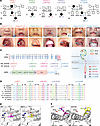 Figure 1
Heterozygous missense HER2 variants cause growth impairment and craniofacial malformations. (A) Pedigrees of 5 families. Heterozygous HER2 variants and genotypes of available family members are indicated. Squares denote male family members, circles female family members, open symbols unaffected, and black symbols affected. mut, mutant. (B) Images of affected family members. Arrowheads mark cleft lip (top row), and arrows denote cleft palate (bottom row). For patient F3-II:2, lip and palate images were obtained at the ages of 1 year and 5 years, respectively. (C) Genomic and protein locations of HER2 variants (left) and the topological feature of HER2 in the plasma membrane (right). Variants are represented with stars. HER2 is comprised of an extracellular domain (ECD) with 4 subdomains (I, II, III, and IV), a single transmembrane domain (TM), and a cytoplasmic tyrosine kinase domain (TKD) followed by a C-terminal tail. (D) Protein sequence alignment of HER2 across various vertebrate species reveals the conservation of amino acids affected by the variants. Ser1150 is less conserved, while all other residues are highly conserved. (E) Structural modeling of the p.A87T variant. Ala87 is located on the C-terminal side of the parallel β-sheet in the extracellular domain I. It is buried within a hydrophobic cavity formed by Leu33, Leu85, Leu117, Thr63, and His88. Substituting alanine with threonine introduces a larger side chain containing a polar hydroxyl group, which may cause steric clashes (indicated by red disks) and disrupt the local hydrophobic environment. (F) Structural modeling of the p.R970W variant. Arg970 is positioned on the N-terminal side of Helix-I in the tyrosine kinase domain. Its positively charged side chain forms a salt bridge with Asp838 (indicated by yellow dashed lines). Substitution with tryptophan, which lacks a charged side chain, is predicted to disrupt this electrostatic interaction, potentially destabilizing the kinase domain.
These findings suggest that rare HER2 variants may represent the genetic cause of a human developmental disorder characterized by growth delay, craniofacial malformations, and an array of associated symptoms.
Attenuation of HER2/ERK signaling by patient variants. To investigate the pathogenicity of the HER2 variants, we first assessed the signaling potential of these HER2 variants in Xenopus embryos. We synthesized mRNAs encoding WT or mutant human HER2 and found that the p.A87T variant was expressed at lower levels than WT HER2 or other mutants (Supplemental Figure 3A). In line with a previous study (11), overexpression of WT HER2 potently induced formation of supernumerary tails in 94.9% of embryos by the tailbud stage, a phenotype indicative of ERK pathway activation (12, 13). In contrast, all HER2 variants displayed markedly reduced capacity to elicit this phenotype (Figure 2A). Additionally, overexpression of WT HER2, but not the variants, induced ectopic xbra (a mesoderm marker and ERK cascade target) expression in the ectoderm at stage 10.5, with xbra levels in the circumferential layer of mesoderm cells unchanged (Figure 2B). Her2 is required for cranial neural crest cell (CNCC) induction and migration in Xenopus (14). At the tailbud stage, the impaired CNCC induction and migration in her2-depleted embryos, visualized by twist1 expression in the pharyngeal arches, was largely rescued by WT HER2 overexpression but only partially by the HER2 variants (Figure 2C and Supplemental Figure 3B). Therefore, the patient-derived HER2 variants behave as loss-of-function alleles that are likely to attenuate HER2/ERK signaling in Xenopus embryos.
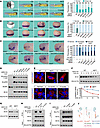 Figure 2
Patient variants impair HER2/ERK signaling. (A) HER2 variants are less effective than WT HER2 in inducing the formation of supernumerary tails. Arrowheads indicate extra tails. Lateral view, anterior to right. Scale bar: 1 mm. Xenopus images were reproduced from Development (35). (B) WT, but not mutant HER2 induces ectopic xbra expression in the ectoderm. Arrowheads indicate ectopic xbra signals in the ectoderm. Lateral view, animal pole to top. Scale bar: 0.5 mm. Xenopus images were reproduced from Development (35). (C) HER2 variants are less efficient than WT HER2 in rescuing impaired twist1 expression in her2-depleted embryos. twist1 expression was detected in the 4 streams of CNCCs migrating towards the pharyngeal arches (marked by white dashed circles): the mandibular (no. 1), hyoid (no. 2), anterior branchial (no. 3), and posterior branchial (no. 4) streams. Lateral view, anterior to left. Scale bar: 0.5 mm. (D) Patient variants reduce HER2 and ERK activities. HER2 knockout HEK293T cells were transfected, stimulated with EGF, and harvested for immunoblot analysis. (E) p.A87T, p.G603S, and p.R970W variants disrupt HER2 membrane localization. Hela cells were transfected and processed for immunofluorescent analysis. Scale bar: 10 μm. (F) p.A87T HER2 shows shortened half life. HER2 knockout HEK293T cells were transfected, treated with cycloheximide (CHX), and harvested for immunoblot analysis. The quantified HER2 levels normalized to β-ACTIN are at the bottom. (G) Bafilomycin A1 (BFA1) partially normalizes p.A87T HER2 expression level. HER2 knockout HEK293T cells were transfected, treated with BFA1, and harvested for immunoblot analysis. (H) p.S1151W variant abolishes HER2 phosphorylation at Ser1151. HER2 knockout HEK293T cells were transfected, stimulated with EGF, and harvested for immunoprecipitation (IP) and immunoblot analysis. (I) p.T1242M HER2 displays diminished threonine phosphorylation. The experiment was performed as in panel H, except that the p.T1242M variant was used. (J) Summary of the pathogenic mechanisms of HER2 variants.
We next examined the impact of these variants on HER2/ERK signaling and explored their pathogenic mechanisms in cultured cells. When overexpressed in HER2 knockout HEK293T cells, all 5 HER2 variants showed reduced autophosphorylation at Tyr1248 upon EGF stimulation, a readout of HER2 kinase activity (1, 15, 16), and a diminished capacity to induce ERK phosphorylation relative to WT HER2 (Figure 2D and Supplemental Figure 4). Membrane localization is a prerequisite for HER2 signaling activity (1). Upon ectopic expression in Hela cells, WT HER2, and the p.S1151W and p.T1242M variants displayed strong membrane localization, whereas p.A87T, p.G603S, and p.R970W variants were mislocalized to the cytoplasm (Figure 2E). Notably, consistent with the results in Xenopus embryos, the p.A87T variant exhibited clearly lower expression levels compared with WT HER2, pointing to compromised protein stability (Figure 2D). This was confirmed by cycloheximide chase assay that clearly demonstrated a reduced half life of p.A87T HER2 (Figure 2F). Moreover, the reduced expression level of p.A87T HER2 could be partially restored following a 10-hour treatment with the lysosome inhibitor Bafilomycin A1 (BFA1), arguing that this variant is intrinsically unstable and targeted to lysosome for degradation (Figure 2G). PFKFB3 (6-Phosphofructo-2-Kinase/Fructose-2,6-Biphosphatase 3)-induced HER2 phosphorylation at Ser1151 has been shown to be required for its kinase activity (Supplemental Figure 4D) (17, 18). Consistently, a phospho-specific HER2 antibody targeting Ser1151 showed a complete loss of signal for p.S1151W variant compared with WT HER2 (Figure 2H). Since Thr1242 has also been identified as a phosphorylation site (19), we tested whether p.T1242M variant could disrupt Thr1242 phosphorylation and thus impair HER2 kinase activity. As expected, a phospho-threonine antibody showed a weaker signal for the p.T1242M variant compared with WT HER2 (Figure 2I). Thus, the patient-derived HER2 variants are bona fide loss-of-function alleles that cannot sustain proper HER2/ERK signaling and impair protein function through different mechanisms: the p.A87T, p.G603S, and p.R970W variants disrupt membrane localization; the p.A87T variant additionally undermines protein stability; and the p.S1151W and p.T1242M variants abolish site-specific phosphorylation (Figure 2J). Together, these results from cultured cells demonstrate that the patient-derived HER2 variants are bona fide loss-of-function alleles that dampen HER2/ERK signaling.
Based on the functional evidence from Xenopus embryos and mammalian cells establishing loss-of-function effects, and following the ACMG-AMP guidelines (American College of Medical Genetics and Genomics and the Association for Molecular Pathology) (20), we classified these 5 HER2 variants as pathogenic (Supplemental Table 2).
Growth delay and craniofacial anomalies in Her2 knock-in mice. To delineate the potential roles of HER2 in mammalian growth and craniofacial development, we analyzed its spatiotemporal expression patterns in murine growth plates and embryonic craniofacial tissues. HER2 exhibited predominant localization to proliferating chondrocytes within the growth plate at postnatal day 21 (P21), consistent with its expression pattern observed during embryonic stages (9) (Figure 3, A–C). In craniofacial structures, robust HER2 expression was observed in CNC-derived mesenchyme, ocular primordia, osteogenic lineages of the maxillary and mandibular prominences, and the midline epithelial seam during palatal shelf fusion (Figure 3, D–O). These results suggest that HER2 may play a pleiotropic role in mammalian longitudinal bone growth and craniofacial morphogenesis.
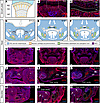 Figure 3
HER2 is expressed in growth plate proliferating chondrocytes and craniofacial tissues in mice. (A) Schematic diagram of mouse growth plate. RZ, resting zone; PZ, proliferating zone; HZ, hypertrophic zone. (B and C) Immunostaining of HER2 (red) in the P21 mouse proximal tibial growth plate shows its predominant expression in proliferating chondrocytes. The boxed region in panel B is shown at higher magnification in panel C. (D–F) Schematic diagrams of coronal sections of mouse craniofacial region at indicated stages (36, 37). (G–I) Overview of HER2 immunostaining (red) in coronal sections of mouse heads at E13.5, E15.0, and E15.5. Aside from epidermis and oral epithelium, HER2 is also expressed in the eyes and cranial neural crest–derived (CNC-derived) mesenchyme. (J–L) Magnified views of the maxillary region from panels G–I. HER2 shows strong expression in the differentiated osteoblasts and osteogenic front (green dashed circles in panels K and L) and the tooth germs (white dashed lines in panels J–L). In addition, HER2 expression is detected in midline epithelial seam formed by the fusing palatal shelves at E15.0 and diminishes as the seam underwent degradation at E15.5 (white arrowheads in panels K and L). (M–O) Magnified views of the mandibular region from panels G–I. Strong HER2 expression is detected in differentiated osteoblasts and osteogenic front (green dashed circles in panels M–O), but not in Meckel’s cartilage and perichondrium (yellow dashed circles in panels M–O). HER2 expression is also observed in the mandibular tooth germs (white dashed lines in panels M–O) and in the tongue muscle (white arrows in panels N and O). T, tongue; PS, palatal shelf; SP, secondary palate; MES, midline epithelial seam; CNC, cranial neural crest. Scale bar: 200 μm in all panels.
To model the pathogenic effects of HER2 variants, we generated a knock-in mouse line harboring the patient-derived p.A87T variant, selected for its detrimental effects on HER2 membrane localization and stability (Supplemental Figure 5, A and B). While heterozygous Her2 p.A87T knock-in mice were healthy and viable, homozygous mutant mice exhibited incomplete preweaning lethality by P21, indicating that the p.A87T allele is partially lethal (Supplemental Figure 5C). To investigate whether embryonic lethality contributed to the partial postnatal mortality, we performed timed mating and analyzed embryonic survival at key gestational stages. At E13.5, the observed mutant embryo ratio conformed well to the expected Mendelian distribution. Strikingly, by E18.5, the proportion of recovered mutant embryos plummeted to 17.3% (119 of 688), a substantial deviation from the anticipated 25%, indicating that approximately 30% of mutant embryos succumbed between E13.5 and E18.5 (Supplemental Figure 5C).
We next characterized the developmental phenotypes in the surviving mutant embryos and juvenile mice. At P21, a portion of surviving mutant mice (22.7%, 5 of 22) displayed pronounced reduction in both body size and body weight, replicating the growth delay observed in the patients (Figure 4A). Among the surviving mutant embryos at E18.5, 7.6% (9 of 119) of them exhibited intrauterine growth restriction, as evidenced by the severe reduction in crown-rump length (Figure 4, B–D). Moreover, the mutant embryos presented a spectrum of craniofacial anomalies, including ocular defect (anophthalmia, 5.0%, 6 of 119), maxillary and mandibular hypoplasia (12.6%, 15 of 119), and cleft palate (4.2%, 5 of 119) (Figure 4, B and E–H, Supplemental Figure 6, and Supplemental Figure 7A). In line with the normal neurological and cognitive findings in our patients (Table 1), we observed no significant differences in cognitive performance among WT, heterozygous, and homozygous Her2 p.A87T knock-in mice (Supplemental Figure 8).
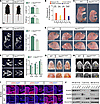 Figure 4
Her2 p.A87T knock-in mice exhibit growth deficits and craniofacial anomalies. (A) Her2A87T/A87T mice display reduced body length and weight at P21. Representative images (left; scale bar: 1 cm) and quantification (right; n = 4 per genotype; **P < 0.01) are shown. (B) Penetrance of developmental defects in E18.5 Her2A87T/A87T embryos, including reduced crown-rump length (CRL), ocular defects, maxillary (Mx) and mandibular (Md) hypoplasia, and cleft palate. MUT, mutant. (C and D) Her2A87T/A87T embryos (7.56%, 9 of 119) display reduced crown-rump length. Representative stereomicroscope images (C) and microcomputed tomography images (D) of E18.5 embryos (scale bar: 2 mm) and quantification (n = 4 per genotype; ***P < 0.001) are shown. (E) Her2A87T/A87T embryos exhibit maxillary and mandibular hypoplasia (12.6%, 15 of 119) and ocular defects (anophthalmia, 5.04%, 6 of 119) at E18.5. Dashed lines with double arrowheads indicate maxillary (top) and mandibular (bottom) lengths. Arrows indicate missing eyes. Each column corresponds to the same embryo. R, right view; L, left view. Scale bar: 2 mm. (F) Microcomputed tomography images of E18.5 craniofacial skeleton confirming reduced maxillary and mandibular lengths and narrower skull width in Her2A87T/A87T embryos. Scale bar: 2 mm. Quantification is shown (n = 4 per genotype; *P < 0.05, **P < 0.01). (G) Her2A87T/A87T embryos (4.2%, 5 of 119) exhibit cleft palate at E18.5. Boxed regions are magnified in the bottom. Arrows indicate complete (middle) or incomplete (right) cleft palate. Scale bar: 1 mm. (H) Representative scanning electron micrographs confirming the cleft palate in Her2A87T/A87T embryos shown in panel G. Scale bar: 1 mm. (I and J) Immunofluorescence (I) and immunoblot (J) showing reduced HER2 and phospho-ERK (pERK) signals, but unchanged ERK level, in the palate shelf (PS), mandible (Md), and tongue (T) of E13.5 Her2A87T/A87T embryos. Boxed regions in panel I are magnified on the right. Scale bar: 200 μm. MUT, mutant. Unpaired t tests (A, D, and F).
The prenatal growth delay and craniofacial anomalies in Her2 p.A87T knock-in mice show substantial overlap with those reported in ERK-deficient mice (21, 22). Combined with our cell culture results, these findings imply that HER2 likely mediates its effects predominantly via the ERK pathway during these developmental processes. Indeed, a marked allele-dosage–dependent reduction in HER2 expression and ERK phosphorylation was evident in the craniofacial region of mutant embryos at E13.5 (Figure 4I). In addition, palatal, tongue, and mandibular tissues in mutant mice all exhibited a marked decline in HER2 expression and ERK phosphorylation relative to their WT littermates at E13.5 (Figure 4J).
Taken together, these findings in Her2 p.A87T knock-in mice unveil that HER2 deficiency directly induces prenatal and postnatal growth delay and diverse craniofacial anomalies, mediated through diminished HER2/ERK signaling.
Growth delay and craniofacial anomalies induced by maternal exposure to Tucatinib in mice. To further substantiate the causal link between HER2 deficiency and human growth delay and craniofacial malformations, we evaluated the embryonic and postnatal developmental outcomes of pharmacological inhibition of HER2 in mice. Tucatinib is an oral, HER2-specific small-molecule tyrosine kinase inhibitor recently approved for the treatment of previously treated HER2-positive metastatic breast cancer and colorectal cancer (23–25). To bypass the midgestational lethality caused by cardiac defects, as observed in Her2-null embryos (6), we administered Tucatinib orally once daily to pregnant WT C57BL/6J dams from E10.5, the developmental stage at which Her2-null embryos die, until E15.5. Offspring were assessed at P21 to evaluate body size and body weight, or dams were sacrificed at E18.5 to analyze fetal outcomes (Figure 5A).
 Figure 5
Maternal exposure to Tucatinib results in growth deficits and craniofacial anomalies in mice. (A) Schematic of Tucatinib administration. (B) Immunoblot showing reduced HER2 and pERK levels in E15.5 palate shelves following Tucatinib treatment. (C) Mice exposed to Tucatinib exhibit reduced body length and weight at P21. Representative images (left; scale bar: 1 cm) and quantification (right; n = 4 per group; **P < 0.01) are shown. (D) Penetrance of developmental defects in E18.5 embryos exposed to Tucatinib, including reduced crown-rump length (CRL), ocular defects, maxillary (Mx) and mandibular (Md) hypoplasia, and cleft palate. *P < 0.05, **P < 0.01, ***P < 0.001. (E and F) Tucatinib-treated embryos (35.14%, 26 of 74) display reduced crown-rump length. Representative stereomicroscope images (E) and microcomputed tomography images (F) of E18.5 mouse embryos (scale bar: 2 mm) treated with vehicle or Tucatinib and quantification (n = 4 per group; ***P < 0.001) are shown. (G) Tucatinib-treated embryos exhibit ocular defects (microphthalmia, 12.16%, 9 of 74; anophthalmia, 9.46%, 7 of 74) and maxillary and mandibular hypoplasia (18.92%, 14 of 74) at E18.5. Dashed lines with double arrowheads indicate maxillary and mandible lengths. Black arrow, microphthalmic eye; white arrows, missing eyes. Insets show the contralateral eye. Scale bar: 2 mm. (H) Microcomputed tomography images of E18.5 craniofacial skeletons confirming reduced maxillary and mandibular lengths and narrower skull width following Tucatinib exposure. Scale bar: 2 mm. Quantification (right; n = 4 per group; ***P < 0.001) is shown. (I) Tucatinib treatment induces cleft palate (9.5%, 7 of 74) in E18.5 embryos. Scanning electron micrographs show complete (middle) or incomplete (right) cleft palate. Yellow arrowheads indicate cleft; dashed lines mark unfused palate shelves. Scale bar: 2 mm. Unpaired t tests (C, F, and H) and χ2 tests (D).
While Tucatinib treatment was well tolerated by the pregnant dams, it potently suppressed HER2 and ERK activities in the offspring (Figure 5B). Remarkably, at P21, Tucatinib treatment led to significant reduction in both body size and body weight in 41.2% (14 of 34) of the offspring (Figure 5C). At E18.5, 35.1% (26 of 74) of embryos prenatally exposed to Tucatinib displayed significantly reduced crown-rump length, confirming intrauterine growth restriction (Figure 5, D–F). In addition, maternal exposure to Tucatinib also resulted in a wide range of craniofacial anomalies in offspring, including ocular defects (microphthalmia, 12.2%, 9 of 74; anophthalmia, 9.5%, 7 of 74), maxillary and mandibular hypoplasia (18.9%, 14 of 74), and cleft palate (9.5%, 7 of 74) (Figure 5, D and G–I, and Supplemental Figure 7B). These defects were virtually indistinguishable from those in Her2 p.A87T knock-in mice, but they occurred at a notably higher frequency, presumably due to the circumvention of early embryonic lethality.
Collectively, the replication of both prenatal and postnatal growth delay and craniofacial anomalies by maternal exposure to Tucatinib in mice offers unequivocal evidence that HER2 deficiency acts as a key driver for these developmental defects.


Copyright © 2026 American Society for Clinical Investigation
ISSN: 0021-9738 (print), 1558-8238 (online)