
Abstract
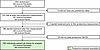
BACKGROUND Statin therapy lowers the risk of major adverse cardiovascular events (MACE) among people with HIV (PWH). Residual risk pathways contributing to excess MACE beyond LDL-cholesterol (LDL-C) are not well understood. Our objective was to evaluate the association of statin-responsive and other inflammatory and metabolic pathways with MACE in the Randomized Trial to Prevent Vascular Events in HIV (REPRIEVE).METHODS Cox proportional hazards models were used to assess the relationship between MACE and proteomics measurements at study entry and year 2, adjusting for time-updated statin use and the baseline 10-year atherosclerotic cardiovascular disease risk score. We built a machine-learning (ML) model to predict MACE using baseline protein values with significant associations.RESULTS For 765 individuals (age: 50.8 ± 5.9 years, 82% men, 18% women), among 7 proteins changing with statin versus placebo, angiopoietin-related protein 3 (ANGPTL3) related most strongly to MACE (adjusted HR [aHR]: 2.31 per 2-fold-higher levels; 95% CI: 1.11–4.80; P = 0.03), such that lower levels of ANGPTL3 achieved with statin therapy were associated with lower MACE risk. Among 248 proteins that did not change in response to statin therapy, 26 were associated with MACE at a FDR below 0.05. These proteins represented a predominantly humoral immune response, leukocyte chemotaxis, and cytokine pathways. Our proteomics ML model achieved a 10-fold cross-validated concordance index (C-index) of 0.74 ± 0.11 to predict MACE, improving on models using traditional risk prediction scores only (C-index: 0.61 ± 0.18).CONCLUSIONS ANGPTL3, as well as key inflammatory pathways, may contribute to a residual risk of MACE among PWH, beyond LDL-C.TRIAL REGISTRATION ClinicalTrials.gov: NCT02344290.FUNDING NIH, Kowa Pharmaceuticals America, Gilead Sciences, ViiV Healthcare.
Authors
Márton Kolossváry, Irini Sereti, Markella V. Zanni, Carl J. Fichtenbaum, Judith A. Aberg, Gerald S. Bloomfield, Carlos D. Malvestutto, Judith S. Currier, Sarah M. Chu, Marissa R. Diggs, Alex B. Lu, Christopher deFilippi, Borek Foldyna, Sara McCallum, Craig A. Sponseller, Michael T. Lu, Pamela S. Douglas, Heather J. Ribaudo, Steven K. Grinspoon
This file is in Adobe Acrobat (PDF) format. If you have not installed and configured the Adobe Acrobat Reader on your system.
Having trouble reading a PDF?
PDFs are designed to be printed out and read, but if you prefer to read them online, you may find it easier if you increase the view size to 125%.
Having trouble saving a PDF?
Many versions of the free Acrobat Reader do not allow Save. You must instead save the PDF from the JCI Online page you downloaded it from. PC users: Right-click on the Download link and choose the option that says something like "Save Link As...". Mac users should hold the mouse button down on the link to get these same options.
Having trouble printing a PDF?
- Try printing one page at a time or to a newer printer.
- Try saving the file to disk before printing rather than opening it "on the fly." This requires that you configure your browser to "Save" rather than "Launch Application" for the file type "application/pdf", and can usually be done in the "Helper Applications" options.
- Make sure you are using the latest version of Adobe's Acrobat Reader.
ICMJE disclosure forms - Download (833.24 KB)


Copyright © 2026 American Society for Clinical Investigation
ISSN: 0021-9738 (print), 1558-8238 (online)