
Abstract
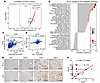
CD24 promotes prostate cancer progression and metastasis by disrupting the ARF-NPM interaction and impairing p53 signaling. However, the mechanisms underlying CD24-driven metastasis remain unclear. This study identifies a novel interaction between CD24 and Regulator of Chromosome Condensation 2 (RCC2), a protein involved in cell proliferation and migration. IHC analysis of prostate adenocarcinoma samples showed frequent coexpression of CD24 (49%) and RCC2 (82%) with a positive correlation between coexpression of CD24 (49%) and RCC2 (82%). Functional assays revealed complex roles: RCC2 KO suppressed proliferation but increased migration and invasion, while CD24 KO reduced both proliferation and migration. Dual KO of CD24 and RCC2 further inhibited proliferation but had varied effects on migration. In mouse xenografts, RCC2 KO increased lung metastasis without significantly affecting primary tumor growth, while CD24 KO reduced both tumor growth and metastasis. Mechanistically, RCC2 controls migration by promoting ubiquitination and degradation of vimentin, affecting cytoskeletal dynamics. In contrast, CD24 targets RCC2 for degradation, thereby regulating β-catenin signaling. Notably, RCC2 KO enhances β-catenin activity by suppressing inhibitors AXIN2 and APC, whereas CD24 KO inhibits this pathway. These findings reveal a regulatory loop where CD24 and RCC2 reciprocally control proliferation and metastasis, positioning the CD24-RCC2 axis as a promising therapeutic target in prostate cancer.
Authors
Xuelian Cui, Yicun Wang, Chao Zhang, Zhichao Liu, Haiyan Yu, Lizhong Wang, Jiangbing Zhou, Runhua Liu
This file is in Adobe Acrobat (PDF) format. If you have not installed and configured the Adobe Acrobat Reader on your system.
Having trouble reading a PDF?
PDFs are designed to be printed out and read, but if you prefer to read them online, you may find it easier if you increase the view size to 125%.
Having trouble saving a PDF?
Many versions of the free Acrobat Reader do not allow Save. You must instead save the PDF from the JCI Online page you downloaded it from. PC users: Right-click on the Download link and choose the option that says something like "Save Link As...". Mac users should hold the mouse button down on the link to get these same options.
Having trouble printing a PDF?
- Try printing one page at a time or to a newer printer.
- Try saving the file to disk before printing rather than opening it "on the fly." This requires that you configure your browser to "Save" rather than "Launch Application" for the file type "application/pdf", and can usually be done in the "Helper Applications" options.
- Make sure you are using the latest version of Adobe's Acrobat Reader.
Unedited blot and gel images - Download (1.48 MB)


Copyright © 2026 American Society for Clinical Investigation
ISSN: 0021-9738 (print), 1558-8238 (online)