
Abstract
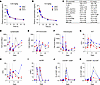
Despite the success of antiretroviral therapy in controlling HIV replication, latent viral reservoirs persist, presenting a major barrier to a cure. Current treatment approaches that aim to reactivate latent virus and eliminate infected cells, termed “shock and kill,” hold promise but have yet to demonstrate meaningful reservoir reduction in vivo. In this study, we explored combining ciapavir, a Smac mimetic latency-reversing agent, with adeno-associated virus–delivered (AAV-delivered) eCD4-Ig to treat antiretroviral therapy–suppressed, SHIV-infected rhesus macaques. We could demonstrate that a Smac mimetic can induce modest reactivation of the latent SHIV reservoir, as evidenced by transient increases in plasma viremia. However, while AAV-expressed eCD4-Ig conferred partial protection against intrarectal SHIV challenge in uninfected animals, neither eCD4-Ig nor ciapavir reduced the viral reservoir in SHIV-infected rhesus macaques, as determined by total SHIV DNA and a 5-target intact provirus detection assay. Animals treated with the combination showed no significant differences in viral rebound kinetics post–analytical treatment interruption compared with controls. Additionally, repeated ciapavir dosing resulted in adverse effects in some animals, suggesting potential toxicity with repeat administration. These findings highlight the challenges in reducing viral reservoirs using this shock-and-kill approach, particularly in SHIV-infected models, and suggest that further optimization of both latency-reversing agent and immune-mediated clearance strategies is required.
Authors
Lars Pache, John K. Bui, Lindsay M. Klouser, Christine M. Fennessey, Alexander C. Noyola, Teresa Einhaus, Haiying Zhu, Laurence Stensland, Isai Leguizamo, Abubakarr A. Koroma, Peter Teriete, W.L. William Chang, Ollivier Hyrien, Natasha N. Duggan, Dominik Heimann, Ailyn C. Pérez-Osorio, Katharine J. Bar, Nicholas D.P. Cosford, Brandon F. Keele, Dennis J. Hartigan-O’Connor, Michael Farzan, Matthew R. Gardner, Keith R. Jerome, Sumit K. Chanda, Hans-Peter Kiem, Christopher W. Peterson
This file is in Adobe Acrobat (PDF) format. If you have not installed and configured the Adobe Acrobat Reader on your system.
Having trouble reading a PDF?
PDFs are designed to be printed out and read, but if you prefer to read them online, you may find it easier if you increase the view size to 125%.
Having trouble saving a PDF?
Many versions of the free Acrobat Reader do not allow Save. You must instead save the PDF from the JCI Online page you downloaded it from. PC users: Right-click on the Download link and choose the option that says something like "Save Link As...". Mac users should hold the mouse button down on the link to get these same options.
Having trouble printing a PDF?
- Try printing one page at a time or to a newer printer.
- Try saving the file to disk before printing rather than opening it "on the fly." This requires that you configure your browser to "Save" rather than "Launch Application" for the file type "application/pdf", and can usually be done in the "Helper Applications" options.
- Make sure you are using the latest version of Adobe's Acrobat Reader.
Supplemental data - Download (2.73 MB)


Copyright © 2026 American Society for Clinical Investigation
ISSN: 0021-9738 (print), 1558-8238 (online)