
Review

Abstract
The abrupt cessation of effective cardiac function due to an aberrant heart rhythm can cause sudden and unexpected death at any age, a syndrome called sudden cardiac death (SCD). Annually, more than 300,000 cases of SCD occur in the United States alone, making this a major public health concern. Our current understanding of the mechanisms responsible for SCD has emerged from decades of basic science investigation into the normal electrophysiology of the heart, the molecular physiology of cardiac ion channels, fundamental cellular and tissue events associated with cardiac arrhythmias, and the molecular genetics of monogenic disorders of heart rhythm. This knowledge has helped shape the current diagnosis and treatment of inherited arrhythmia susceptibility syndromes associated with SCD and has provided a pathophysiological framework for understanding more complex conditions predisposing to this tragic event. This Review presents an overview of the molecular basis of SCD, with a focus on monogenic arrhythmia syndromes.
Authors
Alfred L. George Jr.

Abstract
This article discusses current understanding of myocardial biology, emphasizing the regeneration potential of the adult human heart and the mechanisms involved. In the last decade, a novel conceptual view has emerged. The heart is no longer considered a postmitotic organ, but is viewed as a self-renewing organ characterized by a resident stem cell compartment responsible for tissue homeostasis and cardiac repair following injury. Additionally, HSCs possess the ability to transdifferentiate and acquire the cardiomyocyte, vascular endothelial, and smooth muscle cell lineages. Both cardiac and hematopoietic stem cells may be used therapeutically in an attempt to reverse the devastating consequences of chronic heart failure of ischemic and nonischemic origin.
Authors
Piero Anversa, Jan Kajstura, Marcello Rota, Annarosa Leri

Abstract
Advances in understanding the molecular basis of myocardial dysfunction, together with the evolution of increasingly efficient gene transfer technology, make gene-based therapy a promising treatment option for heart conditions. Cardiovascular gene therapy has benefitted from recent advancements in vector technology, design, and delivery modalities. There is a critical need to explore new therapeutic approaches in heart failure, and gene therapy has emerged as a viable alternative. Advances in understanding of the molecular basis of myocardial dysfunction, together with the development of increasingly efficient gene transfer technology, has placed heart failure within reach of gene-based therapy. The recent successful and safe completion of a phase 2 trial targeting the cardiac sarcoplasmic/endoplasmic reticulum Ca2+ ATPase pump (SERCA2a) has the potential to open a new era for gene therapy for heart failure.
Authors
Roger J. Hajjar

Abstract
The discovery of the genetic basis of inherited arrhythmias has paved the way for an improved understanding of arrhythmogenesis in a wide spectrum of life-threatening conditions. In vitro expression of mutations and transgenic animal models have been instrumental in enhancing this understanding, but the applicability of results to the human heart remains unknown. The ability to differentiate induced pluripotent stem cells (iPSs) into cardiomyocytes enables the potential to generate patient-specific myocytes, which could be used to recapitulate the features of inherited arrhythmias in the context of the patient’s genetic background. Few studies have been reported on iPS-derived myocytes obtained from patients with heritable arrhythmias, but they have demonstrated the applicability of this innovative approach to the study of inherited arrhythmias. Here we review the results achieved by iPS investigations in arrhythmogenic syndromes and discuss the existing challenges to be addressed before the use of iPS-derived myocytes can become a part of personalized management of inherited arrhythmias.
Authors
Silvia G. Priori, Carlo Napolitano, Elisa Di Pasquale, Gianluigi Condorelli
Abstract
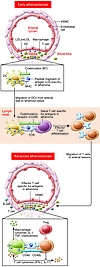
Many remarkable advances have improved our understanding of the cellular and molecular events in the pathogenesis of atherosclerosis. Chief among these is the accumulating knowledge of how the immune system contributes to all phases of atherogenesis, including well-known inflammatory reactions consequent to intimal trapping and oxidation of LDL. Advances in our understanding of the innate and adaptive responses to these events have helped to clarify the role of inflammation in atherogenesis and suggested new diagnostic modalities and novel therapeutic targets. Here we focus on recent advances in understanding how adaptive immunity affects atherogenesis.
Authors
Andrew H. Lichtman, Christoph J. Binder, Sotirios Tsimikas, Joseph L. Witztum

Abstract
Delivery of oxygen to tissues is the primary function of the cardiovascular system. NO, a gasotransmitter that signals predominantly through protein
Authors
Saptarsi M. Haldar, Jonathan S. Stamler

Abstract
Recent clinical and experimental studies are redefining the cellular and molecular bases of pulmonary arterial hypertension (PAH). The genetic abnormalities first identified in association with the idiopathic form of PAH — together with a vast increase in our understanding of cell signaling, cell transformation, and cell-cell interactions; gene expression; microRNA processing; and mitochondrial and ion channel function — have helped explain the abnormal response of vascular cells to injury. Experimental and clinical studies now converge on the intersection and interactions between a genetic predisposition involving the BMPR2 signaling pathway and an impaired metabolic and chronic inflammatory state in the vessel wall. These deranged processes culminate in an exuberant proliferative response that occludes the pulmonary arterial (PA) lumen and obliterates the most distal intraacinar vessels. Here, we describe emerging therapies based on preclinical studies that address these converging pathways.
Authors
Marlene Rabinovitch

Abstract
Fragile X syndrome (FXS) is the most frequent form of inherited intellectual disability and is also linked to other neurologic and psychiatric disorders. FXS is caused by a triplet expansion that inhibits expression of the FMR1 gene; the gene product, FMRP, regulates mRNA metabolism in the brain and thus controls the expression of key molecules involved in receptor signaling and spine morphology. While there is no definitive cure for FXS, the understanding of FMRP function has paved the way for rational treatment designs that could potentially reverse many of the neurobiological changes observed in FXS. Additionally, behavioral, pharmacological, and cognitive interventions can raise the quality of life for both patients and their families.
Authors
Claudia Bagni, Flora Tassone, Giovanni Neri, Randi Hagerman

Abstract
There is an ever-growing demand for transplantable organs to replace acute and chronically damaged tissues. This demand cannot be met by the currently available donor organs. Efforts to provide an alternative source have led to the development of organ engineering, a discipline that combines cell biology, tissue engineering, and cell/organ transplantation. Over the last several years, engineered organs have been implanted into rodent recipients and have shown modest function. In this article, we summarize the most recent advances in this field and provide a perspective on the challenges of translating this promising new technology into a proven regenerative therapy.
Authors
Alejandro Soto-Gutierrez, Jason A. Wertheim, Harald C. Ott, Thomas W. Gilbert

Abstract
Spinal cord injury (SCI) is a devastating condition producing great personal and societal costs and for which there is no effective treatment. Stem cell transplantation is a promising therapeutic strategy, though much preclinical and clinical research work remains. Here, we briefly describe SCI epidemiology, pathophysiology, and experimental and clinical stem cell strategies. Research in stem cell biology and cell reprogramming is rapidly advancing, with the hope of moving stem cell therapy closer to helping people with SCI. We examine issues important for clinical translation and provide a commentary on recent developments, including termination of the first human embryonic stem cell transplantation trial in human SCI.
Authors
Andrea J. Mothe, Charles H. Tator
No posts were found with this tag.


Copyright © 2026 American Society for Clinical Investigation
ISSN: 0021-9738 (print), 1558-8238 (online)