
Submit a comment
Abstract
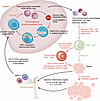
Cancer-associated extramedullary hematopoiesis is increasingly recognized as a systemic mechanism of immune evasion. Although the spleen is an important site of tumor-induced myelopoiesis, how this process is locally maintained remains incompletely understood. In this issue of the JCI, Zhu and colleagues identify a self-reinforcing circuit between tumor-associated neutrophils and splenic hematopoietic stem and progenitor cells (HSPCs). They show that neutrophil-derived, NOX2-dependent ROS activated forkhead box O1 (FOXO1) in neighboring HSPCs, inducing dynamin-related protein 1 dependent (DRP1-dependent) mitochondrial fission and a myeloid-biased, granulocyte-macrophage CSF–producing (GM-CSF–producing) progenitor state. The resulting neutrophil progeny further reinforced oxidative stress, thereby sustaining immunosuppressive myelopoiesis in the spleen. Disruption of this circuit through genetic, pharmacologic, or spleen-directed interventions reduced suppressive myeloid cell production, enhanced cytotoxic T cell activity, and restrained tumor growth. These findings establish mature neutrophils as active regulators of pathological splenic hematopoiesis and identify the neutrophil/ROS/FOXO1/DRP1 axis as a potential therapeutic target in cancer.
Authors
Hongpeng Jia
Guidelines
The Editorial Board will only consider comments that are deemed relevant and of interest to readers. The Journal will not post data that have not been subjected to peer review; or a comment that is essentially a reiteration of another comment.
- Comments appear on the Journal’s website and are linked from the original article’s web page.
- Authors are notified by email if their comments are posted.
- The Journal reserves the right to edit comments for length and clarity.
- No appeals will be considered.
- Comments are not indexed in PubMed.
Specific requirements
- Maximum length, 400 words
- Entered as plain text or HTML
- Author’s name and email address, to be posted with the comment
- Declaration of all potential conflicts of interest (even if these are not ultimately posted); see the Journal’s conflict-of-interest policy
- Comments may not include figures


Copyright © 2026 American Society for Clinical Investigation
ISSN: 0021-9738 (print), 1558-8238 (online)