
Submit a comment
Abstract
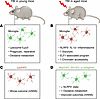
Traumatic brain injury (TBI) disproportionately kills and disables older adults, yet the biology driving this vulnerability remains unresolved. In this issue of the JCI, Lu et al. combined single-cell transcriptomics, metabolomics, and chromatin profiling in mice, validated in human TBI tissue, to define an age-dependent microglial dichotomy. They report that an NLRP3+/IL-1β–linked state dominates the aged brain, while a Lysozyme+/Lyz2+ state predominates in the young. Microglia-targeted perturbation of NLRP3 and ELF1 each shifted the balance and improved survival in mouse models of TBI, and the repurposed drug Imeglimin improved outcomes in these models, confirming that this pathway is druggable. By connecting NLRP3 inflammasome dominance, ELF1-driven transcription, and glycolytic reprogramming to the loss of a protective Lyz2+ response, this work converts age from a clinical risk factor to a set of druggable microglial targets.
Authors
Josh M. Morganti, Adam D. Bachstetter
Guidelines
The Editorial Board will only consider comments that are deemed relevant and of interest to readers. The Journal will not post data that have not been subjected to peer review; or a comment that is essentially a reiteration of another comment.
- Comments appear on the Journal’s website and are linked from the original article’s web page.
- Authors are notified by email if their comments are posted.
- The Journal reserves the right to edit comments for length and clarity.
- No appeals will be considered.
- Comments are not indexed in PubMed.
Specific requirements
- Maximum length, 400 words
- Entered as plain text or HTML
- Author’s name and email address, to be posted with the comment
- Declaration of all potential conflicts of interest (even if these are not ultimately posted); see the Journal’s conflict-of-interest policy
- Comments may not include figures


Copyright © 2026 American Society for Clinical Investigation
ISSN: 0021-9738 (print), 1558-8238 (online)