
Submit a comment
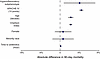
Abstract
BACKGROUND Sepsis encompasses considerable biological and clinical heterogeneity. Previously, 2 phenotypes (“hyperinflammatory” and “hypoinflammatory”) have been consistently identified within sepsis via latent class analysis. These phenotypes differ in their biological features, clinical outcomes, and therapeutic responses to interventions. Prior studies of sepsis heterogeneity have focused primarily on the host response. Here, we investigate the potential influence of the causative pathogen on sepsis heterogeneity and pathobiology.METHODS We performed a retrospective observational analysis of 8,280 critically ill patients with sepsis to identify associations between pathogen characteristics and the hyperinflammatory and hypoinflammatory patient phenotypes. We also performed controlled murine and swine modeling of sepsis and lung injury and a secondary analysis of 449 patients enrolled in the EUPHRATES randomized controlled trial.RESULTS Pathogen characteristics (pathogen identity, burden, virulence, and anatomic site of infection) were strongly and independently associated with the previously reported phenotypes. In a cohort of critically ill patients with sepsis, infection with gram-negative pathogens, primarily Enterobacterales spp. (e.g., Escherichia coli, Klebsiella pneumoniae), was strongly associated with the hyperinflammatory phenotype. The hyperinflammatory phenotype was also independently associated with increased pathogen burden, virulence, and initial anatomic site of infection. In controlled murine and swine modeling, both the identity and burden of the pathogen provoked key biological features of the hyperinflammatory phenotype. Among patients with sepsis, the prognostic value of lactate clearance varied substantially by phenotype. In a secondary analysis of a randomized trial of polymyxin B hemoadsorption (which removes circulating endotoxin), hypoinflammatory patients experienced worse survival.CONCLUSIONS Our results demonstrate the central importance of pathogen features in the clinical and biological heterogeneity of sepsis. Future studies of sepsis pathobiology and heterogeneity should expand their scope beyond the host response, as understanding pathogen-host interactions will be crucial in the development of precision therapeutic strategies to improve patient outcomes.TRIAL REGISTRATION EUPHRATES trial NCT01046669.FUNDING 5P30AG024824, IK2CX002766, R01HL144599, K24HL159247, R01HL158626, R01HL173531, R35GM142992, R35GM145330, R35GM136312, K23HL166880, R35HL140026.
Authors
Rishi Chanderraj, Brian Bartek, Kathleen A. Stringer, Mohamad H. Tiba, Michael W. Sjoding, Ying He, Mark Nuppnau, Kale S. Bongers, Mark D. Adame, Sunny S. Lou, V. Eric Kerschberger, Matthew M. Churpek, Carolyn S. Calfee, Sandhya Tripathi, Debra M. Foster, John A. Kellum, Robert P. Dickson, Pratik Sinha
Guidelines
The Editorial Board will only consider comments that are deemed relevant and of interest to readers. The Journal will not post data that have not been subjected to peer review; or a comment that is essentially a reiteration of another comment.
- Comments appear on the Journal’s website and are linked from the original article’s web page.
- Authors are notified by email if their comments are posted.
- The Journal reserves the right to edit comments for length and clarity.
- No appeals will be considered.
- Comments are not indexed in PubMed.
Specific requirements
- Maximum length, 400 words
- Entered as plain text or HTML
- Author’s name and email address, to be posted with the comment
- Declaration of all potential conflicts of interest (even if these are not ultimately posted); see the Journal’s conflict-of-interest policy
- Comments may not include figures


Copyright © 2026 American Society for Clinical Investigation
ISSN: 0021-9738 (print), 1558-8238 (online)