
Go to JCI Insight
  • About
  • Editors
  • Consulting Editors
  • For authors
  • Publication ethics
  • Publication alerts by email
  • Advertising
  • Job board
  • Contact
  • Clinical Research and Public Health
  • Current issue
  • Past issues
  • By specialty
    • COVID-19
    • Cardiology
    • Gastroenterology
    • Immunology
    • Metabolism
    • Nephrology
    • Neuroscience
    • Oncology
    • Pulmonology
    • Vascular biology
    • All ...
  • Videos
    • ASCI Milestone Awards
    • Video Abstracts
    • Conversations with Giants in Medicine
  • Reviews
    • View all reviews ...
    • The cGAS-STING pathway: DNA sensing in health and disease (Jun 2026)
    • Neurodegeneration (Mar 2026)
    • Clinical innovation and scientific progress in GLP-1 medicine (Nov 2025)
    • Pancreatic Cancer (Jul 2025)
    • Complement Biology and Therapeutics (May 2025)
    • Evolving insights into MASLD and MASH pathogenesis and treatment (Apr 2025)
    • Microbiome in Health and Disease (Feb 2025)
    • View all review series ...
  • Viewpoint
  • Collections
    • In-Press Preview
    • Clinical Research and Public Health
    • Research Letters
    • Letters to the Editor
    • Editorials
    • Commentaries
    • Editor's notes
    • Reviews
    • Viewpoints
    • 100th anniversary
    • Top read articles

  • Current issue
  • Past issues
  • Specialties
  • Reviews
  • Review series
  • ASCI Milestone Awards
  • Video Abstracts
  • Conversations with Giants in Medicine
  • In-Press Preview
  • Clinical Research and Public Health
  • Research Letters
  • Letters to the Editor
  • Editorials
  • Commentaries
  • Editor's notes
  • Reviews
  • Viewpoints
  • 100th anniversary
  • Top read articles
  • About
  • Editors
  • Consulting Editors
  • For authors
  • Publication ethics
  • Publication alerts by email
  • Advertising
  • Job board
  • Contact

Submit a comment

Distinct HIF1α and HIF2α functions control skeletal muscle metabolism and erythropoiesis
Junhyeong Lee, Merc Emil Matienzo, Sangyi Lim, Edzel Evallo, Yeongsin Kim, Sujin Jang, Keon Kim, Chang Hyeon Choi, Youn Ho Han, Chang-Min Lee, Tae-Il Jeon, Sang-Ik Park, Jun Wu, Dong-il Kim, Min-Jung Park
View: Text | PDF
Research Article Metabolism Muscle biology

Distinct HIF1α and HIF2α functions control skeletal muscle metabolism and erythropoiesis

  • Text
  • PDF
Abstract

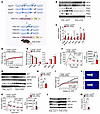
Skeletal muscle frequently encounters hypoxic stress, particularly during exercise, but the specific functions of the hypoxia-inducible factors HIF1α and HIF2α within myofibers remain unclear due to the lack of appropriate in vivo models. Here, we generated 3 complementary mouse models, myofiber-specific triple-PHD knockout (PHD mTKO) and inducible myofiber-specific overexpression of stabilized HIF1α or HIF2α, to delineate isoform-specific roles of HIFα signaling in skeletal muscle. HIF1α stabilization increased the proportion of oxidative fibers yet paradoxically impaired exercise capacity and mitochondrial function. In contrast, HIF2α activation protected against diet-induced obesity, improved glucose tolerance, and maintained mitochondrial function without altering fiber-type composition. Notably, HIF2α stabilization markedly elevated erythropoietin (EPO) expression in skeletal muscle and serum. Myofiber-specific deletion of EPO in the PHD mTKO background abolished polycythemia, demonstrating that this phenotype is driven specifically by muscle-derived EPO. Together, these findings uncover distinct roles of HIF1α and HIF2α in regulating muscle metabolism and mitochondrial function and establish the PHD–HIF2α axis as a myofiber-derived driver of systemic EPO production.

Authors

Junhyeong Lee, Merc Emil Matienzo, Sangyi Lim, Edzel Evallo, Yeongsin Kim, Sujin Jang, Keon Kim, Chang Hyeon Choi, Youn Ho Han, Chang-Min Lee, Tae-Il Jeon, Sang-Ik Park, Jun Wu, Dong-il Kim, Min-Jung Park

×

Guidelines

The Editorial Board will only consider comments that are deemed relevant and of interest to readers. The Journal will not post data that have not been subjected to peer review; or a comment that is essentially a reiteration of another comment.

  • Comments appear on the Journal’s website and are linked from the original article’s web page.
  • Authors are notified by email if their comments are posted.
  • The Journal reserves the right to edit comments for length and clarity.
  • No appeals will be considered.
  • Comments are not indexed in PubMed.

Specific requirements

  • Maximum length, 400 words
  • Entered as plain text or HTML
  • Author’s name and email address, to be posted with the comment
  • Declaration of all potential conflicts of interest (even if these are not ultimately posted); see the Journal’s conflict-of-interest policy
  • Comments may not include figures
This field is required

Copyright © 2026 American Society for Clinical Investigation
ISSN: 0021-9738 (print), 1558-8238 (online)

Sign up for email alerts