
Abstract
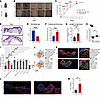
The peritoneal cavity contains a large population of GATA6-expressing large peritoneal macrophages (LPMs), known to support healing of intraabdominal organs. In this study, we aimed to explore their full sphere of influence by examining their ability to perform wound healing at distant sites outside the cavity. In a mouse model combining a remote skin injury with peritoneal stimulation we observed a significant acceleration of skin wound healing in response to LPM activation. Tracking GATA6-expressing LPMs, we demonstrated that LPMs do not migrate to distant wound sites following peritoneal activation. Using parabiosis experiments and administration of activated peritoneal contents indicated an important role of molecules secreted by LPMs in remote skin wound healing. More specifically, proteomic and transcriptomic analyses identified fibronectin as a key factor produced by activated LPMs. In fact, depletion of LPMs or genetic knockout of fibronectin in myeloid cells eliminated the enhanced healing effect. These findings highlight the endocrine function of LPMs in systemic tissue repair, challenging the traditional perspective of plasma fibronectin being exclusively liver derived. Our results suggest that LPMs, strategically positioned in the peritoneal cavity, serve as a source of circulating fibronectin, promoting matrix formation and accelerating wound healing at distant sites.
Authors
Lilian Salm, Simone N. Zwicky, Daniel Spari, Tural Yarahmadov, Marie Siwicki, Fernanda Vargas e Silva Castanheira, Jonas Zbinden, Deborah Stroka, Joel Zindel, Antoine Dufour, Paul Kubes, Guido Beldi
This file is in Adobe Acrobat (PDF) format. If you have not installed and configured the Adobe Acrobat Reader on your system.
Having trouble reading a PDF?
PDFs are designed to be printed out and read, but if you prefer to read them online, you may find it easier if you increase the view size to 125%.
Having trouble saving a PDF?
Many versions of the free Acrobat Reader do not allow Save. You must instead save the PDF from the JCI Online page you downloaded it from. PC users: Right-click on the Download link and choose the option that says something like "Save Link As...". Mac users should hold the mouse button down on the link to get these same options.
Having trouble printing a PDF?
- Try printing one page at a time or to a newer printer.
- Try saving the file to disk before printing rather than opening it "on the fly." This requires that you configure your browser to "Save" rather than "Launch Application" for the file type "application/pdf", and can usually be done in the "Helper Applications" options.
- Make sure you are using the latest version of Adobe's Acrobat Reader.
Supplemental data - Download (1.88 MB)


Copyright © 2026 American Society for Clinical Investigation
ISSN: 0021-9738 (print), 1558-8238 (online)