
Abstract
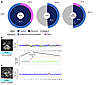
BACKGROUND Liquid biopsy has emerged as a minimally invasive method for tumor diagnosis, monitoring, and therapeutic guidance. For CNS tumors, cerebrospinal fluid (CSF) provides a reliable and accessible source of tumor-derived cell-free DNA (ctDNA).METHODS This study evaluates the clinical utility of CSF liquid biopsy in a real-world prospective setting. A total of 148 CSF samples from 120 patients underwent molecular analysis using droplet digital PCR (ddPCR) and/or next-generation sequencing to detect mutations, fusions, copy number alterations, and mismatch-repair deficient signatures (MMRDness). Samples were collected via lumbar puncture (n = 82; 45% ctDNA positive) or from ventricle sources at the time of surgery or through shunts (n = 66; 65% ct DNA positive).RESULTS Overall, ctDNA was detected in 54% of samples with higher detection in high-grade gliomas at diagnosis (100%, 1 sample equivocal) compared with low-grade gliomas (50%). Among low-grade gliomas, ctDNA detection was higher in disseminated cases (80% versus 43%) and from ventricular versus lumbar samples (56% versus 38%).CONCLUSION Liquid biopsy distinguished relapse from second malignancy and serial sampling demonstrated the potential for ctDNA levels to track treatment response and disease progression. In patients with MMRD tumors, high MMRDness score from ctDNA supported active disease. These findings demonstrate that combined liquid biopsy assays facilitate diagnosis, monitoring, and personalized treatment decisions, offering a viable alternative to invasive surgical biopsies in pediatric CNS tumors.TRIAL REGISTRATION None.FUNDING Proof of Principle Grant from The Hospital for Sick Children; The Canadian Institutes of Health Research; The Canadian Cancer Society; The We Love You Connie Foundation; Garron Family Cancer Center at SickKids; SickKids Clinician Training Program; Ben Stelter Foundation through the Women and Children’s Health Research Institute; Jeffrey Brock Cancer Genetics Research Fellowship; Garron Family Cancer Center Research Fellowship/Scotiabank Clinician Scientist Fellowship; Atrium/CMCC and Hold’em for Life Oncology Fellowship; Tokyo Children’s Cancer Study Group Scholarship of the Gold Ribbons Network.
Authors
Liana Nobre, Yoshiko Nakano, Ian Burns, Robert Siddaway, Michal Zápotocky, Monique Johnson, Mansuba Rana, Cyril Li, Rodney K. Lyn, Richard Yuditskiy, Michelle Ku, Javal Sheth, Adrian B. Levine, Cody L. Nesvick, Anirban Das, Chantel Cacciotti, Shayna Zelcer, Seth A. Climans, Maria MacDonald, Logine Negm, Jiil Chung, Julie Bennett, Andrew Bondoc, Jim Loukides, Lucie Stengs, Melissa Edwards, Eric Bouffet, Vijay Ramaswamy, Anthony P.Y. Liu, Annie Huang, Ute Bartels, Peter B. Dirks, Uri Tabori, Cynthia Hawkins
This file is in Adobe Acrobat (PDF) format. If you have not installed and configured the Adobe Acrobat Reader on your system.
Having trouble reading a PDF?
PDFs are designed to be printed out and read, but if you prefer to read them online, you may find it easier if you increase the view size to 125%.
Having trouble saving a PDF?
Many versions of the free Acrobat Reader do not allow Save. You must instead save the PDF from the JCI Online page you downloaded it from. PC users: Right-click on the Download link and choose the option that says something like "Save Link As...". Mac users should hold the mouse button down on the link to get these same options.
Having trouble printing a PDF?
- Try printing one page at a time or to a newer printer.
- Try saving the file to disk before printing rather than opening it "on the fly." This requires that you configure your browser to "Save" rather than "Launch Application" for the file type "application/pdf", and can usually be done in the "Helper Applications" options.
- Make sure you are using the latest version of Adobe's Acrobat Reader.
ICMJE disclosure forms - Download (2.07 MB)


Copyright © 2026 American Society for Clinical Investigation
ISSN: 0021-9738 (print), 1558-8238 (online)