
Abstract
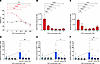
Epstein-Barr virus (EBV) is of growing interest for its potential role in neurodegenerative diseases such as multiple sclerosis (MS) and its possible utility as a therapeutic target in herpesvirus-associated chronic diseases. The effects of brincidofovir (BCV) on EBV reactivation were evaluated in vitro using EBV-infected spontaneous lymphoblastoid cell lines (SLCLs) and peripheral blood mononuclear cells (PBMCs) derived from patients with MS and healthy controls. In addition, a B lymphoblastoid cell line and PBMCs from common marmosets (Callithrix jacchus) naturally infected with an EBV-related gammaherpesvirus (Callitrichine herpesvirus 3, CalHV-3) were used to measure BCV efficacy in a nonhuman primate model. BCV significantly inhibited gammaherpesvirus reactivation, with decreased lytic and latent viral transcript expression. These results suggest that BCV may be a useful antiviral for inhibiting EBV activity in patients with MS. Additionally, this work further validates the utility of CalHV-3 in marmosets as a translational model for the investigation of successful EBV-targeting therapeutics.
Authors
Abaigeal Donaldson, Madeleine R. Druker, Maria Chiara Monaco, Emily H. Stack, Paige Zimmerman, Amanda Lee, Izabela Bialuk, William Frazier, Irene Cortese, Heather Narver, Masatoshi Hazama, Fuminori Yoshida, Xiaofan Li, Laurie T. Krug, Stacey L. Piotrowski, Steven Jacobson
This file is in Adobe Acrobat (PDF) format. If you have not installed and configured the Adobe Acrobat Reader on your system.
Having trouble reading a PDF?
PDFs are designed to be printed out and read, but if you prefer to read them online, you may find it easier if you increase the view size to 125%.
Having trouble saving a PDF?
Many versions of the free Acrobat Reader do not allow Save. You must instead save the PDF from the JCI Online page you downloaded it from. PC users: Right-click on the Download link and choose the option that says something like "Save Link As...". Mac users should hold the mouse button down on the link to get these same options.
Having trouble printing a PDF?
- Try printing one page at a time or to a newer printer.
- Try saving the file to disk before printing rather than opening it "on the fly." This requires that you configure your browser to "Save" rather than "Launch Application" for the file type "application/pdf", and can usually be done in the "Helper Applications" options.
- Make sure you are using the latest version of Adobe's Acrobat Reader.
Supplemental data - Download (956.79 KB)


Copyright © 2026 American Society for Clinical Investigation
ISSN: 0021-9738 (print), 1558-8238 (online)