
Abstract
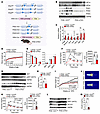
Skeletal muscle frequently encounters hypoxic stress, particularly during exercise, but the specific functions of the hypoxia-inducible factors HIF1α and HIF2α within myofibers remain unclear due to the lack of appropriate in vivo models. Here, we generated 3 complementary mouse models, myofiber-specific triple-PHD knockout (PHD mTKO) and inducible myofiber-specific overexpression of stabilized HIF1α or HIF2α, to delineate isoform-specific roles of HIFα signaling in skeletal muscle. HIF1α stabilization increased the proportion of oxidative fibers yet paradoxically impaired exercise capacity and mitochondrial function. In contrast, HIF2α activation protected against diet-induced obesity, improved glucose tolerance, and maintained mitochondrial function without altering fiber-type composition. Notably, HIF2α stabilization markedly elevated erythropoietin (EPO) expression in skeletal muscle and serum. Myofiber-specific deletion of EPO in the PHD mTKO background abolished polycythemia, demonstrating that this phenotype is driven specifically by muscle-derived EPO. Together, these findings uncover distinct roles of HIF1α and HIF2α in regulating muscle metabolism and mitochondrial function and establish the PHD–HIF2α axis as a myofiber-derived driver of systemic EPO production.
Authors
Junhyeong Lee, Merc Emil Matienzo, Sangyi Lim, Edzel Evallo, Yeongsin Kim, Sujin Jang, Keon Kim, Chang Hyeon Choi, Youn Ho Han, Chang-Min Lee, Tae-Il Jeon, Sang-Ik Park, Jun Wu, Dong-il Kim, Min-Jung Park
This file is in Adobe Acrobat (PDF) format. If you have not installed and configured the Adobe Acrobat Reader on your system.
Having trouble reading a PDF?
PDFs are designed to be printed out and read, but if you prefer to read them online, you may find it easier if you increase the view size to 125%.
Having trouble saving a PDF?
Many versions of the free Acrobat Reader do not allow Save. You must instead save the PDF from the JCI Online page you downloaded it from. PC users: Right-click on the Download link and choose the option that says something like "Save Link As...". Mac users should hold the mouse button down on the link to get these same options.
Having trouble printing a PDF?
- Try printing one page at a time or to a newer printer.
- Try saving the file to disk before printing rather than opening it "on the fly." This requires that you configure your browser to "Save" rather than "Launch Application" for the file type "application/pdf", and can usually be done in the "Helper Applications" options.
- Make sure you are using the latest version of Adobe's Acrobat Reader.
Unedited blot and gel images - Download (9.94 MB)


Copyright © 2026 American Society for Clinical Investigation
ISSN: 0021-9738 (print), 1558-8238 (online)