
Abstract
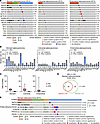
Based on the observation that loss-of-function mutations of KMT2C and KMT2D (KMT2C/D) are enriched and co-occur in gastric adenocarcinoma, we developed genetically engineered mouse models (GEMMs) to conditionally knock out Kmt2c and Kmt2d in gastric epithelial cells. We observed that Kmt2c/d loss led to nuclear dysplasia, cellular crowding, and expansion of cells with mixed gastric lineage markers. When combined with Pten deletion, Kmt2c/d loss drove rapid development of muscle-invasive gastric adenocarcinoma as early as 3 weeks after Cre-mediated gene deletion. The adenocarcinoma exhibited decreased expression of gastric lineage markers and increased expression of intestinal differentiation markers, phenocopying human intestinal-type gastric adenocarcinoma. Bioinformatic integration of single-cell RNA-seq of our GEMMs and human gastric cancer datasets showed coclustering of normal and of cancerous gastric epithelial cells. Kmt2c/d knockout in gastric epithelium reduced protein synthesis but upregulated transcription of ribosomal proteins, rendering the cells hypersensitive to mTOR complex 1 (mTORC1) inhibitors. Additionally, Kmt2c/d knockout increased MHC class I molecule expression and enhanced antigen presentation. Combination of mTORC1 inhibition and anti–programmed cell death 1 immunotherapy markedly suppressed tumor growth in immune-competent mice. Together, these findings reveal the role of Kmt2c/d loss in gastric cancer initiation and suggest potential therapeutic strategies for KMT2C/D-deficient gastric cancer.
Authors
Naitao Wang, Dan Li, Tao Zhang, Mohini R. Pachai, Dana M. Schoeps, Yudi Bao, Woo Hyun Cho, Makhzuna N. Khudoynazarova, Kae Kristoff, Marion Liu, Laura Tang, Yelena Y. Janjigian, Ping Chi, Yu Chen
This file is in Adobe Acrobat (PDF) format. If you have not installed and configured the Adobe Acrobat Reader on your system.
Having trouble reading a PDF?
PDFs are designed to be printed out and read, but if you prefer to read them online, you may find it easier if you increase the view size to 125%.
Having trouble saving a PDF?
Many versions of the free Acrobat Reader do not allow Save. You must instead save the PDF from the JCI Online page you downloaded it from. PC users: Right-click on the Download link and choose the option that says something like "Save Link As...". Mac users should hold the mouse button down on the link to get these same options.
Having trouble printing a PDF?
- Try printing one page at a time or to a newer printer.
- Try saving the file to disk before printing rather than opening it "on the fly." This requires that you configure your browser to "Save" rather than "Launch Application" for the file type "application/pdf", and can usually be done in the "Helper Applications" options.
- Make sure you are using the latest version of Adobe's Acrobat Reader.
Unedited blot and gel images - Download (2.19 MB)


Copyright © 2026 American Society for Clinical Investigation
ISSN: 0021-9738 (print), 1558-8238 (online)