
Abstract
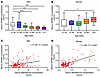
Aging commonly causes decline of testosterone or estrogen, leading to overaccumulation of fatness in men and women, respectively. Although such a phenomenon can be readily explained by estrogen’s direct action on adipocytes in women, accumulative evidence does not support the direct action of testosterone in adipocyte lipid metabolism, suggesting there is a missing intermediary link. Herein, we propose that glycoprotein hormone β5 (GPHB5) is the intermediary linkage between testosterone and the regulation of adiposity. In clinical samples, blood levels of GPHB5 were correlated negatively with men’s ages and positively with circulating testosterone. Testosterone directly stimulated the expression of GPHB5 in cultured cells; pharmacological blockade of androgen receptor (AR) functions abrogated this effect. Knockout of AR led not only to development of obesity but also reduction of GPHB5 expression. Genetic ablation of GPHB5 in men, but not women, reduced the browning of white adipose tissue, diminished energy expenditure, and caused severe obesity. Importantly, elevated blood testosterone levels did not exert catabolic actions in GPHB5–/– mice; yet, recombinant GPHB5 protein could stimulate energy expenditure and reduce adiposity. These results provide strong proof that GPHB5 is the “missing” intermediary hormone linking testosterone (and aging) and its well-known catabolic effect on adipose tissue.
Authors
Gengmiao Xiao, Aijun Qian, Zhuo Gao, Tingting Dai, Hui Liang, Shuai Wang, Mulan Deng, Yunjing Yan, Xindan Zhang, Xuedi Zhang, Yunping Mu, Jiqiu Wang, Aibo Gao, Huijie Zhang, Fanghong Li, Allan Zijian Zhao
This file is in Adobe Acrobat (PDF) format. If you have not installed and configured the Adobe Acrobat Reader on your system.
Having trouble reading a PDF?
PDFs are designed to be printed out and read, but if you prefer to read them online, you may find it easier if you increase the view size to 125%.
Having trouble saving a PDF?
Many versions of the free Acrobat Reader do not allow Save. You must instead save the PDF from the JCI Online page you downloaded it from. PC users: Right-click on the Download link and choose the option that says something like "Save Link As...". Mac users should hold the mouse button down on the link to get these same options.
Having trouble printing a PDF?
- Try printing one page at a time or to a newer printer.
- Try saving the file to disk before printing rather than opening it "on the fly." This requires that you configure your browser to "Save" rather than "Launch Application" for the file type "application/pdf", and can usually be done in the "Helper Applications" options.
- Make sure you are using the latest version of Adobe's Acrobat Reader.
Unedited blot and gel images - Download (34.25 MB)


Copyright © 2026 American Society for Clinical Investigation
ISSN: 0021-9738 (print), 1558-8238 (online)