
Abstract
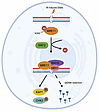
MRE11, a breast tumor suppressor and component of the MRE11-RAD50-NBS1 complex, plays a critical role in DNA end resection and initiation of ataxia-telangiectasia mutation–dependent (ATM-dependent) DNA damage signaling. However, the precise mechanisms governing MRE11 function in the DNA damage response (DDR) remain incompletely understood. Here, we found that MRE11 is deacetylated by the SIRT2 sirtuin deacetylase and breast tumor suppressor, which promotes DNA binding to facilitate DNA end resection and ATM-dependent signaling. SIRT2 deacetylase activity promoted DNA end resection. SIRT2 further complexed with and deacetylated MRE11 at conserved lysine 393 (K393) in response to DNA double-stranded breaks (DSBs), which promoted MRE11 localization and DNA binding at DSBs but not interaction with RAD50, NBS1, or CtIP. Moreover, MRE11 K393 deacetylation by SIRT2 promoted ATM-dependent signaling. Our findings define a mechanism regulating MRE11 binding to DNA through SIRT2 deacetylation, elucidating a critical upstream signaling event directing MRE11 function in the DDR and providing insight into how SIRT2 dysregulation leads to genomic instability and tumorigenesis.
Authors
Fatmata Sesay, Hui Zhang, Priya Kapoor-Vazirani, Andrew T. Jung, Mark E. Essien, Amanda J. Bastien, Nho C. Luong, Xu Liu, PamelaSara E. Head, Duc M. Duong, Xiaofeng Yang, Zachary S. Buchwald, Xingming Deng, Nicholas T. Seyfried, David S. Yu
This file is in Adobe Acrobat (PDF) format. If you have not installed and configured the Adobe Acrobat Reader on your system.
Having trouble reading a PDF?
PDFs are designed to be printed out and read, but if you prefer to read them online, you may find it easier if you increase the view size to 125%.
Having trouble saving a PDF?
Many versions of the free Acrobat Reader do not allow Save. You must instead save the PDF from the JCI Online page you downloaded it from. PC users: Right-click on the Download link and choose the option that says something like "Save Link As...". Mac users should hold the mouse button down on the link to get these same options.
Having trouble printing a PDF?
- Try printing one page at a time or to a newer printer.
- Try saving the file to disk before printing rather than opening it "on the fly." This requires that you configure your browser to "Save" rather than "Launch Application" for the file type "application/pdf", and can usually be done in the "Helper Applications" options.
- Make sure you are using the latest version of Adobe's Acrobat Reader.
Unedited blot and gel images - Download (1.04 MB)


Copyright © 2026 American Society for Clinical Investigation
ISSN: 0021-9738 (print), 1558-8238 (online)