
Abstract
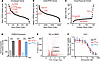
Despite the potential of targeted epigenetic therapies, most cancers do not respond to current epigenetic drugs. The polycomb repressive complex EZH2 inhibitor tazemetostat was recently approved for the treatment of SMARCB1-deficient epithelioid sarcomas, based on the functional antagonism between PRC2 and SMARCB1. Through the analysis of tumors of patients treated with tazemetostat, we recently defined key principles of their response and resistance to EZH2 epigenetic therapy. Here, using transcriptomic inference from SMARCB1-deficient tumor cells, we nominate the DNA damage repair kinase ATR as a target for rational EZH2 combination epigenetic therapy. We showed that EZH2 inhibition promotes DNA damage in epithelioid and rhabdoid tumor cells, at least in part via its induction of piggyBac transposable element derived 5 (PGBD5). We leveraged this collateral synthetic lethal dependency to target PGBD5-dependent DNA damage by inhibition of ATR, but not CHK1, using the ATR inhibitor elimusertib. Consequently, combined EZH2 and ATR inhibition improved therapeutic responses in diverse patient-derived epithelioid and rhabdoid tumors in vivo. This advances a combination epigenetic therapy based on EZH2-PGBD5 synthetic lethal dependency suitable for immediate translation to clinical trials for patients.
Authors
Yaniv Kazansky, Helen S. Mueller, Daniel Cameron, Phillip Demarest, Nadia Zaffaroni, Noemi Arrighetti, Valentina Zuco, Prabhjot S. Mundi, Yasumichi Kuwahara, Romel Somwar, Rui Qu, Andrea Califano, Elisa de Stanchina, Filemon S. Dela Cruz, Andrew L. Kung, Mrinal M. Gounder, Alex Kentsis
This file is in Adobe Acrobat (PDF) format. If you have not installed and configured the Adobe Acrobat Reader on your system.
Having trouble reading a PDF?
PDFs are designed to be printed out and read, but if you prefer to read them online, you may find it easier if you increase the view size to 125%.
Having trouble saving a PDF?
Many versions of the free Acrobat Reader do not allow Save. You must instead save the PDF from the JCI Online page you downloaded it from. PC users: Right-click on the Download link and choose the option that says something like "Save Link As...". Mac users should hold the mouse button down on the link to get these same options.
Having trouble printing a PDF?
- Try printing one page at a time or to a newer printer.
- Try saving the file to disk before printing rather than opening it "on the fly." This requires that you configure your browser to "Save" rather than "Launch Application" for the file type "application/pdf", and can usually be done in the "Helper Applications" options.
- Make sure you are using the latest version of Adobe's Acrobat Reader.
Unedited blot and gel images - Download (5.18 MB)


Copyright © 2026 American Society for Clinical Investigation
ISSN: 0021-9738 (print), 1558-8238 (online)