
Submit a comment
Abstract
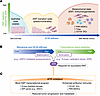
The ability of cancer cells to transition between epithelial and mesenchymal states, a process known as epithelial-to-mesenchymal transition (EMT), is a key driver of cancer metastasis and therapy resistance. While ataxia telangiectasia and Rad3-related (ATR) kinase was originally characterized as a responder to DNA damage and replication stress, recent discoveries implicate a critical role for ATR in EMT and metastasis. Two pivotal studies published in this issue of JCI provide key insights into how ATR intersects with EMT transcriptional reprogramming. Patel et al. demonstrated that ATR prevented R-loop accumulation at EMT-related gene loci, thereby facilitating the transcriptional reprogramming necessary for EMT as well as tumor growth and metastasis. Tu et al. further uncovered a role for ATR in ECM stiffness–induced EMT, which was associated with an immunosuppressive tumor microenvironment. Together, these studies highlight important therapeutic implications for ATR targeting in the context of metastasis and therapy resistance.
Authors
Aida Mestre-Farrera, Zhimin Hu, Jing Yang
Guidelines
The Editorial Board will only consider comments that are deemed relevant and of interest to readers. The Journal will not post data that have not been subjected to peer review; or a comment that is essentially a reiteration of another comment.
- Comments appear on the Journal’s website and are linked from the original article’s web page.
- Authors are notified by email if their comments are posted.
- The Journal reserves the right to edit comments for length and clarity.
- No appeals will be considered.
- Comments are not indexed in PubMed.
Specific requirements
- Maximum length, 400 words
- Entered as plain text or HTML
- Author’s name and email address, to be posted with the comment
- Declaration of all potential conflicts of interest (even if these are not ultimately posted); see the Journal’s conflict-of-interest policy
- Comments may not include figures


Copyright © 2026 American Society for Clinical Investigation
ISSN: 0021-9738 (print), 1558-8238 (online)