
Submit a comment
Abstract
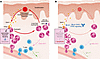
Neutrophils are key drivers of inflammation in Sweet syndrome (SS), a rare inflammatory skin disorder, but how they remain persistently activated in SS skin lesions has been unclear. In this issue of the JCI, Huang, Sati, and colleagues applied single-cell RNA-Seq and immunofluorescence to identify a subset of neutrophils in SS skin that display antigen-presenting cell–like (APC-like) features. The authors showed that when neutrophils interacted with keratinocytes, their lifespan was markedly extended, and they expressed MHC class II via activation of the serum amyloid A1/formyl peptide receptor 2 (SAA1/FPR2) signaling pathway. This, in turn, enabled T cell activation and sustained self-perpetuating inflammatory loops. These findings reveal a previously unrecognized keratinocyte-neutrophil circuit in SS and point to the SAA1/FPR2 axis as a potential target for more precise, mechanism-based therapy.
Authors
Umi Tahara, Masayuki Amagai
Guidelines
The Editorial Board will only consider comments that are deemed relevant and of interest to readers. The Journal will not post data that have not been subjected to peer review; or a comment that is essentially a reiteration of another comment.
- Comments appear on the Journal’s website and are linked from the original article’s web page.
- Authors are notified by email if their comments are posted.
- The Journal reserves the right to edit comments for length and clarity.
- No appeals will be considered.
- Comments are not indexed in PubMed.
Specific requirements
- Maximum length, 400 words
- Entered as plain text or HTML
- Author’s name and email address, to be posted with the comment
- Declaration of all potential conflicts of interest (even if these are not ultimately posted); see the Journal’s conflict-of-interest policy
- Comments may not include figures


Copyright © 2026 American Society for Clinical Investigation
ISSN: 0021-9738 (print), 1558-8238 (online)