
Go to JCI Insight
  • About
  • Editors
  • Consulting Editors
  • For authors
  • Journal stats
  • Publication ethics
  • Publication alerts by email
  • Advertising
  • Job board
  • Contact
  • Clinical Research and Public Health
  • Current issue
  • Past issues
  • By specialty
    • COVID-19
    • Cardiology
    • Gastroenterology
    • Immunology
    • Metabolism
    • Nephrology
    • Neuroscience
    • Oncology
    • Pulmonology
    • Vascular biology
    • All ...
  • Videos
    • ASCI Milestone Awards
    • Video Abstracts
    • Conversations with Giants in Medicine
  • Reviews
    • View all reviews ...
    • The cGAS-STING pathway: DNA sensing in health and disease (Jun 2026)
    • Neurodegeneration (Mar 2026)
    • Clinical innovation and scientific progress in GLP-1 medicine (Nov 2025)
    • Pancreatic Cancer (Jul 2025)
    • Complement Biology and Therapeutics (May 2025)
    • Evolving insights into MASLD and MASH pathogenesis and treatment (Apr 2025)
    • Microbiome in Health and Disease (Feb 2025)
    • View all review series ...
  • Viewpoint
  • Collections
    • In-Press Preview
    • Clinical Research and Public Health
    • Research Letters
    • Letters to the Editor
    • Editorials
    • Commentaries
    • Editor's notes
    • Reviews
    • Viewpoints
    • 100th anniversary
    • Top read articles

  • Current issue
  • Past issues
  • Specialties
  • Reviews
  • Review series
  • ASCI Milestone Awards
  • Video Abstracts
  • Conversations with Giants in Medicine
  • In-Press Preview
  • Clinical Research and Public Health
  • Research Letters
  • Letters to the Editor
  • Editorials
  • Commentaries
  • Editor's notes
  • Reviews
  • Viewpoints
  • 100th anniversary
  • Top read articles
  • About
  • Editors
  • Consulting Editors
  • For authors
  • Journal stats
  • Publication ethics
  • Publication alerts by email
  • Advertising
  • Job board
  • Contact

Submit a comment

GSK3β guides chromosomal repair pathway selection to support BRCA1-independent PARP inhibitor sensitivity
Justin W. Leung, David Gius
View: Text | PDF
Commentary

GSK3β guides chromosomal repair pathway selection to support BRCA1-independent PARP inhibitor sensitivity

  • Text
  • PDF
Abstract

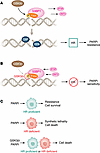
Glycogen synthase kinase-3β (GSK3β) is an established regulator in the DNA double-strand break (DSB) repair pathway. Recent work by Allam et al. revealed a mechanism of DSB repair pathway choice through GSK3β-mediated, site-specific phosphorylation of the tumor suppressor p53 binding protein 1 (53BP1) at threonine 334 (T334). 53BP1 T334 phosphorylation prevented interaction between 53BP1 and its downstream functional partners, PTIP and RIF1, thereby inhibiting 53BP1-directed nonhomologous end joining (NHEJ). Additionally, 53BP1 T334 phosphorylation promoted recruitment of CtIP and RPA32 to DNA damage sites to facilitate homologous recombination (HR). In contrast with loss of 53BP1 function, a 53BP1 T334A phospho-deficient mutant accumulated aberrantly at DSBs, where it impaired end resection and suppressed HR activity. These surprising results suggest that GSK3β may select between NHEJ and HR DNA repair pathways. Additionally, these data support targeting the GSK3β/53BP1 axis to enhance PARP inhibitor efficacy in solid tumors, regardless of BRCA1 status.

Authors

Justin W. Leung, David Gius

×

Guidelines

The Editorial Board will only consider comments that are deemed relevant and of interest to readers. The Journal will not post data that have not been subjected to peer review; or a comment that is essentially a reiteration of another comment.

  • Comments appear on the Journal’s website and are linked from the original article’s web page.
  • Authors are notified by email if their comments are posted.
  • The Journal reserves the right to edit comments for length and clarity.
  • No appeals will be considered.
  • Comments are not indexed in PubMed.

Specific requirements

  • Maximum length, 400 words
  • Entered as plain text or HTML
  • Author’s name and email address, to be posted with the comment
  • Declaration of all potential conflicts of interest (even if these are not ultimately posted); see the Journal’s conflict-of-interest policy
  • Comments may not include figures
This field is required

Copyright © 2026 American Society for Clinical Investigation
ISSN: 0021-9738 (print), 1558-8238 (online)

Sign up for email alerts