
Go to JCI Insight
  • About
  • Editors
  • Consulting Editors
  • For authors
  • Journal stats
  • Publication ethics
  • Publication alerts by email
  • Advertising
  • Job board
  • Contact
  • Clinical Research and Public Health
  • Current issue
  • Past issues
  • By specialty
    • COVID-19
    • Cardiology
    • Gastroenterology
    • Immunology
    • Metabolism
    • Nephrology
    • Neuroscience
    • Oncology
    • Pulmonology
    • Vascular biology
    • All ...
  • Videos
    • ASCI Milestone Awards
    • Video Abstracts
    • Conversations with Giants in Medicine
  • Reviews
    • View all reviews ...
    • The cGAS-STING pathway: DNA sensing in health and disease (Jun 2026)
    • Neurodegeneration (Mar 2026)
    • Clinical innovation and scientific progress in GLP-1 medicine (Nov 2025)
    • Pancreatic Cancer (Jul 2025)
    • Complement Biology and Therapeutics (May 2025)
    • Evolving insights into MASLD and MASH pathogenesis and treatment (Apr 2025)
    • Microbiome in Health and Disease (Feb 2025)
    • View all review series ...
  • Viewpoint
  • Collections
    • In-Press Preview
    • Clinical Research and Public Health
    • Research Letters
    • Letters to the Editor
    • Editorials
    • Commentaries
    • Editor's notes
    • Reviews
    • Viewpoints
    • 100th anniversary
    • Top read articles

  • Current issue
  • Past issues
  • Specialties
  • Reviews
  • Review series
  • ASCI Milestone Awards
  • Video Abstracts
  • Conversations with Giants in Medicine
  • In-Press Preview
  • Clinical Research and Public Health
  • Research Letters
  • Letters to the Editor
  • Editorials
  • Commentaries
  • Editor's notes
  • Reviews
  • Viewpoints
  • 100th anniversary
  • Top read articles
  • About
  • Editors
  • Consulting Editors
  • For authors
  • Journal stats
  • Publication ethics
  • Publication alerts by email
  • Advertising
  • Job board
  • Contact

Submit a comment

Dermal fibroblasts respond to IL-4 and IL-13 and promote T cell recruitment in atopic dermatitis
Tomofumi Numata, Michael Shia, Yoshiyuki Nakamura, Fengwu Li, Hung Chan, Teruaki Nakatsuji, Kellen J. Cavagnero, Jared Simmons, Henry Li, Aaroh Anand Joshi, Marta Palomo-Irigoyen, Richard L. Gallo
View: Text | PDF
Research Article Dermatology Immunology

Dermal fibroblasts respond to IL-4 and IL-13 and promote T cell recruitment in atopic dermatitis

  • Text
  • PDF
Abstract

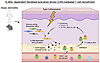
Atopic dermatitis (AD) is a chronic inflammatory skin condition characterized by a type 2 immune response that is not fully understood. Single-cell RNA-seq of human AD skin and murine models of type 2 inflammation identified transcriptionally distinct fibroblast clusters, revealing IL-4Rα–dependent populations of immune-acting fibroblasts (IAFs). These unbiased findings prompted further investigation into the role of dermal fibroblasts during allergic inflammation. These studies demonstrated that, in an inflammatory environment including TNF-α, IL-1β, and IL-17A, the cytokines IL-4 and IL-13 stimulated both mouse and human fibroblasts to produce multiple chemokines, including CCL8, which activated CCR3 to attract T cells. In the skin, fibroblasts were the primary source of many of these chemokines, and targeted deletion of IL-4Rα in mouse fibroblasts reduced T cell infiltration in a mouse model of AD. Additionally, pharmacologic inhibition of CCR3, the receptor shared by many chemokines produced by fibroblasts, decreased T cell infiltration and skin inflammation in mouse models of AD. These findings demonstrate that dermal fibroblasts are more than passive structural cells; they actively participate in the type 2 immune response and contribute to AD by producing chemokines that increase inflammation. Targeting the functions of IAFs could offer an alternative therapeutic approach for AD.

Authors

Tomofumi Numata, Michael Shia, Yoshiyuki Nakamura, Fengwu Li, Hung Chan, Teruaki Nakatsuji, Kellen J. Cavagnero, Jared Simmons, Henry Li, Aaroh Anand Joshi, Marta Palomo-Irigoyen, Richard L. Gallo

×

Guidelines

The Editorial Board will only consider comments that are deemed relevant and of interest to readers. The Journal will not post data that have not been subjected to peer review; or a comment that is essentially a reiteration of another comment.

  • Comments appear on the Journal’s website and are linked from the original article’s web page.
  • Authors are notified by email if their comments are posted.
  • The Journal reserves the right to edit comments for length and clarity.
  • No appeals will be considered.
  • Comments are not indexed in PubMed.

Specific requirements

  • Maximum length, 400 words
  • Entered as plain text or HTML
  • Author’s name and email address, to be posted with the comment
  • Declaration of all potential conflicts of interest (even if these are not ultimately posted); see the Journal’s conflict-of-interest policy
  • Comments may not include figures
This field is required

Copyright © 2026 American Society for Clinical Investigation
ISSN: 0021-9738 (print), 1558-8238 (online)

Sign up for email alerts