
Go to JCI Insight
  • About
  • Editors
  • Consulting Editors
  • For authors
  • Publication ethics
  • Publication alerts by email
  • Advertising
  • Job board
  • Contact
  • Clinical Research and Public Health
  • Current issue
  • Past issues
  • By specialty
    • COVID-19
    • Cardiology
    • Gastroenterology
    • Immunology
    • Metabolism
    • Nephrology
    • Neuroscience
    • Oncology
    • Pulmonology
    • Vascular biology
    • All ...
  • Videos
    • ASCI Milestone Awards
    • Video Abstracts
    • Conversations with Giants in Medicine
  • Reviews
    • View all reviews ...
    • The cGAS-STING pathway: DNA sensing in health and disease (Jun 2026)
    • Neurodegeneration (Mar 2026)
    • Clinical innovation and scientific progress in GLP-1 medicine (Nov 2025)
    • Pancreatic Cancer (Jul 2025)
    • Complement Biology and Therapeutics (May 2025)
    • Evolving insights into MASLD and MASH pathogenesis and treatment (Apr 2025)
    • Microbiome in Health and Disease (Feb 2025)
    • View all review series ...
  • Viewpoint
  • Collections
    • In-Press Preview
    • Clinical Research and Public Health
    • Research Letters
    • Letters to the Editor
    • Editorials
    • Commentaries
    • Editor's notes
    • Reviews
    • Viewpoints
    • 100th anniversary
    • Top read articles

  • Current issue
  • Past issues
  • Specialties
  • Reviews
  • Review series
  • ASCI Milestone Awards
  • Video Abstracts
  • Conversations with Giants in Medicine
  • In-Press Preview
  • Clinical Research and Public Health
  • Research Letters
  • Letters to the Editor
  • Editorials
  • Commentaries
  • Editor's notes
  • Reviews
  • Viewpoints
  • 100th anniversary
  • Top read articles
  • About
  • Editors
  • Consulting Editors
  • For authors
  • Publication ethics
  • Publication alerts by email
  • Advertising
  • Job board
  • Contact
Deiodinases: implications of the local control of thyroid hormone action
Antonio C. Bianco, Brian W. Kim
View: Text | PDF
Review

Deiodinases: implications of the local control of thyroid hormone action

  • Text
  • PDF
Abstract

The deiodinases activate or inactivate thyroid hormone, and their importance in thyroid hormone homeostasis has become increasingly clear with the availability of deiodinase-deficient animals. At the same time, heightened interest in the field has been generated following the discovery that the type 2 deiodinase can be an important component in both the Hedgehog signaling pathway and the G protein–coupled bile acid receptor 1–mediated (GPBAR1-mediated) signaling cascade. The discovery of these new roles for the deiodinases indicates that tissue-specific deiodination plays a much broader role than once thought, extending into the realms of developmental biology and metabolism.

Authors

Antonio C. Bianco, Brian W. Kim

×

Figure 1

Basic deiodinase reactions.

Options: View larger image (or click on image) Download as PowerPoint
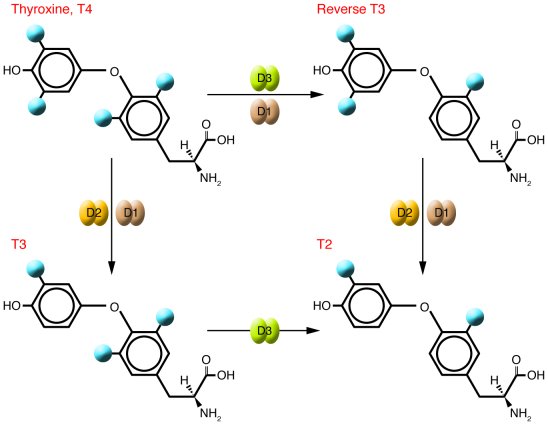
Basic deiodinase reactions.
The reactions catalyzed by the deiodinases r...
The reactions catalyzed by the deiodinases remove iodine moieties (blue spheres) from the phenolic (outer rings) or tyrosil (inner rings) rings of the iodothyronines. These pathways can activate T4 by transforming it into T3 (via D1 or D2) or prevent it from being activated by converting it to the metabolically inactive form, reverse T3 (via D1 or D3). T2 is an inactive product common to both pathways that is rapidly metabolized by further deiodination.

Copyright © 2026 American Society for Clinical Investigation
ISSN: 0021-9738 (print), 1558-8238 (online)

Sign up for email alerts