Go to JCI Insight
  • About
  • Editors
  • Consulting Editors
  • For authors
  • Publication ethics
  • Publication alerts by email
  • Advertising
  • Job board
  • Contact
  • Clinical Research and Public Health
  • Current issue
  • Past issues
  • By specialty
    • COVID-19
    • Cardiology
    • Gastroenterology
    • Immunology
    • Metabolism
    • Nephrology
    • Neuroscience
    • Oncology
    • Pulmonology
    • Vascular biology
    • All ...
  • Videos
    • ASCI Milestone Awards
    • Video Abstracts
    • Conversations with Giants in Medicine
  • Reviews
    • View all reviews ...
    • The cGAS-STING pathway: DNA sensing in health and disease (Jun 2026)
    • Neurodegeneration (Mar 2026)
    • Clinical innovation and scientific progress in GLP-1 medicine (Nov 2025)
    • Pancreatic Cancer (Jul 2025)
    • Complement Biology and Therapeutics (May 2025)
    • Evolving insights into MASLD and MASH pathogenesis and treatment (Apr 2025)
    • Microbiome in Health and Disease (Feb 2025)
    • View all review series ...
  • Viewpoint
  • Collections
    • In-Press Preview
    • Clinical Research and Public Health
    • Research Letters
    • Letters to the Editor
    • Editorials
    • Commentaries
    • Editor's notes
    • Reviews
    • Viewpoints
    • 100th anniversary
    • Top read articles

  • Current issue
  • Past issues
  • Specialties
  • Reviews
  • Review series
  • ASCI Milestone Awards
  • Video Abstracts
  • Conversations with Giants in Medicine
  • In-Press Preview
  • Clinical Research and Public Health
  • Research Letters
  • Letters to the Editor
  • Editorials
  • Commentaries
  • Editor's notes
  • Reviews
  • Viewpoints
  • 100th anniversary
  • Top read articles
  • About
  • Editors
  • Consulting Editors
  • For authors
  • Publication ethics
  • Publication alerts by email
  • Advertising
  • Job board
  • Contact
Transcellular biosynthesis contributes to the production of leukotrienes during inflammatory responses in vivo
Jean-Etienne Fabre, Jennifer L. Goulet, Estelle Riche, MyTrang Nguyen, Kenneth Coggins, Steven Offenbacher, Beverly H. Koller
View: Text | PDF
Article Immunology

Transcellular biosynthesis contributes to the production of leukotrienes during inflammatory responses in vivo

  • Text
  • PDF
Abstract

Leukotrienes are lipid mediators that evoke primarily proinflammatory responses by activating receptors present on virtually all cells. The production of leukotrienes is tightly regulated, and expression of 5-lipoxygenase, the enzyme required for the first step in leukotriene synthesis, is generally restricted to leukocytes. Arachidonic acid released from the cell membrane of activated leukocytes is rapidly converted to LTA4 by 5-lipoxygenase. LTA4 is further metabolized to either LTC4 or LTB4 by the enzyme LTC4 synthase or LTA4 hydrolase, respectively. Unlike 5-lipoxygenase, these enzymes are expressed in most tissues. This observation previously has led to the suggestion that LTA4 produced by leukocytes may, in some cases, be delivered to other cell types before being converted into LTC4 or LTB4. While in vitro studies indicate that this process, termed transcellular biosynthesis, can lead to the production of leukotrienes, it has not been possible to determine the significance of this pathway in vivo. Using a series of bone marrow chimeras generated from 5-lipoxygenase– and LTA4 hydrolase–deficient mice, we show here that transcellular biosynthesis contributes to the production of leukotrienes in vivo and that leukotrienes produced by this pathway are sufficient to contribute significantly to the physiological changes that characterize an ongoing inflammatory response.

Authors

Jean-Etienne Fabre, Jennifer L. Goulet, Estelle Riche, MyTrang Nguyen, Kenneth Coggins, Steven Offenbacher, Beverly H. Koller

×

Figure 4

Options: View larger image (or click on image) Download as PowerPoint
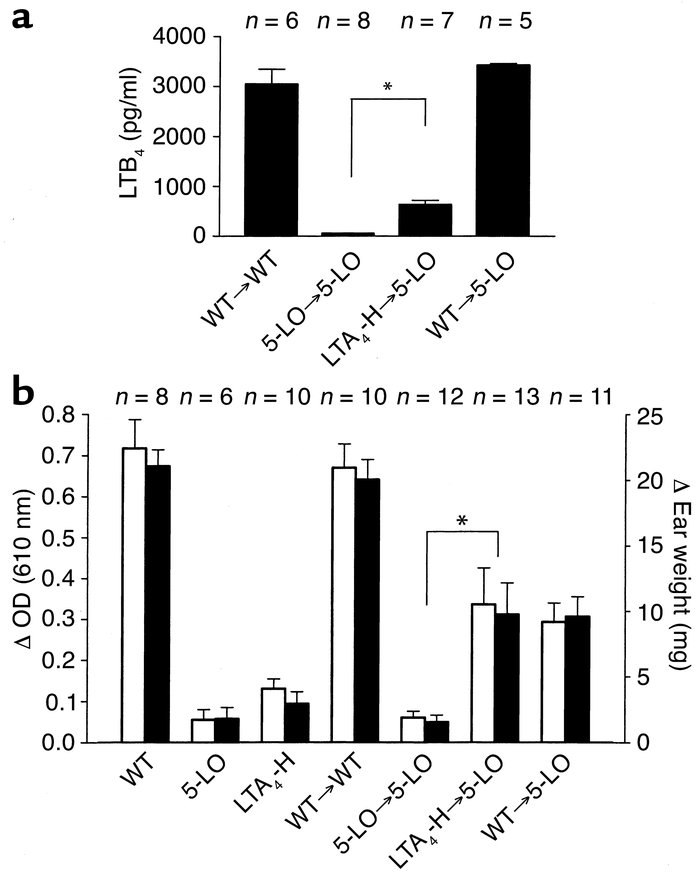
Transcellular biosynthesis in vivo. (a) Zymosan A–induced peritoneal inf...
Transcellular biosynthesis in vivo. (a) Zymosan A–induced peritoneal inflammation. LTB4 production was measured in the peritoneal lavage fluid. Loss of 5-LO expression impairs LTB4 production in response to zymosan A stimulation (5-LO→5-LO). In contrast, the presence of leukocytes expressing 5-LO, but unable to produce LTB4 (LTA4-H→5-LO), results in LTB4 production. *P < 0.05. WT, wild-type; 5-LO, 5-LO–deficient mice; LTA4-H, LTA4-H–deficient mice. The transplanted groups are identified as donor→recipient genotypes. Results are presented as numerical values in Table 1. (b) Acute cutaneous inflammatory responses to AA. Mice received Evans blue dye and indomethacin immediately before topical application of AA. At 1 hour after the treatment, the inflamed tissue was biopsied, weighed, and the serum exudate present in the tissue was determined. The white bars represent the difference in optical densities (Δ OD) between the ear treated with AA and the ear treated with vehicle (acetone) alone. The black bars represent the difference in ear-disc weights (Δ ear weight) between the AA-treated ear and the vehicle-treated ear for each mouse. While loss of 5-LO or LTA4-H attenuated the inflammatory response to AA, the response was significantly increased in mice in which the reconstituted immune cells express 5-LO, but are unable to produce LTB4 (LTA4-H→5LO). This graph combines data from two separate experiments. Statistical significance is indicated only for the transplanted groups for clarity. *P < 0.05. WT, wild-type; 5-LO, 5-LO–deficient mice; LTA4-H, LTA4-H–deficient mice. Results are presented as numerical values in Table 1.

Copyright © 2026 American Society for Clinical Investigation
ISSN: 0021-9738 (print), 1558-8238 (online)

Sign up for email alerts