
Go to JCI Insight
  • About
  • Editors
  • Consulting Editors
  • For authors
  • Publication ethics
  • Publication alerts by email
  • Advertising
  • Job board
  • Contact
  • Clinical Research and Public Health
  • Current issue
  • Past issues
  • By specialty
    • COVID-19
    • Cardiology
    • Gastroenterology
    • Immunology
    • Metabolism
    • Nephrology
    • Neuroscience
    • Oncology
    • Pulmonology
    • Vascular biology
    • All ...
  • Videos
    • ASCI Milestone Awards
    • Video Abstracts
    • Conversations with Giants in Medicine
  • Reviews
    • View all reviews ...
    • The cGAS-STING pathway: DNA sensing in health and disease (Jun 2026)
    • Neurodegeneration (Mar 2026)
    • Clinical innovation and scientific progress in GLP-1 medicine (Nov 2025)
    • Pancreatic Cancer (Jul 2025)
    • Complement Biology and Therapeutics (May 2025)
    • Evolving insights into MASLD and MASH pathogenesis and treatment (Apr 2025)
    • Microbiome in Health and Disease (Feb 2025)
    • View all review series ...
  • Viewpoint
  • Collections
    • In-Press Preview
    • Clinical Research and Public Health
    • Research Letters
    • Letters to the Editor
    • Editorials
    • Commentaries
    • Editor's notes
    • Reviews
    • Viewpoints
    • 100th anniversary
    • Top read articles

  • Current issue
  • Past issues
  • Specialties
  • Reviews
  • Review series
  • ASCI Milestone Awards
  • Video Abstracts
  • Conversations with Giants in Medicine
  • In-Press Preview
  • Clinical Research and Public Health
  • Research Letters
  • Letters to the Editor
  • Editorials
  • Commentaries
  • Editor's notes
  • Reviews
  • Viewpoints
  • 100th anniversary
  • Top read articles
  • About
  • Editors
  • Consulting Editors
  • For authors
  • Publication ethics
  • Publication alerts by email
  • Advertising
  • Job board
  • Contact
The debut of a rational treatment for an inherited neuropathy?
Steven S. Scherer
Steven S. Scherer
View: Text | PDF
Commentary

The debut of a rational treatment for an inherited neuropathy?

  • Text
  • PDF
Abstract

Hereditary neuropathies are common neurological conditions characterized by progressive loss of motor and/or sensory function. There are no effective treatments. Among the many causes of hereditary neuropathies are dominant mutations in serine palmitoyltransferase, long chain base subunit 1 (SPTLC1), which cause hereditary sensory and autonomic neuropathy type 1 (HSAN1). By incorporating l-alanine in place of l-serine, the mutant HSAN1–associated serine palmitoyltransferase generates deoxysphingolipids, which are thought to be neurotoxic. In this issue of the JCI, Garofalo and colleagues report that oral l-serine reverses the accumulation of deoxysphingolipids in humans with HSAN1 and in a transgenic mouse model. As oral l-serine reduces the severity of neuropathy in the mouse model of HSAN1, these data suggest a rational candidate therapy for this devastating condition.

Authors

Steven S. Scherer

×

Figure 1

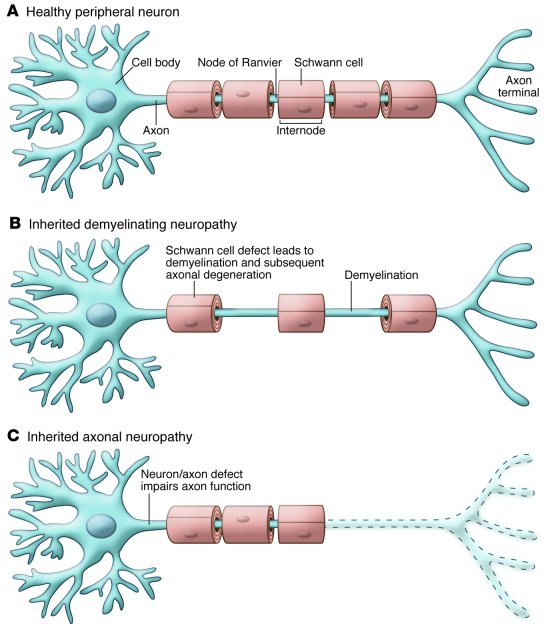
The effects demyelination and axonal damage on myelinated axons.
Options: View larger image (or click on image) Download as PowerPoint
The effects demyelination and axonal damage on myelinated axons.
(A) A s...
(A) A single neuron and its axon, which has five myelin internodes that are separated by nodes of Ranvier. (B) In an inherited demyelinating neuropathy, two myelin internodes have been lost, leaving demyelinated segments that will usually be remyelinated. Even though demyelination is the primary pathology, axonal degeneration (see C) is a common, long-term consequence. (C) In an inherited axonal neuropathy, the distal part of the axon has degenerated (dashed region), and the myelin sheaths that formerly surrounded the degenerated region have disappeared as a secondary consequence of the axonal degeneration.

Copyright © 2026 American Society for Clinical Investigation
ISSN: 0021-9738 (print), 1558-8238 (online)

Sign up for email alerts