
Abstract
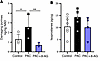
Current treatment protocols for most types of cancers require chemotherapeutic agents that are associated with significant side effects, including chemotherapy-induced peripheral neuropathy (CIPN). Currently, there are no effective CIPN prevention strategies, and current treatment approaches remain limited. The enzyme purine nucleoside phosphorylase (PNPase) actively modulates both oxidative injury and cellular damage. Here, we tested the hypothesis that the signs and symptoms of CIPN are due to a chemotherapy-induced dysregulation of the purine metabolome. We assessed the effect of PNPase inhibition on paclitaxel-induced (PAC-induced) CIPN. Female adult Sprague-Dawley rats were treated with PAC and randomized to oral treatment with either the PNPase inhibitor 8-aminoguanine (8-AG) or its vehicle. Some rats were injected with shRNA against PNPase prior to PAC injections. PAC-treated rats exhibited multiple abnormalities: mechanical allodynia and changes in damaging purines, intraepidermal nerve fiber (IENF) density, and signaling cascades involved in mitochondrial disruption and axonal damage. Inhibition of PNPase improved behavioral function (mechanical allodynia), rescued the loss/damage of IENF, and normalized markers for mitochondrial dysfunction and nerve damage. These findings support the hypothesis that inhibition of PNPase prevented (and potentially reversed) CIPN through several mechanisms that included a reduction in neuronal damage and development of mechanical allodynia.
Authors
Lori A. Birder, Amanda Wolf-Johnston, Jonathan Franks, Mara L.G. Sullivan, Simon C. Watkins, Anthony J. Kanai, Vladimir B. Ritov, Edwin K. Jackson
This file is in Adobe Acrobat (PDF) format. If you have not installed and configured the Adobe Acrobat Reader on your system.
Having trouble reading a PDF?
PDFs are designed to be printed out and read, but if you prefer to read them online, you may find it easier if you increase the view size to 125%.
Having trouble saving a PDF?
Many versions of the free Acrobat Reader do not allow Save. You must instead save the PDF from the JCI Online page you downloaded it from. PC users: Right-click on the Download link and choose the option that says something like "Save Link As...". Mac users should hold the mouse button down on the link to get these same options.
Having trouble printing a PDF?
- Try printing one page at a time or to a newer printer.
- Try saving the file to disk before printing rather than opening it "on the fly." This requires that you configure your browser to "Save" rather than "Launch Application" for the file type "application/pdf", and can usually be done in the "Helper Applications" options.
- Make sure you are using the latest version of Adobe's Acrobat Reader.


