
Metabolism
Abstract
Adipose inflammation plays a key role in obesity-induced metabolic abnormalities. Epigenetic regulation, including DNA methylation, is a molecular link between environmental factors and complex diseases. Here we found that high fat diet (HFD) feeding induced a dynamic change of DNA methylome in mouse white adipose tissue (WAT) analyzed by reduced representative bisulfite sequencing. Interestingly, DNA methylation at the promoter of estrogen receptor α (Esr1) was significantly increased by HFD, concomitant with a down-regulation of Esr1 expression. HFD feeding in mice increased the expression of DNA methyltransferase 1 (Dnmt1) and Dnmt3a, and binding of DNMT1 and DNMT3a to Esr1 promoter in WAT. Mice with adipocyte-specific Dnmt1 deficiency displayed increased Esr1 expression, decreased adipose inflammation and improved insulin sensitivity upon HFD challenge; while mice with adipocyte-specific Dnmt3a deficiency showed a mild metabolic phenotype. Using a modified CRISPR/RNA-guided system to specifically target DNA methylation at the Esr1 promoter in WAT, we found that reducing DNA methylation at Esr1 promoter increased Esr1 expression, decreased adipose inflammation and improved insulin sensitivity in HFD-challenged mice. Our study demonstrated that DNA methylation at Esr1 promoter played an important role in regulating adipose inflammation, which may contribute to obesity-induced insulin resistance.
Authors
Rui Wu, Fenfen Li, Shirong Wang, Jia Jing, Xin Cui, Yifei Huang, Xucheng Zhang, Jose A. Carrillo, Zufeng Ding, Jiuzhou Song, Liqing Yu, Huidong Shi, Bingzhong Xue, Hang Shi

Abstract
T cells rely on different metabolic pathways to differentiate into effector or memory cells, and metabolic intervention is a promising strategy to optimize T cell function for immunotherapy. Pyruvate dehydrogenase (PDH) is a nexus between glycolytic and mitochondrial metabolism, regulating pyruvate conversion to either lactate or acetyl-CoA. Here, we retrovirally transduced pyruvate dehydrogenase kinase 1 (PDK1) or pyruvate dehydrogenase phosphatase 1 (PDP1), which control PDH activity, into CD8+ T cells to test effects on T cell function. Although PDK1 and PDP1 were expected to influence PDH in opposing directions, by several criteria they induced similar changes relative to control T cells. Seahorse metabolic flux assays showed both groups exhibited increased glycolysis and oxidative phosphorylation. Both groups had improved primary and memory recall responses following infection with murine gammaherpesvirus-68. However, metabolomics using labeled fuels indicated differential usage of key fuels by metabolic pathways. Importantly, CD8+ T cell populations after B cell lymphoma challenge were smaller in both groups, resulting in poorer protection, which was rescued by glutamine and acetate supplementation. Overall, this study indicates that PDK1 and PDP1 both enhance metabolic capacity, but the context of the antigenic challenge significantly influences the consequences for T cell function.
Authors
Taewook Kang, Young-Kwang Usherwood, Julie A. Reisz, Sukrut C. Kamerkar, Rachel Culp-Hill, Owen M. Wilkins, Andreia F. Verissimo, Fred W. Kolling IV, Anton M. Hung, Shawn C. Musial, Pamela C. Rosato, Angelo D’Alessandro, Henry N. Higgs, Edward J. Usherwood
Abstract
Transforming growth factor beta (TGF-β) signaling is the master modulator of renal fibrosis. However, targeting drugs have failed to prevent the progression of chronic kidney disease (CKD) in clinical trials due to the extensive biological regulation of TGF-β signaling. It is necessary to investigate the precise downstream mechanisms of TGF-β signaling that regulate renal fibrosis. In this study, we found that PR-domain containing 16 (PRDM16) expression in human renal tubular epithelial cells was markedly reduced by TGF-β. Mechanistically, activated Smad3 induced by TGF-β interacted with the cofactor H-Ras and bound to the promoter of PRDM16, downregulating its transcription. Tubular-specific knockout of PRDM16 promoted renal fibrosis in models of unilateral ureteral occlusion (UUO) and unilateral ischemia-reperfusion injury (UIRI) by exacerbating mitochondrial dysfunction. In vitro, PRDM16 blocked TGF-β-induced mitochondrial injury and lipid deposition by upregulating Peroxisome Proliferator-Activated Receptor Gamma Coactivator-1α (PGC-1α). Delivery of the exogenous PRDM16 gene preserved renal function and ameliorated the progression of renal fibrosis by protecting mitochondrial function. We report PRDM16 as a novel downstream target of TGF-β signaling that attenuates renal fibrosis by safeguarding tubular mitochondrial function.
Authors
Qian Yuan, Ben Tang, Yuting Zhu, Chao Wan, Yaru Xie, Yajuan Xie, Cheng Wan, Hua Su, Youhua Liu, Chun Zhang
Abstract
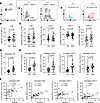
Cellular metabolism plays a key role in T cell biology. Increased glycolysis and mitochondrial respiration have been identified in CD4+ helper T cells from both patients with systemic lupus erythematosus (SLE) and lupus mouse models. Inhibiting this metabolic activity can reduce T cell activation and ameliorate disease symptoms in lupus mice. However, the metabolic differences among circulating follicular helper T (cTfh) cell subsets in patients with SLE versus healthy controls (HCs) have not been thoroughly studied. While the frequencies of cTfh cells and their subsets were similar between patients with SLE and HCs, patients exhibited a higher proportion of activated ICOS+ programmed cell death 1–positive cells, which correlated with disease activity. cTfh17 cells from both patients with SLE and HCs demonstrated heightened glycolytic activity and expression of glycolysis-related genes compared with cTfh1 and cTfh2. Glucose deprivation significantly diminished costimulatory molecule expression and cytokine production, including IL-17A, IL-10, IL-2, and TNF-α. Glycolysis inhibition reduced the B cell activation capacity of cTfh17 cells. This glucose dependence was more pronounced in cTfh17 than cTfh2 from patients with SLE, but it similarly affected both cTfh2 and cTfh17 cells from HCs. These findings highlight distinct metabolic dependencies among cTfh subsets and the critical role of glycolysis in cTfh17-mediated B cell activation in SLE.
Authors
Vera Kim, Takaya Misao, Hong Tian, Meggan Mackay, Cynthia Aranow, Sun Jung Kim
Abstract
Psoriasis is a chronic autoimmune skin disease characterized by abnormal keratinocyte proliferation and immune dysregulation. Altered lipid metabolism has been implicated in its pathogenesis, but the underlying mechanisms remain unclear. In this study, we generated an keratinocyte-specific Sprouty RTK signaling antagonist 1 (SPRY1) knockout (Spry1ΔEpi) mouse model, which exhibits psoriasis-like symptoms. Using both psoriasis patient samples and Spry1ΔEpi mice, we investigated the role of diacylglycerol acyltransferase 2 (DGAT2) in psoriasis. Our results show that DGAT2 expression is reduced, and glycerides metabolism is disrupted in psoriatic lesions in both psoriasis patients and Spry1ΔEpi mice. Lipidomic analysis reveals significant alterations in glycerides, glycerophospholipids, sphingolipids, and fatty acids in Spry1ΔEpi mice. At the cellular level, DGAT2 downregulation and lipid dysregulation enhance Toll-like receptor 3 (TLR3)-mediated inflammatory signaling in keratinocytes. Furthermore, increased DGAT2 secretion from keratinocytes promotes CD8⁺ T cell activation, proliferation and survival, amplifying psoriatic inflammation. These findings highlight the role of DGAT2 and lipid metabolism in the pathogenesis of psoriasis and reveal their interaction with immune responses in psoriasis.
Authors
Ying-Ying Li, Li-Ran Ye, Ying-Zhe Cui, Fan Xu, Xi-Bei Chen, Feng-Fei Zhang, Yi Lu, Yu-Xin Zheng, Xiao-Yong Man
Chronic integrated stress response causes dysregulated cholesterol synthesis in white matter disease
Abstract
Maladaptive integrated stress response (ISR) activation is observed in human diseases of the brain. Genetic mutations of eIF2B, a critical mediator of protein synthesis, cause chronic pathway activation resulting in a leukodystrophy but the precise mechanism is unknown. We generated N208Y eIF2Bα mice and found that this metabolite binding mutation leads to destabilization of eIF2Bα, a systemic ISR, and neonatal lethality. 2BAct, an eIF2B activator, rescued lethality and significantly extended the lifespan of this severe model, underscoring its therapeutic potential in pediatric disease. Continuous treatment was required for survival, as withdrawal led to ISR induction in all tissues and rapid deterioration, thereby providing a model to assess the impact of the ISR in vivo by tuning drug availability. Single nuclei RNA-sequencing of the CNS identified astrocytes, oligodendrocytes, and ependymal cells as the cell types most susceptible to eIF2B dysfunction and revealed dysfunctional maturation of oligodendrocytes. Moreover, ISR activation decreased cholesterol biosynthesis, a process critical for myelin formation and maintenance. As such, persistent ISR engagement may contribute to pathology in other demyelinating diseases.
Authors
Karin Lin, Nina Ly, Rejani B. Kunjamma, Ngoc Vu, Bryan King, Holly M. Robb, Eric G. Mohler, Janani Sridar, Qi Hao, José Zavala-Solorio, Chunlian Zhang, Varahram Shahryari, Nick van Bruggen, Caitlin F. Connelly, Bryson D. Bennett, James J. Lee, Carmela Sidrauski
Abstract
Autophagy is a catabolic quality control pathway that has been linked to neurodegenerative disease, atherosclerosis and ageing, and can be modified by nutrient availability in preclinical models. Consequently, there is immense public interest in stimulating autophagy in people. However, progress has been hampered by the lack of techniques to measure human autophagy. As a result, several key concepts in the field, including nutritional modulation of autophagy, have yet to be validated in humans. We conducted a single arm pre-post study in 42 healthy individuals, to assess whether an acute nutritional intervention could modify autophagy in humans. Two blood samples were collected per participant: after a 12 h overnight fast and 1 h post-consumption of a high protein meal. Autophagy turnover was assessed using a physiologically relevant measure of autophagic flux in peripheral blood mononuclear cells. A lysosomal inhibitor was added directly to whole blood, with the resulting build-up of autophagy marker LC3B-II designated as flux, and measured quantitatively via ELISA. Notably, consumption of a high protein meal had no impact on autophagy, with no differences between overnight fasting and postprandial autophagic flux. We observed sexual dimorphism in autophagy, with females having higher autophagic flux compared to males (p = 0.0031). Exploratory analyses revealed sex-specific correlations between autophagy, insulin and glucose signalling. Importantly, our findings show that an acute nutritional intervention (overnight fasting followed by consumption of a protein-rich meal) does not change autophagic flux in humans, highlighting the need to conduct further autophagy studies in humans.
Authors
Sanjna Singh, Célia Fourrier, Kathryn J. Hattersley, Leanne K. Hein, Jemima Gore, Alexis Martin, Linh V.P. Dang, Barbara King, Rachael A. Protzman, Paul J. Trim, Leonie K. Heilbronn, Julien Bensalem, Timothy J. Sargeant
Abstract
Acute kidney injury (AKI) is characterized by a rapid decline in renal function. In severe or recurrent cases, AKI can progress to chronic kidney disease (CKD), marked by renal inflammation and fibrosis. Despite the severity of these outcomes, early-stage diagnostic tools and pharmacological interventions for AKI-to-CKD progression remain limited. In this study, we examined circular RNA (circRNA) expression profiles in mouse renal cortex tissues 14 days post-ischemia/reperfusion (I/R) injury using circRNA sequencing. The renal biopsy samples of patients after AKI exhibited reduced CircNSD1 expression, which was inversely associated with inflammation and fibrosis. Overexpression of CircNSD1 attenuated ferroptosis in vivo and in vitro, while slowing AKI-to-CKD progression. Mechanistically, CircNSD1 downregulated ACSL4 and SlC39A14 expression through histone H3 lysine 36 (H3K36) methylation, a critical pathway regulating ferroptosis after AKI or hypoxia/reoxygenation (H/R) injury. Furthermore, we identified that CircNSD1 encoded a NSD1-916aa peptide, which may functionally contribute to its observed effect. Collectively, these findings demonstrated that CircNSD1 may serve as a diagnostic and therapeutic target for early detection of AKI-to-CKD transition.
Authors
Li Gao, Junsheng Zhang, Chaoyi Chen, Sai Zhu, Xianglong Wei, Guiqin Tang, Sheng Wang, Yukai Wang, Xinran Liu, Ling Jiang, Yonggui Wu
Abstract
Metabolic health is influenced by adipose tissue, and obesity and lipodystrophy are characterized by inflammation and metabolic dysfunction. Whereas obesity and lipodystrophy treatments involve pharmacological approaches and lifestyle changes, these therapies require long-term, repeated dosing, and are not successful for all patients. Gene therapy with targets such as FGF21 and sTGFBR2 provides an alternative approach, specifically in lipodystrophy. Preclinical experiments in mice housed at 22°C are confounded by a mild cold stress not generally experienced by humans, which can negatively affect translation of metabolic therapeutics. In this study, we investigated effects of FGF21/sTGFBR2 combination gene therapy on obese and lipodystrophic mice, and how housing temperature influences therapeutic efficacy. In obese mice, FGF21/sTGFBR2 improved insulin resistance and hyperlipidemia more dramatically at warmer temperatures. In lipodystrophic mice on a high fat diet, combination therapy required adipose tissue to improve insulin resistance at 30°C, whereas FGF21 alone improved insulin resistance at 22°C. Transcriptomic analyses revealed that lipodystrophic mice had upregulated hepatic cell proliferation and fibrosis pathways, and that FGF21 promoted hepatic metabolism. Thus, metabolic dysfunction caused by lipodystrophy is improved by targeting FGF21 and TGFB signaling, but effectiveness in preclinical models may be dependent upon environmental temperature and presence of adipose tissue.
Authors
Jessica N. Maung, Yang Chen, Keegan S. Hoose, Rose E. Adler, Hadla Hariri, Mia J. Dickson, Taryn A. Hetrick, Gabriel A. Ferguson, Rebecca L. Schill, Hiroyuki Mori, Romina M. Uranga, Kenneth T. Lewis, Isabel D. K. Hermsmeyer, Donatella Gilio, Christopher de Solis, Amber Toliver, Noah Davidsohn, Elif A. Oral, Ormond A. MacDougald

Abstract
Males often experience worse cardiac outcomes than females in sepsis. This study identified pyruvate dehydrogenase kinase 4 (PDK4) as a key mediator of this disparity. PDK4 regulates glucose utilization by inhibiting pyruvate dehydrogenase (PDH) in mitochondria. In a mouse endotoxemia model, a sublethal dose of lipopolysaccharide (LPS, 5 mg/kg) significantly upregulated myocardial PDK4 and induced cardiac dysfunction in males but not females. Cardiac-specific PDK4 overexpression promoted this cardiac dysfunction in both sexes, whereas PDK4 knockout provided protection. In WT males, LPS reduced PDH activity and fatty acid oxidation (FAO) while increasing lactate levels, suggesting a shift toward glycolysis. These effects were exacerbated by PDK4 overexpression but attenuated by knockout. In females, metabolic changes were minimal, aside from reduced FAO in LPS-challenged females overexpressing PDK4. Additionally, a higher LPS dose (8 mg/kg) triggered cardiac dysfunction in females, accompanied by modest upregulation of PDK4, but without changes in PDH or lactate. Dichloroacetate (DCA), restraining PDK-mediated PDH inhibition, improved cardiac function in males but not females during endotoxemia. PDK4 overexpression also exacerbated cardiac mitochondrial damage, reduced mitophagy, and increased oxidative stress and inflammation during endotoxemia — effects that were prevented by PDK4 knockout. These findings suggest that PDK4 drives sex-specific cardiac responses in sepsis.
Authors
John Q. Yap, Azadeh Nikouee, Matthew Kim, Quan Cao, David J. Rademacher, Jessie E. Lau, Ananya Arora, Leila Y. Zou, Yuxiao Sun, Luke Szweda, Hesham Sadek, Sharon Elliot, Benjamin Roos, Marilyn K. Glassberg, Hong-Long Ji, Xiang Gao, Qunfeng Dong, Qun Sophia Zang
No posts were found with this tag.


