
Metabolism
Abstract
Impaired wound healing poses a major and increasingly frequent health problem. Among the key players in the healing process are fibroblasts, but their metabolic profile in healing wounds is largely unknown. Using a combination of transcriptomics, targeted proteomics and metabolomics, we identified retinol metabolism as a top regulated pathway in wound fibroblasts. This is functionally relevant, since even a mild retinol deficiency caused a delay in wound closure and re-epithelialization, which mainly resulted from misdirected keratinocyte migration on the new granulation tissue. Quantitative proteomics identified integrin alpha 11 (Itga11) as a less abundant protein in wounds of mice subjected to a retinol-deficient diet. Reduced levels of this fibroblast-specific protein likely altered the granulation tissue matrix, which in turn affected re-epithelialization. These results provide a comprehensive overview on the transcriptome, proteome and metabolome of wound fibroblasts and identify retinol metabolism in fibroblasts as a key regulator of tissue repair.
Authors
Till Wüstemann, Elizabeta Madzharova, Mateusz S. Wietecha, Norbert B. Ghyselinck, Marcus Höring, Gerhard Liebisch, Nicola Zamboni, Ulrich auf dem Keller, Sabine Werner
Abstract
Long chain fatty acid oxidation disorders (LC FAODs) cause energy deficits in heart and skeletal muscle that are only partially corrected by current medium chain lipid therapies such as triheptanoin. We find that heart and muscle lack medium chain acyl CoA synthetases, limiting the capacity for β-oxidation of medium-chain fatty acids. Instead, heart and muscle mitochondria robustly respire on medium-chain acylcarnitines. The mitochondrial matrix enzyme carnitine acetyltransferase (CrAT) efficiently converts orally delivered octanoylcarnitine (C8 carnitine) to octanoyl CoA for energy generation. C8-carnitine exhibits twice the oral bioavailability of triheptanoin and distributes to muscle and heart. A single oral dose significantly enhances grip strength and treadmill endurance while attenuating lactic acidosis in two mouse models of LC-FAODs. Thus, medium chain acylcarnitines overcome a previously unrecognized metabolic bottleneck in LC FAOD muscle and may represent an alternative to triglyceride based therapies for bioenergetic disorders.
Authors
Keaton J. Solo, Yuxun Zhang, Sivakama S. Bharathi, Bob B. Zhang, Adam C. Richert, Alexandra V. Schmidt, Clinton Van't Land, Olivia D'Annibale, Timothy C. Wood, Eric S. Goetzman

Abstract
BACKGROUND Icosapent ethyl (IPE), an ethyl ester of eicosapentaenoic acid (EPA), reduces cardiovascular disease (CVD), but the mechanism remains elusive. We examined the effect of IPE supplementation on lipoprotein subclasses, lipidomes, and pro-atherogenic properties.METHODS Using 3 independent metabolomic platforms, we examined the effect of high-dose IPE supplementation for 28 days on fatty acid profiles, lipoprotein subclasses, lipidomes, and pro-atherogenic properties in normolipidemic volunteers (n = 38).RESULTS IPE supplementation increased lipoprotein EPA on average 4-fold within 7 days, returning to baseline after a 7-day washout. Notably, the incorporation displayed marked interindividual variance, negatively correlating with baseline levels. We identified persistent participant-specific lipoprotein fingerprints despite uniform IPE-induced lipidome remodeling across all lipoprotein classes. This remodeling resulted in reductions in saturated, monounsaturated, and n-6 polyunsaturated fatty acids, resulting in reduced clinical risk markers, including triglyceride, remnant cholesterol, and apolipoprotein B (apoB) levels and 10-year CVD risk score. Of the pro-atherogenic properties tested, IPE significantly reduced apoB lipoprotein binding to proteoglycans, which correlated with lower apoB particle concentration, cholesterol content, and specific lipid species in LDL, including phosphatidylcholine 38:3 previously associated with CVD.CONCLUSION These findings highlight IPE’s rapid, uniform remodeling of lipoproteins and reduced proteoglycan binding, likely contributing to previously observed CVD risk reduction. Persistent interindividual lipidome signatures underscore the potential for personalized therapeutic approaches in atherosclerotic CVD treatment.TRIAL REGISTRATION NCT04152291.FUNDING Jenny and Antti Wihuri Foundation, Research Council of Finland, Sigrid Jusélius Foundation, Finnish Foundation for Cardiovascular Research, Emil Aaltonen Foundation, Ida Montin Foundation, Novo Nordisk Foundation, Finnish Cultural Foundation, and Jane and Aatos Erkko Foundation.
Authors
Lauri Äikäs, Petri T. Kovanen, Martina B. Lorey, Reijo Laaksonen, Minna Holopainen, Hanna Ruhanen, Reijo Käkelä, Matti Jauhiainen, Martin Hermansson, Katariina Öörni
Abstract
Atherosclerotic cardiovascular disease is a major contributor to the global disease burden. Atherosclerosis initiation depends on cholesterol accumulation in subendothelial macrophages (Mφs). To clarify the role of Bmal1 in Mφ function and atherosclerosis, we used several global and myeloid-specific Bmal1 deficient mouse models. Myeloid-specific Bmal1 deficient mice had higher Mφ cholesterol and displayed greater atherosclerosis compared to controls. Bmal1-deficient Mφs exhibited: (1) elevated expression of Cd36 and uptake of oxLDL; (2) diminished expression of Abca1 and Abcg1, and decreased cholesterol efflux and reverse cholesterol transport; and (3) reduced Npc1 and Npc2 expression, and diminished cholesterol egress from lysosomes. Molecular studies revealed that Bmal1 directly regulates basal and cyclic expression of Npc1 and Npc2 by binding the E-boxes in their promoters and indirectly regulates the basal and temporal regulation of Cd36 and Abca1/Abcg1 involving Rev-erbα and Znf202 repressors, respectively. In conclusion, Mφ Bmal1 is a key regulator of the uptake of modified lipoproteins, cholesterol efflux, lysosomal cholesterol egress and atherosclerosis, and therefore may be a master regulator of cholesterol metabolism in Mφs. Restoration of Mφ Bmal1 expression or blocking of factors that decrease its activity may be effective in preventing atherosclerosis.
Authors
Xiaoyue Pan, John O'Hare, Cyrus Mowdawalla, Samantha Mota, Nan Wang, M. Mahmood Hussain
Abstract
Glioblastoma IDH-wildtype is the most common and aggressive primary brain tumor in adults, with poor prognosis despite current therapies. To identify new therapeutic vulnerabilities, we investigated the role of CDK12, a transcription-associated cyclin-dependent kinase, in glioblastoma. Genetic or pharmacologic inactivation of CDK12 impaired tumor growth in patientderived xenograft (PDX) models and enhanced the efficacy of temozolomide. Metabolic profiling using extracellular flux analysis and stable isotope tracing with U-¹³C-glucose and U-¹³Cglutamine showed that CDK12 inhibition disrupted mitochondrial respiration, resulting in energy depletion and apoptotic cell death characterized by caspase activation and Noxa induction. Mechanistically, we identified a direct interaction between CDK12 and GSK3β. CDK12 inhibition activated GSK3β, leading to downregulation of PPARD, a transcriptional regulator of oxidative metabolism. This CDK12–GSK3β–PPARD axis was required for glioblastoma cell proliferation and metabolic homeostasis. In vivo, CDK12 inhibition significantly extended survival without overt toxicity and induced complete tumor regression in a subset of animals. Strikingly, combined CDK12 inhibition and temozolomide treatment led to complete tumor eradication in all animals tested. These findings establish CDK12 as a key regulator of glioblastoma metabolism and survival, and provide strong preclinical rationale for its therapeutic targeting in combination with standard-of-care treatments.
Authors
Jeong-Yeon Mun, Chang Shu, Qiuqiang Gao, Zhe Zhu, Hasan O. Akman, Mike-Andrew Westhoff, Georg Karpel-Massler, Markus D. Siegelin
Abstract
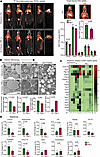
Recent experimental and epidemiologic data have strongly associated air pollution in the pathogenesis of insulin resistance and type 2 diabetes mellitus. We explored the effect of inhalational exposure to concentrated ambient particulate matter smaller than 2.5 μm (PM2.5), or filtered air, using a whole-body inhalation system (6 hours/day, 5 days/week) for 24 weeks on metabolism and brown adipose tissue (BAT) function. Mechanistic evaluation of insulin resistance, glucose uptake with 18F-fluorodeoxyglucose positron emission tomography, alongside evaluation for differentially methylated regions, chromatin accessibility, and differential expression of genes was performed. PM2.5 exposure impaired metabolism through changes in key BAT transcriptional programs involved in redox stress, lipid deposition, fibrosis, and altered thermogenesis. Significant differential methylation and widespread chromatin remodeling was noted in BAT with PM2.5. Integrated analysis uncovered a role for the histone deacetylase HDAC9 and histone demethylase KDM2B. The latter demethylates Lys-4 and Lys-36 of histone H3. Specifically, studies using ChIP combined with quantitative PCR confirmed HDAC9 and KDM2B occupancy and reduced H3K36me2 on the promoter of target BAT genes in PM2.5 mice, while Hdac9/Kdm2b knockdown and overexpression increased and reduced BAT metabolism, respectively. Collectively, our results provide insights into air pollution exposure and changes in BAT and metabolism.
Authors
Rengasamy Palanivel, Jean-Eudes Dazard, Bongsoo Park, Sarah Costantino, Skanda T. Moorthy, Armando Vergara-Martel, Elaine Ann Cara, Jonnelle Edwards-Glenn, Shyam Biswal, Lung Chi Chen, Mukesh K. Jain, Francesco Paneni, Sanjay Rajagopalan

Abstract
Normothermic machine perfusion (NMP) has become a valuable tool to expand the pool of transplantable organs. However, the application of NMP to kidneys presents substantial challenges, mostly due to high variability in the composition of currently used perfusion solutions. Here, we provide a multimodal cross-species cellular atlas of kidney injury associated with NMP using a literature-based consensus buffer. This resource provided a systematic framework that was used to develop a metabolite-enhanced perfusion solution, which protected renal proximal tubular cells, improving cellular viability and transplantation outcomes across species, including human kidneys.
Authors
Jan Czogalla, Fabian Hausmann, Simon Lagies, Sydney E. Gies, Sabrina Christiansen, Nico Kaiser, Fabian Haas, Yusuke Okabayashi, Dominik Kylies, Smilla Hofmann, Rossana Franzin, Niklas Sabra, Sarah Bouari, Yitian Fang, Gisela Ambagtsheer, Ilka Edenhofer, Silvia Chilla, Anne K. Mühlig, Marina Zimmermann, Milagros N. Wong, Takashi Yokoo, Oliver Kretz, Maja Lindenmeyer, Florian Grahammer, Martin J. Hoogduijn, Ron de Bruin, Malte Kuehl, Sonja Hänzelmann, Bernd Kammerer, Loreto Gesualdo, Stefan Bonn, Robert C. Minnee, Tobias B. Huber, Victor G. Puelles

Abstract
Methylmalonic acidemia (MMA) is a severe metabolic disorder affecting multiple organs because of a distal block in branched-chain amino acid (BCAA) catabolism. Standard of care is limited to protein restriction and supportive care during metabolic decompensation. Severe cases require liver/kidney transplantation, and there is a clear need for better therapy. Here, we investigated the effects of a small molecule branched-chain amino acid transaminase (BCAT) inhibitor in human MMA hepatocytes and an MMA mouse model. Mitochondrial BCAT is the first step in BCAA catabolism, and reduction of flux through an early enzymatic step is successfully used in other amino acid metabolic disorders. Metabolic flux analyses confirmed robust BCAT inhibition, with reduction of labeling of proximal and distal BCAA-derived metabolites in MMA hepatocytes. In vivo experiments verified the BCAT inhibition, but total levels of distal BCAA catabolite disease markers and clinical symptoms were not normalized, indicating contributions of substrates other than BCAA to these distal metabolite pools. Our study demonstrates the importance of understanding the underlying pathology of metabolic disorders for identification of therapeutic targets and the use of multiple, complementary models to evaluate them.
Authors
Madeline G. Hemmingsen, Guo-Fang Zhang, Yunhan Ma, Hannah Marchuk, Kalyani R. Patel, Tong Chen, Xinning Li, Mark Chapman, Sabrina Collias, Dolores H. Lopez-Terrada, James Beasley, Ashlee R. Stiles, Randy J. Chandler, Charles P. Venditti, Sarah P. Young, Mercedes Barzi, Beatrice Bissig-Choisat, Doug Krafte, Christopher B. Newgard, Karl-Dimiter Bissig
Abstract
Impaired muscle regrowth in aging is underpinned by reduced pro-inflammatory macrophage function and subsequently impaired muscle cellular remodeling. Macrophage phenotype is metabolically controlled through TCA intermediate accumulation and activation of HIF1A. We hypothesized that transient hypoxia following disuse in old mice would enhance macrophage metabolic inflammatory function thereby improving muscle cellular remodeling and recovery. Old (20 months) and young adult mice (4 months) were exposed to acute (24h) normobaric hypoxia immediately following 14-days of hindlimb unloading and assessed during early re-ambulation (4- and 7-days) compared to age-matched controls. Treated aged mice had improved pro-inflammatory macrophage profiles, muscle cellular remodeling, and functional muscle recovery to the levels of young control mice. Likewise, young adult mice had enhanced muscle remodeling and functional recovery when treated with acute hypoxia. Treatment in aged mice restored the muscle molecular fingerprint and biochemical spectral patterns (Raman Spectroscopy) observed in young mice and strongly correlated to improved collagen remodeling. Finally, intramuscular delivery of hypoxia-treated macrophages recapitulated the muscle remodeling and recovery effects of whole-body hypoxic exposure in old mice. These results emphasize the role of pro-inflammatory macrophages during muscle regrowth in aging and highlight immunometabolic approaches as a route to improve muscle cellular dynamics and regrowth.
Authors
Zachary J. Fennel, Negar Kosari, Paul-Emile Bourrant, Elena M. Yee, Robert J. Castro, Anu S. Kurian, Jonathan Palmer, Morgan Christensen, Katsuhiko Funai, Ryan M. O'Connell, Anhong Zhou, Micah J. Drummond
Abstract
In vitro studies have implicated orphan receptor GPRC5B in β-cell survival, proliferation and insulin secretion, but its relevance for glucose homeostasis in vivo is largely unknown. Using tamoxifen-inducible, β-cell-specific GPRC5B knockout mice (Ins-G5b-KOs) we show here that loss of GPRC5B does not affect β-cell function in the lean state, but results in strongly reduced insulin secretion and disturbed glucose tolerance in mice subjected to high fat diet for 16 weeks. Flow cytometry and single-cell expression analyses in islets from obese mice show a reduced β-cell abundance and a less mature β-cell phenotype in Ins-G5b-KOs. Expression of β-cell-specific transcription factor MafA is reduced both on the RNA and protein level, as are transcripts of MafA target genes. Mechanistically, we show that phosphorylation of cAMP response element-binding protein (CREB), a major regulator of MafA expression, is reduced in islets of obese Ins-G5b-KOs, and that this phenotype precedes the downregulation of MafA and MafA target genes. Taken together, GPRC5B helps to maintain mature β-cell function in obesity through cAMP/CREB-dependent regulation of MafA expression.
Authors
Tianpeng Wang, Remy Bonnavion, Janett Piesker, Stefan Günther, Nina Wettschureck
No posts were found with this tag.


