
Physician-Scientist Development
Open Access |  10.1172/jci.insight.199316
Comparing MD-PhD trainee experiences by disciplinary background
Cambray Smith,1,2 Evans K. Lodge,2,3,4 C. Ray Cheever,2,5 Seth M. Holmes,6,7 and Anna R. Kahkoska5
1Department of Health Policy and Management,
2School of Medicine, and
3Department of Epidemiology, University of North Carolina at Chapel Hill, Chapel Hill, North Carolina, USA.
4Department of Family Medicine, Memorial Hospital, South Bend, Indiana, USA.
5Department of Nutrition, University of North Carolina at Chapel Hill, Chapel Hill, North Carolina, USA.
6Division of Society and Environment, University of California at Berkeley, Berkeley, California, USA.
7University of Barcelona, ICREA Catalan institution for Research and Advanced Study, Barcelona, Spain.
Address correspondence to: Cambray Smith, Department of Health Policy and Management, Gillings School of Global Public Health, McGavran-Greenberg Hall, Chapel Hill, North Carolina, 27516, USA. Phone: 919.843.6507; Email: cambray_smith@med.unc.edu.
Find articles by Smith, C. in: PubMed | Google Scholar
1Department of Health Policy and Management,
2School of Medicine, and
3Department of Epidemiology, University of North Carolina at Chapel Hill, Chapel Hill, North Carolina, USA.
4Department of Family Medicine, Memorial Hospital, South Bend, Indiana, USA.
5Department of Nutrition, University of North Carolina at Chapel Hill, Chapel Hill, North Carolina, USA.
6Division of Society and Environment, University of California at Berkeley, Berkeley, California, USA.
7University of Barcelona, ICREA Catalan institution for Research and Advanced Study, Barcelona, Spain.
Address correspondence to: Cambray Smith, Department of Health Policy and Management, Gillings School of Global Public Health, McGavran-Greenberg Hall, Chapel Hill, North Carolina, 27516, USA. Phone: 919.843.6507; Email: cambray_smith@med.unc.edu.
Find articles by Lodge, E. in: PubMed | Google Scholar
1Department of Health Policy and Management,
2School of Medicine, and
3Department of Epidemiology, University of North Carolina at Chapel Hill, Chapel Hill, North Carolina, USA.
4Department of Family Medicine, Memorial Hospital, South Bend, Indiana, USA.
5Department of Nutrition, University of North Carolina at Chapel Hill, Chapel Hill, North Carolina, USA.
6Division of Society and Environment, University of California at Berkeley, Berkeley, California, USA.
7University of Barcelona, ICREA Catalan institution for Research and Advanced Study, Barcelona, Spain.
Address correspondence to: Cambray Smith, Department of Health Policy and Management, Gillings School of Global Public Health, McGavran-Greenberg Hall, Chapel Hill, North Carolina, 27516, USA. Phone: 919.843.6507; Email: cambray_smith@med.unc.edu.
Find articles by Cheever, C. in: PubMed | Google Scholar
1Department of Health Policy and Management,
2School of Medicine, and
3Department of Epidemiology, University of North Carolina at Chapel Hill, Chapel Hill, North Carolina, USA.
4Department of Family Medicine, Memorial Hospital, South Bend, Indiana, USA.
5Department of Nutrition, University of North Carolina at Chapel Hill, Chapel Hill, North Carolina, USA.
6Division of Society and Environment, University of California at Berkeley, Berkeley, California, USA.
7University of Barcelona, ICREA Catalan institution for Research and Advanced Study, Barcelona, Spain.
Address correspondence to: Cambray Smith, Department of Health Policy and Management, Gillings School of Global Public Health, McGavran-Greenberg Hall, Chapel Hill, North Carolina, 27516, USA. Phone: 919.843.6507; Email: cambray_smith@med.unc.edu.
Find articles by Holmes, S. in: PubMed | Google Scholar
1Department of Health Policy and Management,
2School of Medicine, and
3Department of Epidemiology, University of North Carolina at Chapel Hill, Chapel Hill, North Carolina, USA.
4Department of Family Medicine, Memorial Hospital, South Bend, Indiana, USA.
5Department of Nutrition, University of North Carolina at Chapel Hill, Chapel Hill, North Carolina, USA.
6Division of Society and Environment, University of California at Berkeley, Berkeley, California, USA.
7University of Barcelona, ICREA Catalan institution for Research and Advanced Study, Barcelona, Spain.
Address correspondence to: Cambray Smith, Department of Health Policy and Management, Gillings School of Global Public Health, McGavran-Greenberg Hall, Chapel Hill, North Carolina, 27516, USA. Phone: 919.843.6507; Email: cambray_smith@med.unc.edu.
Find articles by Kahkoska, A. in: PubMed | Google Scholar
Published April 7, 2026 - More info
JCI Insight. 2026;11(10):e199316. https://doi.org/10.1172/jci.insight.199316.
© 2026 Smith et al. This work is licensed under the Creative Commons Attribution 4.0 International License. To view a copy of this license, visit http://creativecommons.org/licenses/by/4.0/.

-
Results
Participant characteristics. Demographic data for 234 participants are available in Supplemental Table 1 (supplemental material available online with this article; https://doi.org/10.1172/jci.insight.199316DS1). The mean age of the cohort was 28.0 years (SD, 3.0; range, 21–41 years), with no significant difference between SSHPH and non-SSHPH students. More respondents identified as cisgender women than cisgender men (42.7%, n = 100 vs. 30.8%, n = 72, respectively). We combined respondents with diverse gender identities with those responses that were missing gender identity information to decrease identifiability (26.5% other gender or missing, n = 62). Racial diversity was low, with 54.3% of participants (n = 127) identifying as White and 11.1% (n = 26) as Asian. 8.1% of respondents (n = 19) were combined into a new category titled Underrepresented in MD-PhD training to decrease identifiability of participants. This category includes those who identify as American Indian or Alaska Native, Black or African American, Native Hawaiian or Pacific Islander, and mixed or multiple races. Data for 26.5% of the cohort was missing. Only 4.1% (n = 5) of non-SSHPH respondents identified as Hispanic/Latine, compared with 11.7% (n = 13) of SSHPH students (P = 0.03). Only a small proportion (12.4%, n = 29) identified as being from a low-income background, with no notable associations based on SSHPH status. Of note, our demographics were collected at the end of the survey, and there is a large percentage of missing responses.
Most participants (94.0%, n = 220) were in combined MD-PhD programs, with 76.1% (n = 178) in MSTPs. On average, they were midway through training (2.2 years of medical school and 2.5 years of graduate school completed). All regions of the US were represented, with 25.6% (n = 60) from the Midwest, 20.5% (n = 48) from the Southeast, 18.4% (n = 43) from the Northeast, and 12.0% (n = 28) from the West. Program names were not collected to decrease identifiability given the small numbers of SSHPH trainees at each school, but, based on an optional survey filled out by 74 participants interested in receiving notification of published results, students represented at least 27 unique institutions.
The most common SSHPH disciplines captured in our study were anthropology and epidemiology (each 27%, n = 30), along with fields such as health policy, science and technology studies, health behavior, philosophy/ethics, history, English/literature, and economics. Overall, 39.6% (n = 44) were in social sciences, 39.6% (n = 44) were in public health, and 8.1% (n = 9) were in humanities. Regardless of SSHPH status, most participants were interested in academic or academic medicine careers. SSHPH students were more likely than non-SSHPH participants to report interest in primary care (36.0% vs. 11.4%, P < 0.01) and less likely to report interest in industry (10.8% vs. 22.0%, P = 0.03). Nearly 70% of SSHPH participants and 58.5% of non-SSHPH participants responded to at least 1 free-text question.
Sense of belonging. Summary statistics of self-reported sense of belonging on a scale of 1–5 (not at all to extremely) are reported in Table 1 and Supplemental Table 2. SSHPH participants felt slightly less personally understood (3.5 vs. 3.8, P = 0.021), less welcomed based on their field of study (4.0 vs. 4.3, P < 0.01), and less respected based on their research interests than non-SSHPH participants (3.8 vs. 4.4 by students, P < 0.01 and 4.0 vs. 4.3 by program leadership, P = 0.013). Belonging within medical school was similar across groups, (3.2) but SSHPH participants reported higher belonging in graduate school (3.9 vs. 3.4, P < 0.01) compared with non-SSHPH peers. Overall sense of belonging in MD-PhD programs was lower for SSHPH students (3.7 vs. 4.0, P < 0.01).
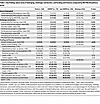 Table 1
Key findings about sense of belonging, challenges and barriers, and funding and finances compared by MD-PhD disciplinary group
Qualitative responses offered context for these patterns. Participants noted that their (a) research interests, (b) different training requirements, and (c) philosophical disciplinary differences — particularly the critical theoretical lens common in SSHPH fields — contributed to isolation and reduced belonging. Quotations exploring these themes are provided below.
One SSHPH student described comprehensively how these barriers contributed to a decreased sense of belonging: “I feel like we’re structurally marginalized from both MD students and PhD classmates as well as other MD/PhD students in basic sciences — as a result of different funding packages/financial concerns; different demands on our time and programmatic requirements/responsibilities; different job market prospects; different number of years of continuous training (fewer in each program, more overall); different intellectual orientations. These practical differences in the structure of our training mean we’re dealing with divergent material realities and personally has made it hard to have a sense of belonging with others.”
Another trainee described how they felt valued, yet gaps in understanding of their training path left room for additional belonging: “I also think that my MSTP leadership/the program values me, but I think they don’t really understand what I do which makes me feel lonely despite receiving positive support.”
Both SSHPH and non-SSHPH trainees referenced ideological disciplinary tensions. For example, one non-SSHPH participant was skeptical of SSHPH disciplines and viewed them as outside the MD-PhD mission (Supplemental Table 3): “Leave politics out of curriculum. We came here to learn biomedical science, not be indoctrinated in dubious theories on intersectionality from humanities departments or socialist ideology on equity.”
Other comments indicated that having greater numbers of SSHPH trainees in their programs increased their sense of belonging, compared with decreased belonging among transfer students (including transfers between institutions and/or transferring into MD-PhD programs mid-training), those training at multiple institutions, or those navigating major life events.
Challenges and barriers. Table 1 presents reported data on barriers and challenges experienced during training. Quantitative ratings of poor institutional support, personal responsibilities (e.g., care taking), first-generation status, personal illness (including mental health), and mistreatment/discrimination were similar between SSHPH and non-SSHPH participants (range of 1.8–2.6 overall, on a Likert scale of 1-5, from low to high, no significant differences). SSHPH students reported less stress related to the general challenges of MD-PhD training (e.g., academic demands of medical school; 2.5 vs. 3.0, P = 0.012) but more stress related to a lack of role models (2.7 vs. 2.1, P < 0.01) and uncertain job prospects (1.7 vs. 1.3, P = 0.042). Participants reporting “Other” challenges shared a diverse set of concerns, including anxiety about global politics, administrative requirements of medical and graduate school, and uncertain career goals.
Qualitatively, SSHPH participants described challenges and barriers related to (a) confusing application and recruitment policies from MD-PhD programs, (b) inexperienced research mentors for SSHPH MD-PhD students, (c) misaligned expectations from MD-PhD program leadership related to graduate milestones and measures of productivity, and (d) feeling like they fell into gaps between administrative systems, which required self-advocacy and extra work.
Students shared stories about being told that their institutions supported SSHPH training on websites or during interviews, yet they faced many roadblocks once arriving at the program, such as not finding any suitable SSHPH mentors prepared to work with MD-PhD students: “My program didn’t have a great sense of whether the broader institution would be capable of supporting my research goals. They accepted me to the mdphd program, but I realized pretty quickly… that I was going to have a very hard time finding research mentors here.”
Trainees described instances in which their program leadership tried to support them but struggled to do so: “In my experience, it was REALLY difficult to try to pursue a PhD in a “nontraditional” discipline. I think my MD/PhD admin folks tried their best to help me… but many of the PIs I reached out to had never even heard of an MD/PhD program… much less did they have the first idea of how to mentor an MD/PhD student.”
However, others described feeling like they did not having any advocates looking out for them: “I have often felt like an afterthought in the MD/PhD program and University… I have struggled with everything from being included on email list-servs, to registering for courses, to getting…a parking permit or ID card... I constantly feel that I have to advocate for myself - “explain” that I am a dual degree student in medicine and anthropology. It should not be MY responsibility to educate administrators about their own degree programs.”
Funding and finances. Table 1 describes the status of participants’ funding and finances. Overall, SSHPH participants reported more stress about funding than non-SSHPH students (2.5 vs. 2.1, P < 0.01). There were no significant differences in how SSHPH and non-SSHPH participants funded their medical school training, but SSHPH participants were significantly more likely than non-SSHPH participants to have service expected (e.g., teaching assistantships) for their base funding during graduate school (51.4% vs. 19.5%, P < 0.01). Guaranteed years of funding for medical school and graduate school did not differ between groups (3.8 and 4.0 years overall, respectively). About one-fifth of participants reported that funding affected their decision when choosing a graduate school department, with no differences based on SSHPH status. SSHPH participants were significantly more likely than non-SSHPH participants to report working additional jobs for pay (36.9% vs. 22.8%, P = 0.015), including jobs related to their professional goals (27.0% vs. 14.6%, P < 0.01). Levels of current undergraduate, medical school, and graduate school debt were not significantly different between groups.
Qualitatively, SSHPH students reported a variety of experiences with funding. Specifically, trainees described (a) a lack of funding parity between SSHPH and non-SSHPH disciplines, (b) differences in service requirements to secure base funding during graduate school, (c) lack of relevant grant opportunities for their scholarly work, and (d) longer training periods that increased funding stress. While many responses described differences in funding levels based on disciplinary groups, others described specific commitments from a few MD-PhD programs to pay students the same regardless of PhD discipline (e.g., supplementing SSHPH students for parity), although this sometimes still included differences in work requirements: “I specifically chose my institution because it funded its social science MD/PhDs at the same level as its science PhDs. I do think it’s frustrating though that I am required to TA and RA without additional pay while the science PhDs receiving the same funding don’t have to TA or can do so for more money.”
Participants commonly described a lack of institutional prioritization during graduate school years that were based at the university-level (i.e., beyond MD-PhD programs, mentors, or departments): “The university doesn’t care to provide a living wage to non-STEM students” and “the school of public health poorly funds graduate students and has a service expectation, making securing funding stressful.”
Participants also described challenges securing outside grants, writing “The way the F30 and F31 grant application process is structured, it’s difficult for us to apply. Often, what we’re working on doesn’t fit under a particular institute,” and “When I reached out to Pos [Project Officers] with my F30 specific aims for my proposed project, it was turned down in part because it was a global health project. Another student in my cohort lost points because their advisor does not have a history of NIH funding. This puts social sciences MD/PhD students at a huge disadvantage for receiving NIH funding.”
SSHPH and non-SSHPH students both reported concerns about broader structural equity, with concerns that those without outside support may fare worse economically. Trainees across disciplines also commonly advocated for higher stipends and adjustments for cost of living. A non-SSHPH trainee reported that “I am fortunate to not have debt only because I have a lot of parental financial support. I wouldn’t be able to afford this without them.”
Recommendations for leadership. Finally, participants provided recommendations for leadership to improve SSHPH training (Table 2). Trainees shared 5 domains of recommendations for MD-PhD directors. Each recommendation had several specific suggestions for how to enact these changes. For MD-PhD directors, trainees recommended (a) making intentional efforts to understand SSHPH research, training, and clinical paths, which involves seeking clarity about differences in SSHPH training, making active attempts to learn about diverse disciplines, and individualizing career support; (b) fostering relationships and mentorship with SSHPH faculty and leadership, including recruiting faculty role models, meeting with SSHPH faculty and departmental leaders, and supporting mentors unfamiliar with MD-PhD training; (c) creating a program that broadly benefits from the contributions of SSHPH disciplines through modeling appreciation of disciplinary diversity and sponsorship of inclusive program activities; (d) making the application process more streamlined by improving information available on websites, standardizing application processes, and recruiting more SSHPH students (with the condition that they would be supported once they join the program); and (e) advocating and working toward funding parity, including seeking out creative ways to fund students and looking to the models of programs that have made this a priority.
SSHPH trainees consistently emphasized the importance of program directors learning about their disciplines and valuing their contributions: “If a “non-traditional” (e.g., Public Health) PhD pathway is offered by the MD-PhD program, then program directors should take the time to learn about the structure of those programs just like they would know about Neuroscience or Microbiology.”
This also included understanding why their clinical interests may be distinct from traditional MD-PhD training paths: “When planning transition to residency, recognize that non-traditional PhDs may have research expertise that overlaps across multiple specialties; a general medicine track may be best suited for their career goals.”
Respondents described how students and university-wide scholarship could benefit from new relationships and collaborations across disciplines: “I’ve noticed that at my institution, our program director seems somewhat familiar with the biomedical research landscape at our institution and is extremely proactive in advocating for MD/PhD students... It seems that he is far less knowledgeable about what is going on in the social sciences departments, and I don’t even know if he’s ever spoken to my graduate program director. It would be nice if program directors could form these sorts of relationships beyond the biomedical sciences, not just for the sake of our students, but also for fostering greater interdisciplinarity at the university at large.”
Trainees described specific ways in which these contributions could be integrated into routine MD-PhD programming to the benefit of all students: “Please open space for our kinds of work in program-wide programming. Invite SSH students and faculty to speak to the entire MD-PhD [program]. Not to be flippant, but I have tried to take something away from many lectures about mice genes; and I deeply appreciate that my peers and program equally invite and take something away from lectures about the histories of medical racism, citation politics, or critical perspectives on epidemiology and disease outbreaks. These lectures are a hit!”
They also recommended better support for SSHPH mentorship: “Better support for mentors who may be unfamiliar with MD-PhD requirements, especially as it relates to funding mechanisms (e.g., basic science researchers are often more familiar with NIH funding mechanisms whereas social science researchers often look to other funding sources).”
Being fully transparent about the university’s ability to support SSHPH students — as well as decreasing barriers to applying to programs — was encouraged by students, who said, “Don’t accept students who are not doing doctoral work in programs you don’t support 100%” and “Do not require separate applications. Do not require MPHs, that is way too much school.”
Participants described the importance of advocating and prioritizing pay equity, with some providing examples of their programs enacting this: “Funding equity between the social sciences and other fields has been a priority of our program director since their tenure began. This is really key.”
The 3 recommendations for NIH included (a) valuing and promoting the training of SSHPH students (using MSTPs as a way to distribute structured support), which involves understanding and promoting the contributions of SSHPH trainees and creating metrics to reward programs with disciplinary diversity; (b) creating new funding and mentoring opportunities for SSHPH students, including adapting or creating additional grant opportunities for SSHPH students, providing SSHPH-relevant resources to help with grant writing, and supporting the development of new residency tracks; and (c) promoting funding parity through MSTP requirements.
Trainees often wanted the NIH to know why their work mattered and shared the following comments: “The history of American medicine has always acknowledged that politics, social factors, and the environment are all determinants to health. To not support… research in these areas, especially when they are orders of magnitude cheaper relative to wet lab research, is to do a disservice to the American public, many of whose health are more impacted by these issues than a ‘scientific’ question.”; “MD/PhDs in social science make very important contributions but require additional funding. There are so many amazing prospective students who would do great work, but not enough funded spots, so we’re missing out on a lot of much needed research as a result!”; and “Many of the problems of our healthcare system are beyond biomedical intervention — let us shed light on these problems and how to get past them!”
Participants described specific mechanisms by which these changes could be implemented: “[Provide] examples of successful F30/F31 applications in the social sciences” and “Need for additional funding opportunities that correlate to ‘traditional’ MD/PhD paths. Need for specialized research tracks in residency, especially!”
They described the MSTP designation as an important way to set funding expectations across programs: “Ensure that SSH PhDs are paid equally across all MSTP institutions. This should be a requirement for programs to maintain MSTP status if they want to train SSH students.”
Several trainees from both SSHPH and non-SSHPH disciplines reported concerns about mistreatment from mentors (Supplemental Table 4) and recommended that MD-PhD and NIH leaders more actively work to protect students from mistreatment, especially those who may be affected by other social inequities.

Article tools
- Download citation information
- Send a comment
- Terms of use
- Standard abbreviations
- Need help? Email the journal
Related Collection:
Article
-
The national MD-PhD program outcomes study: Relationships between medical specialty, training duration, research effort, and career paths
-
The national MD-PhD program outcomes study: Outcomes variation by sex, race, and ethnicity
-
Mind the gap: Expediting gender parity in MD-PhD admissions
-
Trends in NIH-supported career development funding: implications for institutions, trainees, and the future research workforce
-
Pearls of wisdom for aspiring physician-scientist residency applicants and program directors
-
New insights into an old question: can the MD-PhD physician-scientist pipeline be improved?
-
Gaps between college and starting an MD-PhD program are adding years to physician-scientist training time
-
Predoctoral MD-PhD grants as indicators of future NIH funding success
-
Sociodemographic factors and research experience impact MD-PhD program acceptance
-
Interventions to support fellowship application success among predoctoral physician-scientists
-
Training the physician-scientist: views from program directors and aspiring young investigators
-
The National MD-PhD Program Outcomes Study: career paths followed by Black and Hispanic graduates
-
Is it time to reduce the length of postgraduate training for physician-scientists in internal medicine?
-
Dispelling the myth: comparable duration and impact of research training for MD-PhD and PhD graduates
-
More women than ever are entering MD-PhD programs. What lies ahead for them?
-
The financial impact of MD-PhD training compared with MD training for academic physicians
-
Science: our past, our present, and always our future
-
The physician-scientist: looking back, looking forward
-
Paving the physician-scientist career path: from grassroots gathering to national forum
-
A study of MD-PhD pre-health advising identifies challenges to building a robust MD-PhD applicant pool
-
Admissions to MD-PhD programs: how well do application metrics predict short- or long-term physician-scientist outcomes?
-
Development and evaluation of a symposium model for building physician-scientist skills, connections, and persistence
-
An insider’s guide to understanding and obtaining an NIH K career development award
-
Dual-degree pathways in the residency match: a comparative analysis of application behaviors and outcomes


