
Abstract
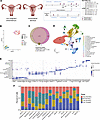
The human endometrium undergoes dynamic changes across the menstrual cycle to establish a receptive state for embryo implantation. Using bulk and single-cell RNA-Seq, we characterized gene expression dynamics in the cycling endometrium and the decidua from early pregnancy. We demonstrated that during the mid-secretory phase — the period encompassing the window of implantation — secretory glandular epithelial cells undergo notable transcriptional changes and alterations in cell-cell communication. Through comprehensive analyses, we identified the glandular epithelium receptivity module (GERM) signature, comprising 556 genes associated with endometrial receptivity. This GERM signature was consistently perturbed across datasets of endometrial samples from women with impaired fertility, validating its relevance as a marker of receptivity. In addition to epithelial changes, we observed shifts in stromal cell populations, notably involving decidual and senescent subsets, which also play key roles in modulating implantation. Together, these findings provide a high-resolution transcriptomic atlas of the receptive and early pregnant endometrium and shed light on key molecular pathways underlying successful implantation.
Authors
Gregory W. Burns, Emmanuel N. Paul, Manisha Persaud, Qingshi Zhao, Rong Li, Kristin Blackledge, Jessica Garcia de Paredes, Pratibha Shukla, Ripla Arora, Anat Chemerinski, Nataki C. Douglas
This file is in Adobe Acrobat (PDF) format. If you have not installed and configured the Adobe Acrobat Reader on your system.
Having trouble reading a PDF?
PDFs are designed to be printed out and read, but if you prefer to read them online, you may find it easier if you increase the view size to 125%.
Having trouble saving a PDF?
Many versions of the free Acrobat Reader do not allow Save. You must instead save the PDF from the JCI Online page you downloaded it from. PC users: Right-click on the Download link and choose the option that says something like "Save Link As...". Mac users should hold the mouse button down on the link to get these same options.
Having trouble printing a PDF?
- Try printing one page at a time or to a newer printer.
- Try saving the file to disk before printing rather than opening it "on the fly." This requires that you configure your browser to "Save" rather than "Launch Application" for the file type "application/pdf", and can usually be done in the "Helper Applications" options.
- Make sure you are using the latest version of Adobe's Acrobat Reader.


