
Abstract
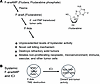
We investigated whether destroying malignant cells and the associated tumor microenvironment (TME) by focal gene therapy would broaden immune checkpoint inhibitor (ICI) effectiveness. We show that ICI antitumor activity against syngeneic (murine) triple-negative breast cancer (TNBC) was augmented when a therapeutic transgene (purine nucleoside phosphorylase, referred to here as E. coli PNP) was used to cleave fludarabine (2-fluoro-arabinofuranosyl adenine) to the anticancer purine base, 2-fluoroadenine (F-Ade). We also established strong repression of anatomically distant, non-PNP-expressing tumors being treated by the same strategy. TNBC cytoreduction was associated with decreased intratumoral PD1+ Tregs, increased granzyme B+ NK cells, elevated MKI67+ T8 cells, and rapid immune clearance. Because F-Ade works by a mechanism that destroys quiescent neoplastic and supporting cells in the microenvironment, and since resistance to ICIs depends upon an intact TME, tumor killing by this approach offers a means to sensitize refractory malignancies to immune ablation and points to broad applicability against numerous cancer subtypes.
Authors
Regina Rab, Jeong S. Hong, Brendan L.C. Kinney, Nicole C. Schmitt, William B. Parker, Adrianna Westbrook, Kelsey B. Bennion, Mandy L. Ford, Douglas H. Weitzel, Paula L. Miliani de Marval, Eric J. Sorscher, Annette Ehrhardt
This file is in Adobe Acrobat (PDF) format. If you have not installed and configured the Adobe Acrobat Reader on your system.
Having trouble reading a PDF?
PDFs are designed to be printed out and read, but if you prefer to read them online, you may find it easier if you increase the view size to 125%.
Having trouble saving a PDF?
Many versions of the free Acrobat Reader do not allow Save. You must instead save the PDF from the JCI Online page you downloaded it from. PC users: Right-click on the Download link and choose the option that says something like "Save Link As...". Mac users should hold the mouse button down on the link to get these same options.
Having trouble printing a PDF?
- Try printing one page at a time or to a newer printer.
- Try saving the file to disk before printing rather than opening it "on the fly." This requires that you configure your browser to "Save" rather than "Launch Application" for the file type "application/pdf", and can usually be done in the "Helper Applications" options.
- Make sure you are using the latest version of Adobe's Acrobat Reader.


